The myth: a polite message can't count as spam
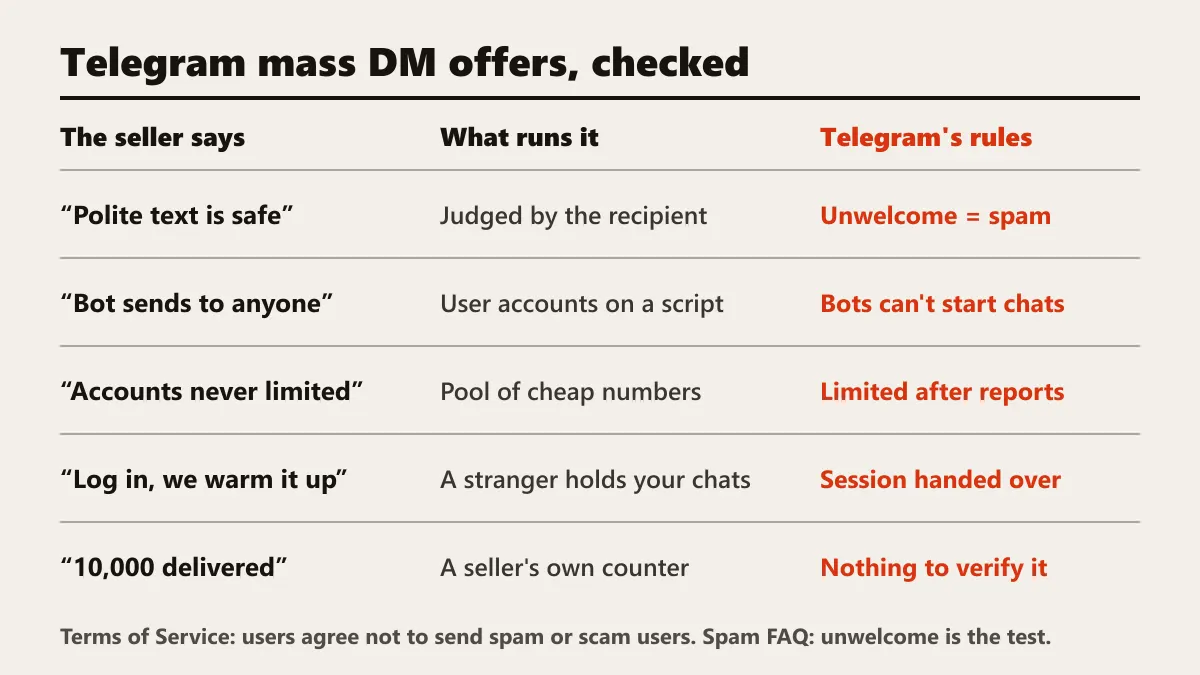
Most sellers of a telegram mass dm pitch the same idea: keep the text friendly, skip the links, and nobody can call it spam. Telegram's own rules say the opposite. Its Spam FAQ, written for people whose accounts were limited, states that for private messages "it really doesn't matter what you send, as long as the receivers find it unwelcome". A photo counts. An invite link counts. So does a bare hello. The FAQ goes further and names what people mind most: unsolicited adverts, links, invites to groups or channels, random photos and anything tied to commerce or online popularity. That list describes almost every mass dm telegram campaign ever sold. The test is the recipient's reaction, not the sender's wording, which is why a careful script does not protect the account that sends it. Telegram also warns that its username search "is not a tool for making new friends", and asks users to contact people only when they are sure the message is expected.
Obscura is a UK content-removal firm. It files platform reports, copyright notices and legal letters through official channels, and it does not send, sell or run bulk messaging of any kind.
This page reads the topic from the other end: what Telegram's rules do to the sender, and what a person on the receiving end can do. The Telegram Terms of Service already settle the headline point, listing among the things every user agrees not to do: "Use our service to send spam or scam users."
How does a mass dm telegram campaign reach strangers at all?
Telegram gives no button for messaging ten thousand people who have never heard of you. A campaign has to assemble that reach from parts, and each part leaves a trace. The usual inputs are a list of user IDs or usernames lifted from public groups, a pool of ordinary user accounts registered on cheap or virtual numbers, and a script that logs those accounts in and sends from them on a timer. When a vendor talks about a telegram mass dm sender, this is normally what it means: client software driving real user accounts, not an official feature. The Telegram moderation page gives a sense of the scale the platform polices; as of 8 November 2026 its live counter showed more than 29.7 million groups and channels blocked during 2026. Those figures cover groups and channels, not private chats, but private messages run through the same reporting machinery. Every account in the sending pool is one Report spam tap away from moderator review.
Why a telegram mass dm bot can't cold-message anyone
Bots are the other half of the confusion. Telegram's bot documentation is blunt: "Bots can't start conversations with users. A user must either add them to a group or send them a message first." A bot built in BotFather therefore cannot open a private chat with a stranger, however it is configured. Anything sold as a telegram mass dm bot that reaches people who never pressed Start is a user-account script with a bot's name on it.
Telegram mass message bot or opt-in broadcast?
A telegram mass message bot does have a lawful job. Once people have started it, a bot can send updates to them, and the Bots FAQ sets the pace: about 30 messages per second for bulk notifications, 20 messages per minute in a group, and up to 1,000 per second when a bot owner enables paid broadcasts. To mass message telegram users this way you need their consent first, which is the whole difference between a subscriber list and spam.
What happens to the sending account after a Report spam tap?
The sequence is short. A recipient presses Report spam in the chat, and those messages are forwarded to Telegram's moderators. If the moderators agree, the Spam FAQ says, "the account becomes limited temporarily". A limited account keeps some functions: it can still write to people who have saved its number as a contact, and it can reply to anyone who messages it first. What it loses is the ability to open conversations with strangers, which is the only ability a bulk sender was paying for. Group admins can report spam posted in their groups too, so a campaign that drops links into communities faces a second set of reporters. For a first offence the FAQ expects a limit of "a few days or so". Repeated offences bring longer blocks. Persistent senders, in Telegram's words, "may lose the ability to do so forever". There is no paid unlock and no early release; the FAQ answers that request with a flat "this is impossible".
Two details catch people out.
First, @SpamBot is the appeal route for someone who believes a limit was wrong, not a way to speed up a deserved one. Second, the FAQ admits some new accounts arrive limited because their numbers, often virtual or VoIP ones, carry a previous owner's history. That is exactly the kind of number a cheap sending pool runs on. A seller who promises an account "can't be limited" is promising something Telegram itself says it does not offer, and an account that is limited after you have paid stays limited.
Telegram mass dm service, sender and panel offers: what is on sale?
Read past the packaging and a telegram mass dm service usually sells one of three things. Some vendors run the whole send from their own accounts and deliver a screenshot of a counter. Others rent a telegram mass dm panel: a web dashboard where the buyer uploads a message and a target list and the panel spreads the send across its account pool. A third group sells the software and a stack of accounts, leaving the buyer to run it. Delivery figures come from the seller and cannot be checked against anything Telegram publishes, and the accounts doing the sending exist to be burned. Some panels go further and ask buyers to log in their own Telegram account or upload a session file so it can "warm up" the send. That hands a stranger full control of the account, its chats and contacts. Telegram's terms forbid the spam either way, so a buyer has no platform to complain to when the panel disappears.
The reputational cost lands on the advertised brand.
Every recipient who taps Report spam sees your name in the message, and many of them screenshot it before they block. Obscura declines this work outright: it will not send a mass DM, recommend a sender, run a panel or take a login to "manage" an account on someone's behalf.
Being targeted rather than doing the targeting? If a wave of Telegram messages is spreading claims about you or using your name to scam people, send Obscura a confidential outline. We read the evidence first, tell you which official route fits, and never ask for your Telegram login or codes.
You received a mass message on Telegram. What now?
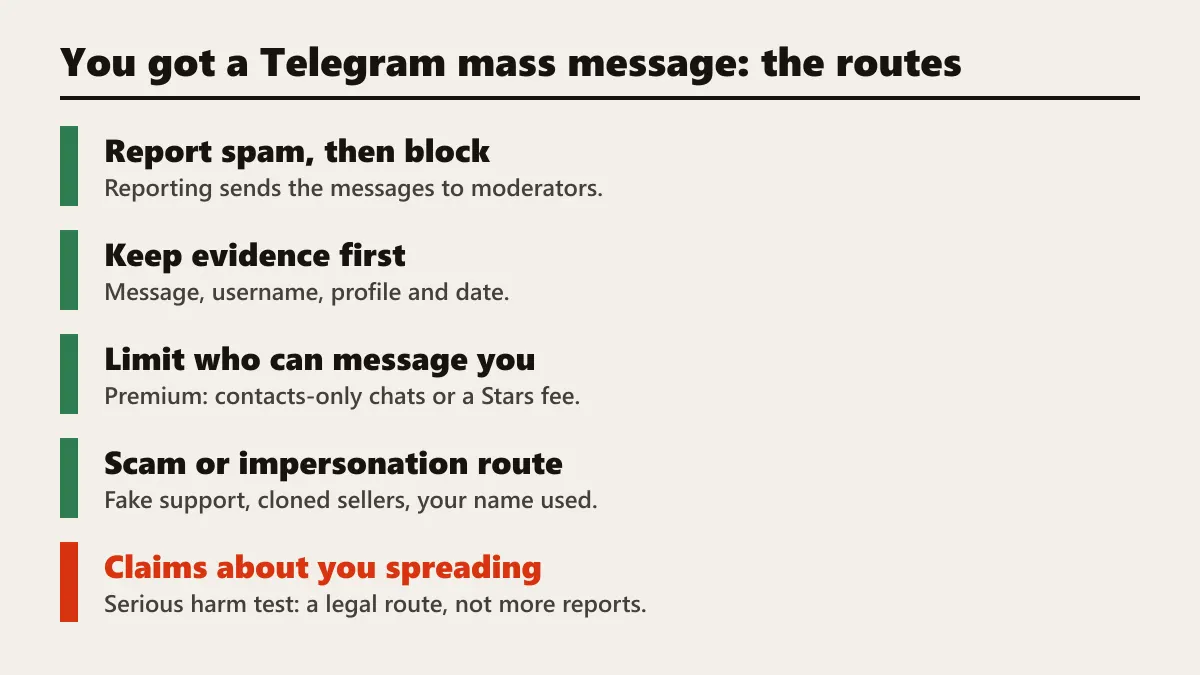
- Don't click, pay or reply with personal details. Mass messages often carry phishing links or fake "support" offers. If the link imitates a real brand's site, a host and registrar complaint is the route, as set out in our guide to taking down a phishing site.
- Press Report spam, then block. Reporting forwards the messages to moderators; blocking alone does not. The step-by-step menus for accounts, groups and channels are in our guide on how to report a Telegram account, group or channel.
- Keep evidence before it changes. Screenshot the message, the sender's profile and username, and the date. Senders delete chats, rename accounts and swap numbers.
- Tighten who can reach you. Since a January 2024 update, Premium users can choose who may send them messages, and people outside their contacts who don't have Premium can no longer start chats with them (Telegram blog, 31 January 2024). Since March 2025 Premium users can also charge a Stars fee for messages from non-contacts, under Settings, Privacy and Security, Messages (Telegram blog, 7 March 2025).
- Treat a scam as a scam. A message selling a recovery, an investment or a "verified" upgrade belongs in the scam route; our briefing on reporting a scam on Telegram covers copied and cloned sellers.
Blocking one sender rarely ends a campaign. A mass DM usually comes from a pool of accounts, so the same text can arrive again tomorrow from a fresh username with a new profile photo, and each block covers only the account in front of you. Reporting does more, because every confirmed report pushes another account in that pool toward a limit, and a limited account can no longer open chats with strangers at all. Your report also gives moderators the message itself rather than a description of it. People often ask whether the sender learns who reported them. Telegram does not tell the reported user who pressed the button, and one report does not trigger a ban on its own, a point explained in our piece on whether someone on Telegram will know you reported them. Organising friends to report the sender in bulk adds nothing either, because moderators review content rather than counting taps, as covered in our look at who reads mass reports on Telegram.
When the mass DM is about you
Sometimes the person harmed is not the recipient but the subject. A former partner, a rival or a disgruntled customer sends the same accusation to hundreds of people in a shared group, or a scammer messages a brand's followers while posing as its support team. These cases need a different route, because the goal is to stop the spread and repair the name, not just to silence a sender. In England and Wales a private message sent to third parties is a publication, and under section 1 of the Defamation Act 2013 a statement is not defamatory unless it has caused or is likely to cause serious harm to the claimant's reputation; for a business that trades for profit, serious harm means serious financial loss. Volume helps that test, because a claim repeated to a thousand readers reaches further than one sent to a single person. Where the sender is impersonating someone, Telegram's FAQ points to @NoToScam for scammers pretending to be you.
Here is how Obscura handles one of these files. We start with the evidence you already hold: screenshots, sender usernames and IDs, the groups the message reached, and dates. We then sort each item by route. Impersonation goes to Telegram's impersonation channel. Copied photos or logos can support a copyright complaint. Public channel posts repeating the claim go through Telegram's reporting tools. Statements that look defamatory and are causing real loss go to a media lawyer for a letter, which we coordinate but never bluff. If the same claims have spread to websites or search results, the work moves into the social media defamation routes that apply off Telegram.
What Obscura will not do
A message that already sits in a recipient's private chat stays on their device; Telegram can limit the sender, but no report reaches into other people's inboxes and pulls the text back out. Truthful statements and genuine opinion are not removable by any lawful route either, and threatening a legal claim against them tends to draw more attention to the original message. Obscura files the report or prepares the notice; Telegram, a host or a court makes the final decision, and nobody can promise its outcome or its timing. We will not send or broker a mass DM, organise a reporting campaign against a rule-abiding account, file a false report, run bots, or ask for passwords or two-factor codes. Payment never comes before a confidential review of what is possible. The full limits are on our disclaimer page, and the same logic applies on other messengers, such as WhatsApp, where reporting spam on a contact, number or group follows the app's own process.