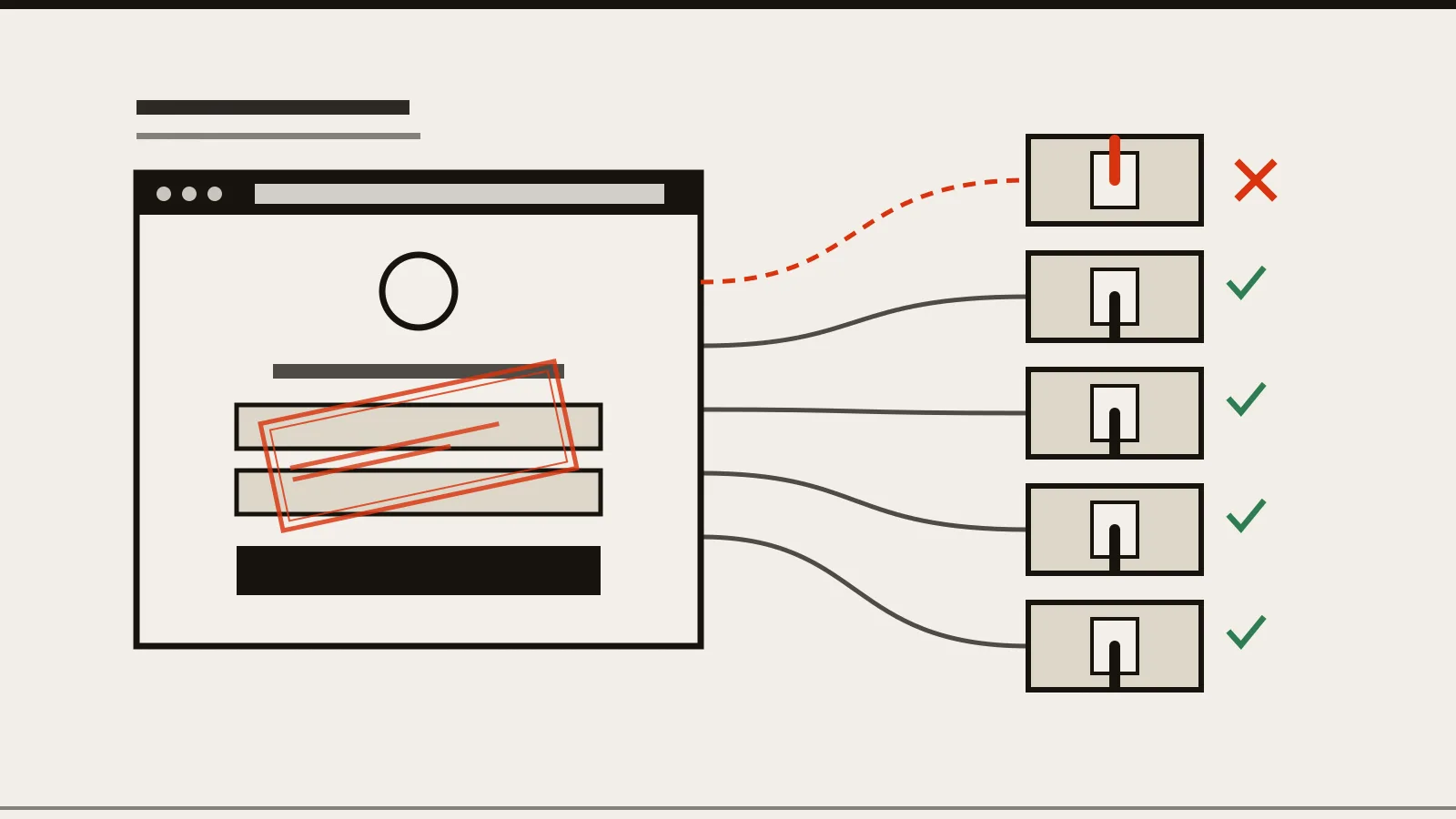
What does a phishing takedown service actually switch off?
A phishing site is not one object that someone can delete. It is a domain name rented from a registrar, a set of files on a hosting company's server, often a proxy such as Cloudflare standing in front of both, and a link that travels by email, text, marketplace chat, Discord and social profiles. Any phishing takedown service works through those parts one at a time. It sends evidence to the registrar so the domain stops resolving, to the host so the files go, to the proxy that hides the real host, and to the browser blocklists so Chrome, Edge, Safari and Firefox put a red warning in front of the page while it is still live. The fifth switch is the account that spreads the link. Every one of those switches is open to you as well. What a paid phishing site takedown service adds is detection before customers find the clone, volume, follow-up and abuse-desk contacts that answer quickly.
| Switch | Who holds it | What a report there does | Who may file |
|---|---|---|---|
| Browser blocklist | Google Safe Browsing, Microsoft SmartScreen, Netcraft's feed | A full-page warning in most browsers, often within hours | Anyone who saw the page |
| Registrar | The company the domain was registered through | Suspends the name, so every URL on it stops working | Anyone with evidence |
| Host | The company storing the files | Deletes the page or the hosting account | Anyone with evidence |
| Proxy or CDN | Cloudflare and similar services | Takes reports on its Phishing & Malware form; the real host sits behind it | Anyone with evidence |
| Distribution account | Email provider, marketplace, Discord, social platform | Removes the profile, listing, server or message carrying the link | Anyone who received it |
A phishing domain takedown is the strongest of the five, because one suspension kills every URL on the name at once. At the host, a phishing website takedown is narrower. The files go, but the owner can point the same domain at a new server within minutes, which is why vendors file at both ends.
Registrars have had less room to shrug since 5 April 2024. On that date ICANN's DNS abuse amendments took effect, and an accredited registrar holding actionable evidence that a domain is used for phishing, malware, botnets, pharming or spam that delivers them must "promptly take the appropriate mitigation action(s)" (ICANN Compliance advisory, 2 May 2024). In the first sixteen months, to 5 August 2025, ICANN Compliance opened 400 investigations and reported that nearly 20,000 malicious domain names were mitigated (ICANN, 20 October 2025). The volume they face is large. The Anti-Phishing Working Group counted 425,808 phishing attacks in June 2026 alone, its highest month since April 2023 (APWG trends reports, Q2 2026).
How to get a phishing site takedown, in the order that works
Most people start at the wrong end. They email the impersonated bank, wait, and the page keeps harvesting logins. Here is how to get a phishing site takedown without paying anyone, in the order that cuts exposure fastest:
- Do not type anything into it. If you already entered a password or a card number, change the password and call the bank first; the takedown can wait ten minutes. Then copy the full URL from the address bar or, for an email or text, long-press the link and copy it without opening it. Note the date and time with the time zone.
- Capture it. Take one screenshot of the page with the address bar visible. For an email lure, keep the original message with its full headers; every mail client has a "show original" or "view source" option.
- Report a phishing site to the blocklists first. Paste the URL into Google Safe Browsing's phishing report form and Microsoft's Report unsafe site page, which takes guest reports. Neither needs the site owner's cooperation, and a warning in Chrome or Edge protects the next person before the domain is gone. Google does not say what happens to a public report; its own scans add a site "within minutes of detection".
- Find who holds the name and the server. ICANN's free lookup tool (lookup.icann.org) shows the registrar and its abuse email. If the name servers belong to Cloudflare, the hosting company is hidden behind it, so the report goes to Cloudflare's abuse form instead.
- Send the abuse reports. One message each to the registrar, the host and, where it applies, Cloudflare. Cloudflare's form is at abuse.cloudflare.com, under Phishing & Malware. Put "Phishing" and the defanged URL in the subject line and attach the screenshot.
- Use the national route. In the UK, forward a phishing email to report@phishing.gov.uk, forward a scam text to 7726, and report a scam website through the NCSC's website form. As of July 2026 the NCSC counted 58 million reported scams and 256,000 scams removed across 454,800 URLs (NCSC, phishing scams). Elsewhere, forward the email as an attachment to reportphishing@apwg.org, the Anti-Phishing Working Group's intake address.
- Check back at 24 and 72 hours, then search for the same kit on a new name. Phishing kits are redeployed, not retired.
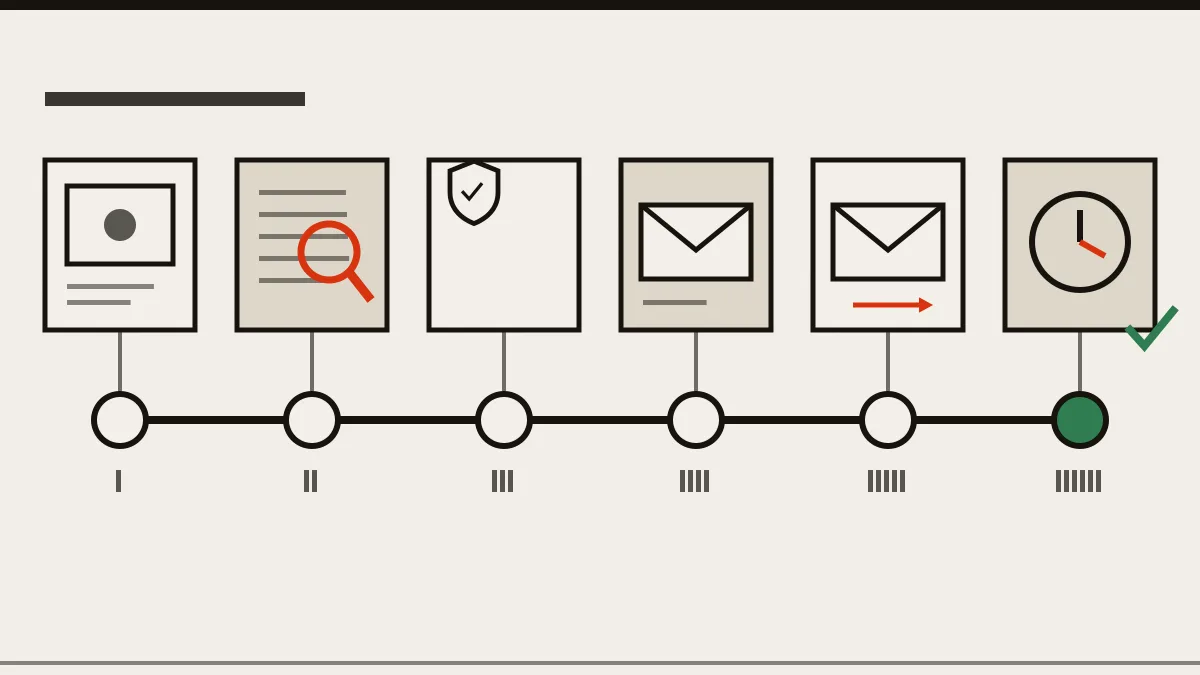
That list is the same set of reports a vendor sends. The vendor sends them faster, at scale, through registrar and host contacts that it has worked with for years.
What goes into an abuse report that gets acted on
When we file these, the reports that come back actioned fastest are short. They carry the live URL written in a safe, unclickable form (hxxps://example[.]com), one screenshot with the address bar showing, the brand being copied with a link to its real login page, the time seen, and the email headers if there was an email. Abuse desks work through a queue, and anything that forces them to open three attachments before they understand it waits in the queue. The reports that stall are the ones that argue. "This company is a fraud and ripped off its customers" describes a dispute, not phishing, and registrars do not settle disputes. Keep the wording to what the page does: it imitates a named brand's login and collects credentials. If you own the brand, say so and attach proof; a rights-holder report carries more weight than a bystander's, although a bystander's report is still valid.
Take down a fraudulent website that isn't phishing
A fake shop is a different job. To take down fraudulent website operations that sell goods and never ship them, the abuse report is weaker, because ICANN's rule covers phishing, malware, botnets, pharming and spam, and a non-delivering shop is fraud rather than DNS abuse in that narrow sense. Some registrars still suspend fake shops under their own terms. Many pass the case to the host or tell you to go to the police or a court.
So the route shifts toward the money. Ask the card issuer for a chargeback, or open a dispute with the payment service you used, as soon as you suspect the shop. Report it to the blocklists anyway, because a browser warning stops the next buyer. In the UK, report it to Report Fraud, which replaced Action Fraud for England, Wales and Northern Ireland in December 2025; in Scotland, call Police Scotland on 101. In the US, report it to the FTC at ReportFraud.ftc.gov. People who reported losses to the FTC in 2025 lost $15.9 billion in total (FTC, March 2026), and that figure is why payment providers move faster than registrars on fake shops: the chargeback costs them.
Phishing site detection & takedown service: what the vendors sell
Commercial phishing site detection & takedown service providers all sell the same two halves. Detection means scanning new domain registrations, certificate logs, ads, app stores and social platforms for anything that copies a client's brand. Takedown means filing the reports described above, at volume, with a letter of authorisation from the brand so the abuse desk sees a rights holder rather than a stranger. None of the vendors below sells to private individuals, and none of the pages we read on 4 October 2026 published a price; each one routes to a demo or a sales call.
| Vendor | Based | Public claim on its own page (read 4 Oct 2026) | What the number measures |
|---|---|---|---|
| Netcraft | UK | Median takedown 33 minutes; "25M+" phishing domains taken down | Time to removal |
| ZeroFox | US | "95% takedown acceptance rate"; URL blocking in as little as 15 minutes | Acceptance, and time to block |
| Allure Security | US | Median time to block about 15 minutes | Time to block, not removal |
| Doppel | US | Median phishing-domain takedown "under one hour" | Time to removal |
Read those numbers as marketing, because that is what they are. They are measured by the vendor, on the vendor's own cases, and they do not measure the same thing. "Time to block" counts the minutes until a browser warning appears, while the site itself can stay up for days. "Acceptance rate" counts reports that a registrar or host agreed to act on, not sites that disappeared. Fortra's PhishLabs sells the same service in the US, but its page refused our fetch, so we quote nothing from it.
The only independent baseline we know of is old. In 2007, Cambridge researchers Tyler Moore and Richard Clayton measured ordinary phishing sites staying up for a median of 20 hours, with a mean near 62 hours, against a median of 55 hours for the "rock-phish" gang's sites (Moore and Clayton, eCrime 2007). Takedown is far faster now. Nobody has published a neutral, vendor-against-vendor timing since.
How to choose the best phishing takedown service
A search for "best phishing takedown service United States" returns lists written by the vendors themselves, each ranking itself first. There is no neutral league table, so judge a provider by its answers to six questions:
| Ask them | Why it matters | Answer that should worry you |
|---|---|---|
| Is your median measured to removal or to a browser block? | The two differ by days | "Our median is 15 minutes", with no definition |
| What happens when the kit moves to a new domain? | Clones return within hours | Each new domain is billed as a new case |
| Do you cover social profiles, marketplace listings, ads and apps? | The lure usually spreads beyond the site | Domains only |
| Who signs the reports? | A rights holder's authorisation carries weight | They file in your name without a mandate |
| How do you price: per takedown or by subscription? | Per-case pricing punishes a busy month | No written scope |
| What is your success rate, and what counts as success? | Acceptance is not removal | "100% removal, guaranteed" |
Our verdict, by buyer: a US or UK brand that sees clones every month needs a detection-plus-takedown subscription from a provider that measures to removal and includes re-registration monitoring. With one cloned page, a business needs nobody. The free reports above, filed today, are what the best phishing takedown service would file for it anyway.
Can a cryptocurrency fraud takedown service get your money back?
No takedown returns cryptocurrency that has already left your wallet. A cryptocurrency fraud takedown service can do the same five-switch work on a crypto scam: suspend the wallet-drainer domain, get the fake exchange flagged in browsers, and remove the Telegram channel, X account or Discord server pushing the link. It can also get the drainer domain onto wallet blocklists; MetaMask keeps a public one, eth-phishing-detect, on GitHub. Wallet-drainer phishing took $83.85 million from 106,106 victims in 2025, 83% less than in 2024 (Scam Sniffer annual report, January 2026). Funds that have reached an exchange can be frozen only when that exchange gets a police or court request, which is why the police report matters more than any private service.
That gap is where recovery scams live. In August 2025 the FBI warned that criminals pose as law firms offering to recover crypto for victims of earlier scams, and noted that "the US Government does not request payment for law enforcement services" (FBI IC3 public service announcement, 13 August 2025). The FTC's advice on refund and recovery scams says the same thing in plainer words. If a fraud takedown offer arrives after you posted about your loss, treat it as the second wave of the first scam.
Crypto lures also run through messaging apps. A Telegram "investment group" is a channel, a bot and an admin account, and the honest route to take down a Telegram channel is an evidenced report to Telegram, not a panel; we tested what those panels reach in our look at the Telegram mass report bot trade. On WhatsApp, where the "account manager" usually writes from an unknown number, the steps to block, report and ban someone's WhatsApp number are the whole toolkit. A seller who offers more is selling a WhatsApp ban service that cannot read an encrypted chat, or a WhatsApp mass report bot that runs on your own account.
How to report a fraudulent seller on eBay or OfferUp
Marketplace fraud is a scam account, not a phishing site, and the platform holds every switch. The report removes the account; the claim gets the money back. File both.
| Marketplace | Report the account | Get the money back | The trap |
|---|---|---|---|
| eBay | Tell eBay through its help page on problems with sellers, and report the listing | Money Back Guarantee, up to 30 days after the estimated or actual delivery date | Payment outside eBay is not covered |
| OfferUp | Report the profile, or the listing, inside the app, then block | Through OfferUp support, for purchases paid in the app | Cash, payment apps or gift cards for an item you have not seen |
| Facebook Marketplace | Report the listing and the seller's profile | Purchase Protection, for checkout purchases only (not available from the UK) | Meetups paid in cash or bank transfer |
How to report a fraudulent seller on eBay starts from the order rather than the listing, if you bought something. Start a request from the order in your purchase history for an item that did not arrive or does not match the listing. The Money Back Guarantee lets you ask eBay to step in up to 30 calendar days after the estimated or actual delivery date (eBay Money Back Guarantee policy). The account report is a separate act. eBay's page on resolving issues with sellers says that when a seller breaks the rules, "you can let us know and we'll look into it". Do both, and never accept a seller's offer to "sort it out" by bank transfer, because that payment falls outside the guarantee.
To report a fraudulent seller on OfferUp, use the report option on the seller's profile or on the listing inside the app, then block them so the chat stops. If you need to report OfferUp account for fraud rather than a single item, report the profile, because the account report covers every listing it runs. OfferUp's help pages refused our fetch on 4 October 2026, so we describe the route without quoting its menu labels. A TruYou badge means OfferUp checked that a real person stands behind the account. It does not mean the person is honest. Payments taken outside the app, by payment app or gift card, leave OfferUp with nothing to refund.
Facebook Marketplace works on a ladder: the listing, then Marketplace access, then the account. Our briefing on the Facebook impersonation and Marketplace scammer reports covers each rung, and the guide to take down a Facebook account, yours or theirs explains when the profile itself goes. Meta acts on the violation, not the number of people reporting, as our note on what gets someone banned from Facebook shows.
How do you report a Discord server for phishing?
Discord phishing usually arrives as a "free Nitro" message, a fake staff warning or a QR code that hands over your login session. To report a Discord server for phishing, report the messages first, because each report has to point at evidence. Right-click the message (or press and hold on mobile) and choose Report Message, then report the profile that sent it from the three-dot menu with Report User Profile. Discord's Safety Center confirms both paths and says your identity is not shared with the person you report (Discord Safety Center, updated January 2026). People search "report Discord server for phishing" expecting a button on the server itself, and there is no help-centre guide for one.
So the server goes down through what Discord finds in it. Turn on Developer Mode, copy the server ID and the message links, and include them in a report through Discord's support form. In the EU, discord.com/report is the Digital Services Act form. Our step-by-step on how to report a Discord server or user by ID shows where each ID lives. Discord removed 41,002 servers in the first half of 2024 (Discord transparency report, H1 2024), so whole-server removals do happen.
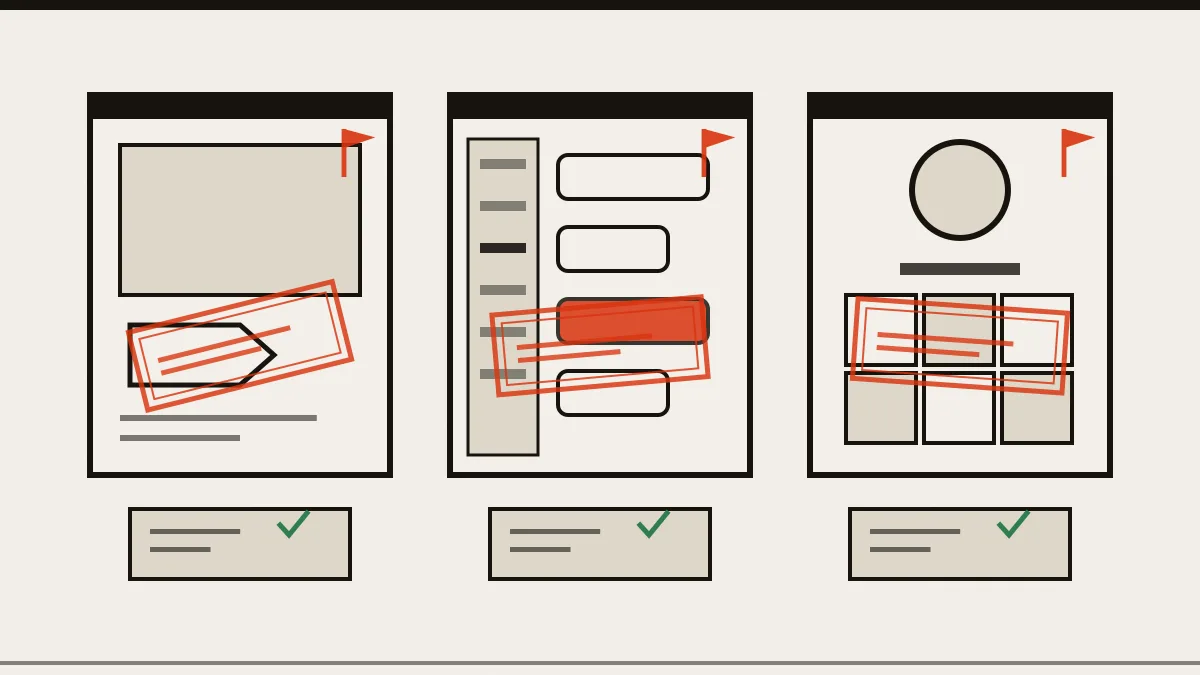
Filing a phishing profile report on social platforms
A phishing profile report is how you remove the account that carries the link, which is usually a fake support profile, a copied brand page or a hijacked creator account sending "verify your account" messages. Pick the reason that matches what the profile does. A profile that copies a brand or a person is impersonation, and only the copied party or its representative can file the strongest version. One that sends a login link is a scam or fraud report, and anyone who received the message can file it. Every phishing profile report should carry the message screenshot and the profile URL, never just the username, because usernames change.
Each platform names the route differently. On Instagram, the guide to Instagram account takedown explains which report removes a whole profile, and getting someone banned on Instagram shows why one evidenced report beats twenty empty ones. On X, there are five instruments to take down a Twitter account, and the account owner controls fewer of them than people think when they try to ban someone on Twitter. Brands wanting professional help there should read our note on Twitter account removal service cases first: they are won on the evidence assembled before filing.
TikTok phishing usually arrives as a fake giveaway. The route to get a TikTok taken down quickly depends on whether the problem is a video or the account, and how to get someone banned on TikTok explains which reports count. Snapchat lures move through Quick Add and Stories; you can take down a Snapchat account that isn't yours only through Snapchat's report flow, and our piece on how someone gets banned from Snapchat sets out what never works. On YouTube, scam livestreams and fake "support" channels follow the community guidelines strike system, which is what terminates a YouTube channel, and a cloned video can be taken down and kept down with the right claim. On LinkedIn, fake recruiter profiles that phish for CVs and logins fall under the LinkedIn account takedown routes for impersonation.
Why a ban service or report bot won't take a phishing account down
Search for "fraud takedown" and some of the results are not takedown services at all. They are ban sellers and report bots, and they promise to get a scammer's account deleted for a fee. Platforms decide on the violation in front of them, not on the number of reports, so a crowd of reports adds nothing to one report that shows the phishing link.
We have tested most of these products. An Instagram ban service sells reports, not outcomes, and the Instagram spam report bot is a myth with a malware problem. The scripts sold to mass report an Instagram account come from four sources and end at the same dead end. On X, a Twitter ban service cannot do more than the report button, and attempts to mass report a Twitter account with a bot fall in the same trap. A TikTok ban service at $250 still buys a report, and a TikTok mass report bot mostly gets the target's videos reviewed, not removed. The YouTube mass report bot hits a daily quota and then nothing. A Facebook ban service puts the legal risk on the buyer, the Facebook mass report tool runs on hijacked accounts, and a Snapchat mass report bot has no reporting endpoint it could even call.
There is a plainer problem too. Any stranger who asks for your login "to file the reports from your account", or for payment in crypto before any work, is running the scammer's own play. Several of the bots we examined were credential stealers.
A clone of your site or your profile is live right now? Send the URL through our confidential contact form. We will tell you which of the five switches applies and whether you need anyone at all. Most single-site cases don't.
What a phishing takedown cannot do
A phishing takedown removes infrastructure. It does not remove the people behind it, and it cannot touch everything that a frightened client sometimes asks us to remove. Here is where the line sits:
- The kit comes back. Phishing kits are redeployed on a fresh domain within hours, so phishing takedown is a cycle of detection and filing, not a single event. Anyone selling "permanent removal" of a phishing campaign is overselling.
- Money is a separate track. The bank, card issuer or exchange, plus a police report, is the only route to funds. The takedown only stops new victims.
- Criticism is not phishing. Reviews, news reports or forum threads calling your business a scam are speech, and when they are true or honestly held opinion they cannot be removed through phishing or fraud channels. They can only be outranked. Filing a false phishing or trademark complaint to get them down is an abuse of those channels and can expose the filer to liability.
- We work lawfully. We never forge notices, never file in a name we are not authorised to use, never ask for passwords and never take payment in crypto only. Every case starts with a confidential review before anything is charged, and our disclaimer sets out the limits in full.
If a clone already ranks in Google search, the Safe Browsing report usually adds a warning first. The result drops out of the index after the page stops resolving, which takes days, not minutes.
How long does a phishing takedown take?
Timing depends on the switch. A browser blocklist warning tends to appear within minutes to hours of a credible report; the vendors that publish block times put their medians around 15 minutes. Registrars and hosts work in hours to days. Netcraft reports a 33-minute median to removal on its own cases, while the 2007 Cambridge baseline was a median of 20 hours, and a single report from a member of the public sits closer to the slow end. ICANN's rule says "promptly" and sets no fixed hour count, so a registrar that takes three days is not automatically in breach. Marketplace and social accounts are usually reviewed within days, and an account goes only when the review finds the violation.
Cost follows the same split. The public reports cost nothing. Commercial phishing takedown service contracts are sold by quote, usually as an annual subscription, and none of the four vendors above published a figure on the pages we read. Obscura's team reviews a case before quoting anything, and the review itself is free.