
Six seller claims, and the record each one has to survive
A facebook mass report tool is software or a paid service promising to file many complaints against one Facebook profile, Page or post so that Meta removes it. Listings word this in similar ways, so the six claims below are paraphrased composites rather than quotations from one vendor.
| The claim | What can be checked | Result |
|---|---|---|
| "Runs through Facebook's API" | Meta's developer documentation | No reporting endpoint found |
| "Enough reports force removal" | Meta's help page, Oversight Board record | Contradicted |
| "Aged accounts stay undetected" | Meta threat reports, 2021 and 2022 | Cannot be promised |
| "Banned within 24 hours, guaranteed" | Meta's published strike ladder | Not the seller's decision |
| "Legal, and no risk to the buyer" | Facebook's Terms, US case law | Unsupported |
| "Free to try, just log in" | Meta's malware reporting | The risk runs towards the buyer |
Two limits on this test. We did not buy, install or run any of these products, so it examines the promises and not the code. And Obscura is a content-removal firm that earns its fees through policy, copyright and legal routes, which makes it a competitor for some of the same worried customers. Each finding therefore carries a link you can open yourself.
Sources were rechecked on 4 November 2026. This is briefing material, not legal advice.
Is a facebook mass report bot really connected to Facebook's API?
We found no documented connection for it to use. A bot, in the proper sense, is software talking to a published interface on the owner's terms, and Meta's Graph API reference covers things like Pages, ads, messaging and business management without listing a call that lets one user file an abuse complaint about another. The closest match belongs to Workplace, Meta's company intranet product. Its Graph API v12.0 changelog deprecated the reported_object_id field and added administrator endpoints for reviewing, allowing, quarantining and deleting items already reported inside a company. Those endpoints manage complaints that exist. They do not create new ones about a stranger. Absence is harder to prove than presence, so the practical test is simple: ask any vendor for the endpoint name and its documentation URL. If that request gets a sales answer, the product is driving a browser through the ordinary report form.
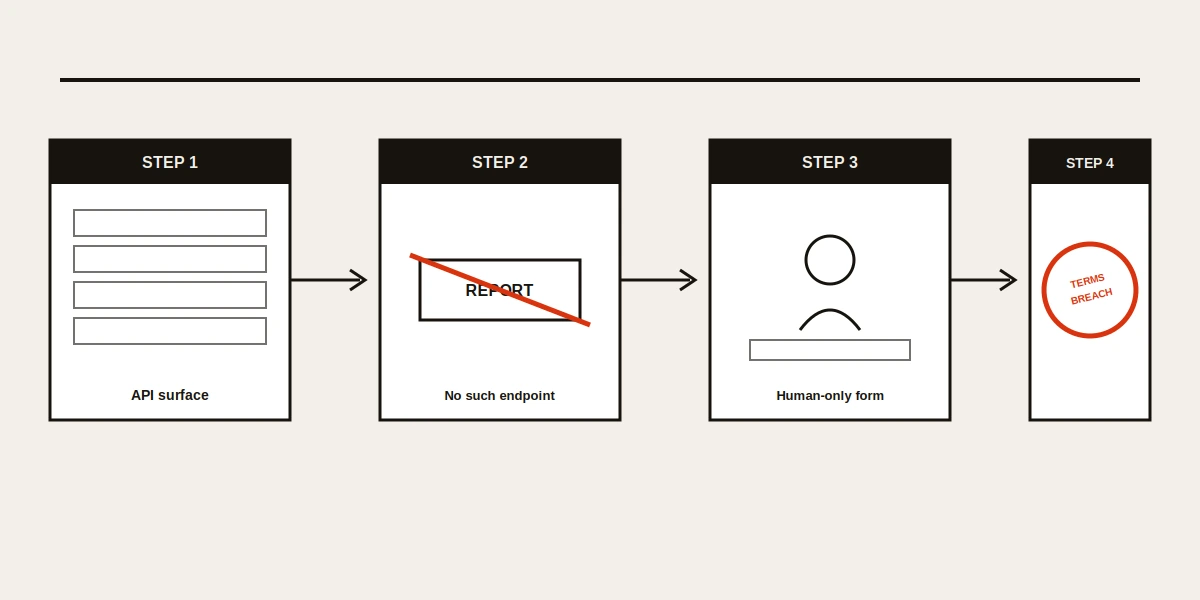
That workaround has its own written answer. Meta's page on automated data collection names scripts, HTTP libraries and other executable code used to automate actions outside the Platform APIs as not allowed. It also quotes section 3.2.3 of the Terms, which applies "regardless of whether such automated access or collection is undertaken while logged-in". Signing in first buys no exemption, so a facebook mass report bot that uses real sessions still falls under the ban.
Other platforms give a useful comparison. X offered no bulk route when we ran the same check. YouTube is the outlier, with a real reporting call in its Data API, and even that one stops at a daily quota.
Do enough reports make a facebook mass report succeed?
No public evidence says they do, and Meta says the opposite. Its Facebook Help Centre states that the number of times something is reported does not determine whether it is removed. Meta's page on how it prioritises review names three factors for ordering the queue: severity, virality and the likelihood of a violation. Report count is not among them, and the same page says human reviewers do not necessarily see every report.
The best public test of this is a case where reporting failed even though the post did break the rules. In Post in Polish Targeting Trans People, decided on 16 January 2024, 11 users filed 12 reports between April and May 2023. Meta's automated systems closed 10 of them. The first hate speech report scored low on severity and virality, and later ones were closed because Meta will "deduplicate those reports to ensure consistency". Two reports reached human reviewers, who both found no violation. Only after the Oversight Board selected the case did Meta conclude that the post broke two policies and remove it.
Twelve reports is a small sample against the thousands a panel advertises, and one case proves no general rule. Its value is the mechanism it exposes on the record: repeats of the same complaint can be merged, not added up.
When does a facebook mass report appear to work?
Sometimes a target does vanish after a wave, and sellers take the credit. Three explanations fit that sequence without any effect from volume.
The content may have broken a rule anyway, and since January 2025 Meta has said that for less severe violations it will "rely on someone reporting an issue before we take any action". One accurate report is enough to open that door. The account may already have carried strikes. Or the decision may simply be wrong: Meta's H1 2026 integrity report, published on 19 March 2026, puts incorrect removals below 0.1% but admits that false positives rose more than 100% for a very brief period of Q4 2025 because of a bug.
Meta publishes no scoring formula, so nobody outside can rule out that repeated reports affect how soon something is looked at. What nobody has shown is a count changing the verdict. We reached the same position on the limits of report counts on Instagram, and it fits what Meta acts on when it bans a Facebook account and what a review counts on TikTok. Reported groups raise a related question about Facebook groups.
Can aged accounts keep a facebook mass report tool undetected?
Nobody can honestly promise that, because Meta has publicly removed report networks and named the rule it used. The Inauthentic Behavior policy prohibits using inauthentic assets to "misuse Meta reporting systems to harass, intimidate or silence others", which puts coordinated filing inside the enforcement scope rather than beside it. In December 2021, Meta reported removing a network in Vietnam that falsely reported activists and government critics, sometimes filing hundreds or thousands of complaints, and that relied mainly on authentic and duplicate accounts. Authentic accounts did not shield it. In April 2022, Meta's Q1 threat report described about 200 accounts run from Russia that repeatedly reported people in Ukraine and Russia for fictitious violations, coordinating in a cooking-themed group of about 50 members. A harmless-looking group name did not hide it either. Both reports describe only the networks Meta caught, so the undetected share stays unknown. "Undetectable" is a claim the seller cannot test.
Account stock also wears out. Meta said in July 2025 that it had acted on about 500,000 accounts for spammy behaviour and fake engagement and removed about 10 million profiles impersonating large content producers in the first half of that year (CNBC, 14 July 2025). Those figures cover spam and impersonation rather than report farms, but any seller's inventory sits in the same line of fire.
Rented credibility has met resistance too. On 26 February 2026, Meta said it had sent cease and desist letters to eight former Business Partners, citing phony "un-ban" services and "renting access to trusted accounts". That concerned advertisers, not report bots. Still, the phrase "trusted accounts" gave nobody a pass.
EU law now addresses repeat filers as well. Article 23(2) of the Digital Services Act requires platforms to suspend, after a prior warning and for a reasonable period, the processing of notices from those who frequently submit manifestly unfounded ones. For the supply side of this trade, see who reads a Telegram panel's reports and what Meta treats as abuse in report bots.
What can a facebook mass report service guarantee in 24 hours?
It can guarantee activity on its own side and nothing on Meta's. Meta publishes its restriction ladder for Facebook, and for most violations it climbs slowly: one strike brings a warning, two to six bring limits on specific features, seven brings a one-day limit on creating content, eight brings three days, nine brings seven days, and ten or more brings 30 days. Disabling follows continued violations after repeated warnings and restrictions, and the page gives no fixed strike count. Under Meta's strike rules, strikes expire after one year, and content posted more than 90 days earlier generally does not count. The fast track exists only for serious cases such as child sexual exploitation, where one occurrence can disable an account. So a "permanent ban by tomorrow" on a rule-abiding profile has no route through the published ladder, and an allegation of severe harm made up to reach that fast track would be a false report of the worst kind.
Read the refund wording before anything else. Terms that promise "delivery", "completion" or a re-run describe the seller's own activity, and a counter reaching 100% proves only that the counter moved. A money-back line means little when the facebook mass report service itself gets to define what was delivered. Advertised prices are no better guide, since no vendor publishes anything an outsider can audit. Our review of price bands and legal risk covers that side, and what buyers really get on Instagram shows the same offer with a different logo.
Is buying a facebook mass report legal and free of risk?
Start with what the record lacks: our search turned up no published US judgment against a report-bot seller by name, so nobody can cite a ruling squarely on point. The nearest case law concerns automated access to Meta's services, and it runs in more than one direction.
- Facebook v. Power Ventures, Ninth Circuit, 2016. Users had handed over their logins, and the court accepted that this arguably authorised access at first. Once Facebook sent a cease and desist letter and blocked the IP addresses, that user permission was not enough (case note). "My customers agreed" is a weak defence for that reason.
- Meta v. BrandTotal, Northern District of California, May 2022. A split order: Meta won on direct access to password-protected areas, while the court held that one browser extension did not itself "access" Meta's computers (order on Justia).
- Meta v. Voyager Labs, filed January 2023. Meta alleged over 38,000 fake accounts and more than 600,000 users scraped. Meta's December 2024 update says Voyager accepted a permanent injunction and a payment.
- Meta v. Bright Data, January 2024. Meta lost on this one. The court held that its terms did not reach logged-off scraping of public data (Quinn Emanuel client alert). A reporting tool sits on the far side of that line: it has to be logged in, and it submits complaints rather than reading public pages.

These are scraping and access cases, and none of them involved a buyer of reports. For a buyer, the plainer exposure is contractual. Facebook's Terms, effective 1 January 2025, bar "fraudulent, duplicative or groundless" reports or appeals in section 3.2. Beyond the platform, a campaign aimed at one person over time can engage the Protection from Harassment Act 1997 in the UK, and a false copyright notice dressed up as a complaint carries liability under 17 U.S.C. section 512(f). A receipt, a target list and a chat with the vendor would all be poor things to have surface in a dispute, a point we also made about ban-for-hire offers on X.
Obscura declines this work outright: no reports against accounts that broke no rule, no forged notices, no bluffed litigation, no bots, and no guarantees. Our acceptable-use terms say so in contract language.
Is a free facebook mass report tool safe to try?
Free usually means you are paying with access. A script needs logged-in sessions and has none of its own, so "connect your account" or "add reporter accounts" is where the transaction really happens. A password, a session cookie or a one-time code given to a stranger hands over the account, whatever the screen calls that step.
The malware record gives this some weight. In May 2023, Meta said it had found 10 malware families using ChatGPT and similar themes since March that year, some of them browser extensions listed in official web stores. One family it described, NodeStealer, took browser cookies and saved credentials to compromise Facebook, Gmail and Outlook accounts. Those were AI-themed lures rather than report tools. The shared lesson is about the bait: a tempting free utility aimed at Facebook users, requiring installation or a login, is a known way to lose an account.
A hosted panel asks for less and still takes something. Your payment details and the name of your target now sit on a server run by people you cannot identify, and no retention period comes with them. Compare that against what a firm's published privacy notice has to state. Many other myths about getting someone banned survive for one reason: nobody checks them before paying. Anyone who can really help you does not need your login.
What works instead, whichever side of the report you are on
Volume is the wrong lever from both directions. Which route fits depends on your position.
If a post really does break a rule
File one accurate report in the category that matches the breach, with the URL and screenshots saved first. Then match the problem to its own instrument: a copyright notice when you hold the rights, a legal notice for a statement that is provably false and damaging, an erasure request where a legal basis exists. Facebook's harassment route and the impersonation and Marketplace routes cover two of the common paths, and who decides a Facebook report explains where each one lands. Child safety material belongs with the authorities and specialist hotlines, not with any reporting vendor.
If you think a campaign has targeted you
You will rarely be able to prove the wave, and it is not the question an appeal decides. Argue the rule instead.
- Save the notice text, the policy it cites, the URL and the timestamps before anything changes.
- Quote that policy in one appeal, inside the stated window, and show why the content does not breach it.
- Treat repeat submissions as a risk, because the Terms list duplicative appeals beside duplicative reports.
- Keep any new account out of it while the appeal is live, since a replacement can look like evasion.
- Note clusters of notices in time. They will not win the appeal, but they may matter to a harassment complaint later.
- Refuse paid "un-ban" offers and any request for a password or login code.
Capture habits matter most where evidence expires quickly, as our Snapchat briefing explains. The block and mute controls on X draw a similar line between what you control and what the platform decides.
What will not come down
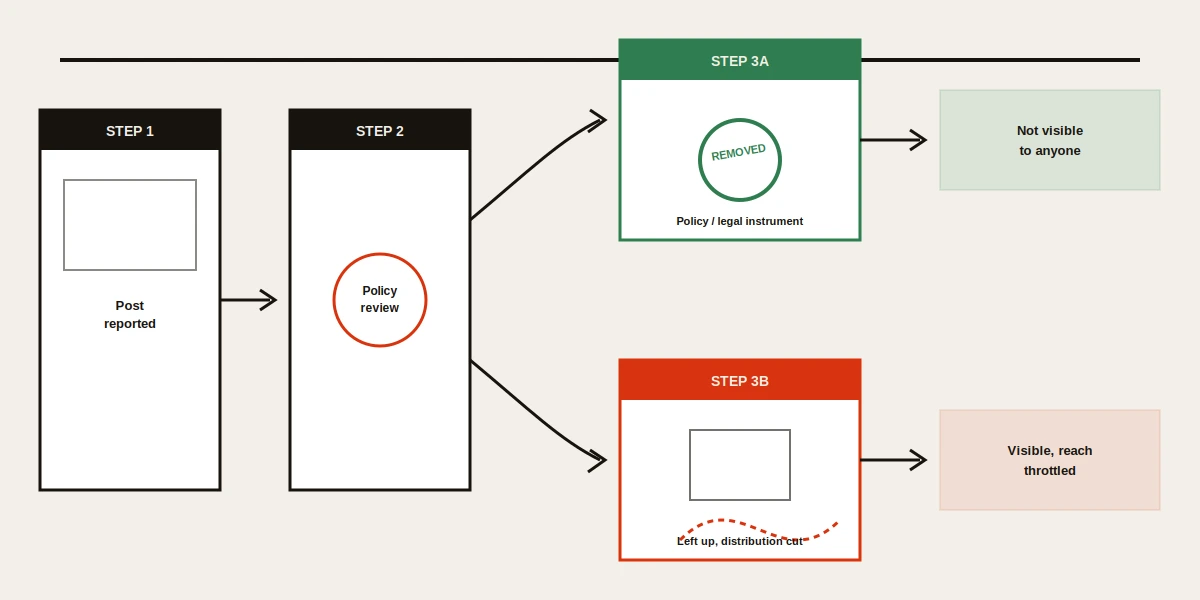
Truthful reporting, honest opinion and genuine public records do not breach the Community Standards, and more complaints will not turn them into violations. For those the only honest option is suppression, which differs from removal in ways that matter, and our disclaimer sets out what we will not promise. Removal stays Meta's decision on Meta's platform; Obscura prepares and routes a case, and it cannot make that decision for anyone.
When a case comes to us, the first thing we establish is which instrument the content is eligible for, because that sets every later step. If none fits, we say so before any charge, and the free channels may be all you need. Send us the evidence for a confidential review, never your password. For the wider picture, the briefing archive tracks this pattern across platforms.