The short version: three laws, two courtrooms
Doxxing in California can land in a criminal court, a civil court, or both, depending on what the poster intended and who the target is.
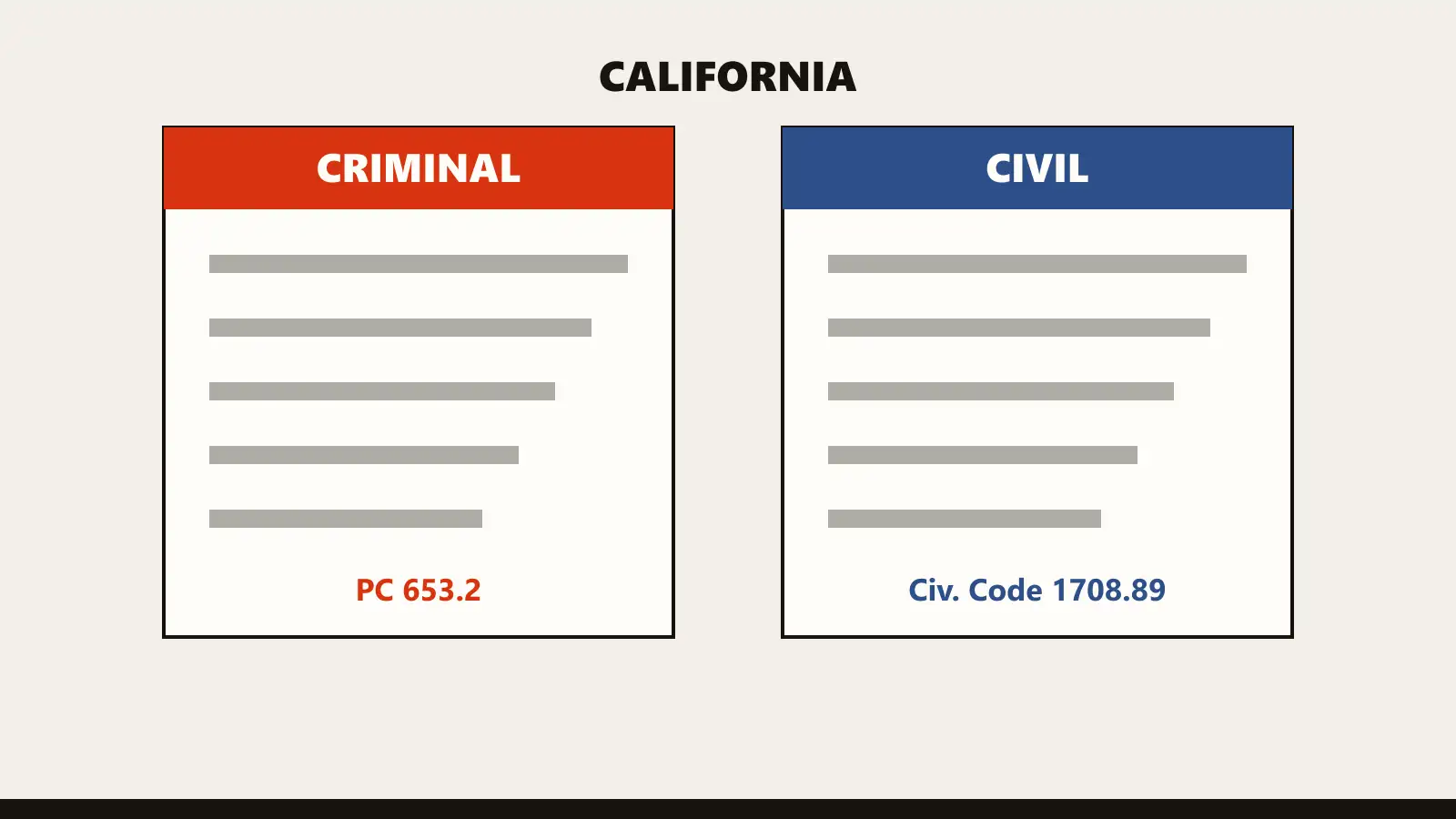
That split is the most useful thing to know about California doxxing. A criminal case is brought by a prosecutor, after a police report, and ends in a fine or jail. A civil case is brought by you, against the poster, and ends in money, an injunction or both. California has a specific statute on each side. Penal Code 653.2 makes it a misdemeanour to post someone's personal identifying information electronically, without consent, intending to put them in reasonable fear for their safety and to prompt others to harass or hurt them; the penalty is up to a year in county jail and a fine of up to $1,000. Since 1 January 2025, the Doxing Victims Recourse Act (AB 1979, now Civil Code 1708.89) has given victims a direct right to sue. Around both sit older laws on stalking, threats and impersonation that prosecutors use when the facts fit better.
Obscura is a UK content-removal firm that handles the removal side of these cases for clients in California, working alongside, not instead of, local counsel and police.
Whether you search doxxing illegal california, doxxing california law or doxxing laws california, the answer below is the same body of rules.
So, is doxxing illegal in California?
Yes, when intent to frighten or endanger is present. Posting a public fact without that intent usually is not a crime.
The answer to "is doxxing illegal in california" turns on purpose. Publishing an address that already appears in property records, as part of a news story or a neighbourhood dispute, is not doxxing in the legal sense. The same address, posted with a call to "go and see" the person, alongside a photo of their car, is the conduct 653.2 was written for. Courts look at the whole post and the context around it: earlier threats, the audience it was aimed at, and what followers did next. That is why the same question, is doxxing a crime in california, gets a different answer for a journalist and for a harasser. The statute does not ban information; it bans using information as a weapon. In practice prosecutors often charge stalking under Penal Code 646.9 instead, when the doxxing is one part of a repeated course of conduct with a credible threat, because stalking can be charged as a felony and 653.2 cannot.
What is doxxing in California, legally speaking?
California law does not use one definition. Each statute describes the conduct in its own words.
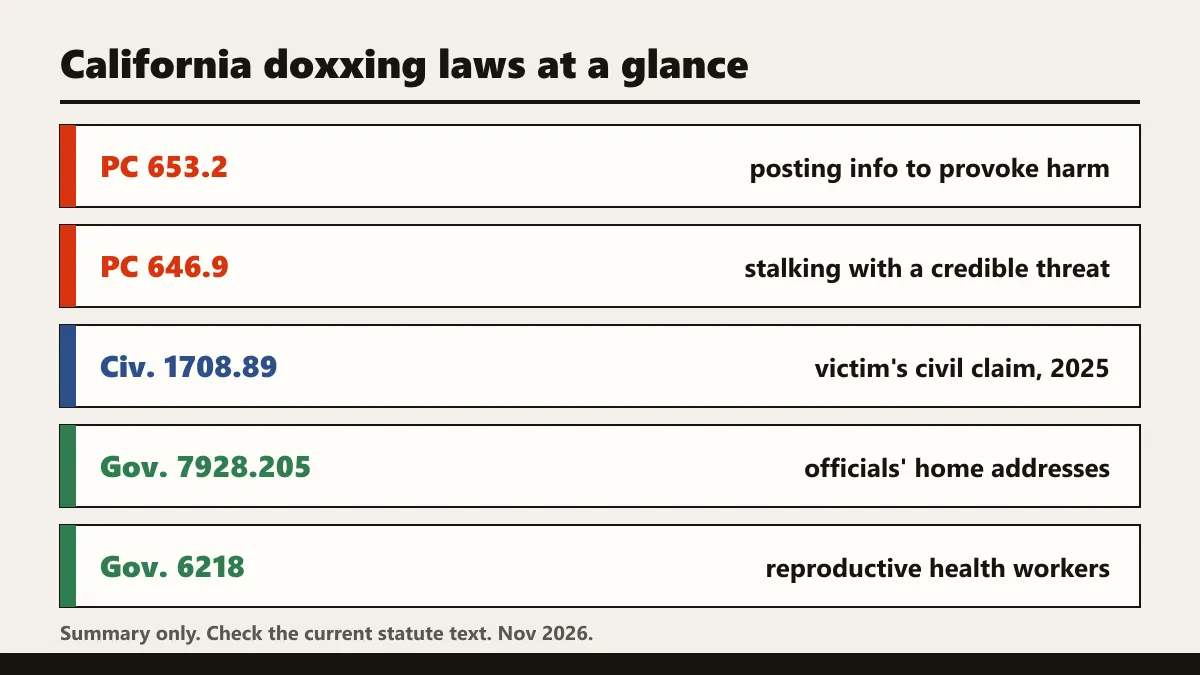
| Law | What it covers | Who brings it | Outcome |
|---|---|---|---|
| Penal Code 653.2 | posting personal identifying information to provoke harassment or harm | prosecutor | misdemeanour, up to 1 year and $1,000 |
| Penal Code 646.9 | stalking, including online, with a credible threat | prosecutor | misdemeanour or felony |
| Civil Code 1708.89 (AB 1979) | doxxing that causes harm, civil claim | the victim | damages, injunction, legal costs |
| Gov. Code 7928.205 | posting officials' home addresses with intent to harm | prosecutor, or the official | misdemeanour, takedown demand |
| Gov. Code 6218 | personal details of reproductive health workers and patients | prosecutor, or the person | penalties and injunctions |
| Penal Code 528.5 | credible online impersonation to harm or defraud | prosecutor, or the victim | misdemeanour, civil action |
So the question of what is doxxing in california has a layered answer. At its core the conduct is broadly the same: personal information, published without consent, aimed at someone. What changes is who the target is (an official, a clinic worker, a private person), what the poster wanted, and whether the case is criminal or civil. A note on spelling: the statute uses "doxing" with one x, and both spellings mean the same thing. The table reflects statute texts as of November 2026; laws in this area change most sessions, so check the current wording on the California Legislative Information site before relying on any line of it. The civil act is the newest piece of the California anti doxxing law, and its scope has not been tested much in appellate courts yet.
How the California anti doxxing law works for a civil claim
The 2025 civil act changed the practical picture more than any criminal statute, because it puts the case in the victim's hands.
Under the older criminal laws, a doxxing victim needed a prosecutor to take the case. Many never did, especially when the poster was anonymous or out of state. The civil route means you can sue the person who published your details, ask a court for damages, and ask for an order that the posts come down. The act also lets plaintiffs proceed under a pseudonym, which matters because a public lawsuit can otherwise republish the very address you want hidden. Two cautions. Suing an anonymous poster first means a subpoena to the platform to unmask them, which takes time and may fail. And a judgment against an individual does not remove copies elsewhere online. That is where the removal work fits: a court order naming specific URLs is one of the strongest documents you can hand to a host or to Google's legal team. Obscura does not give California legal advice; we prepare the evidence trail and file the removals once counsel has the order.
What should you do first if you are doxxed in California?
Safety first, evidence second, removal third. The order matters because removal can destroy proof.
- If there is a threat to your safety, call 911. A doxxing post with a threat is a police matter before anything else.
- Capture everything. Screenshot each post with its URL, date and the account name, and save the page as a file. Deleted posts are hard to prove.
- Report to the platform. Every major platform bans posting private information. Our guides on how to report doxxing on X and on doxxing threads on 4chan give the exact steps.
- Ask Google to delist. Google's personal information removal policy covers contact details and doxxing content.
- File a police report for 653.2 or 646.9, and keep the report number for later requests.
- Talk to a California lawyer about a 1708.89 claim, especially if the poster is identifiable.
- Opt out of people-search sites, since doxxers often harvest addresses there.
If you are a public official or a reproductive health worker, enrol in the Secretary of State's Safe at Home address programme, which gives you a substitute address for public records.
What doesn't count, and what we refuse
Not every unwelcome post is doxxing under California doxxing laws, and some requests are ones we turn down.
Criticism, bad reviews and accurate reporting about your public conduct are protected speech. Naming you in a news story is not doxxing. Posting your work email in a dispute about your business is usually not doxxing either, though the platform may still remove it. Being called out under your own name on a forum is unpleasant and often lawful. Obscura will not file removal requests against lawful speech, will not claim a post breaks 653.2 when it does not, and will not use mass reporting. Tactics sold as a Discord mass reporter or the best WhatsApp ban service rely on volume, platforms ignore it, and it can expose the reporter. Asking does YouTube tell you who reported your video usually means someone fears retaliation, and one accurate report is safer than a flood. We never ask for your passwords. The limits are set out on our disclaimer.
Where doxxers hide: accounts, handles and fake pages
Doxxing rarely arrives alone. It usually comes with throwaway accounts, borrowed names and copied photos.
A doxxer posting your address may also be running an account in your name. Impersonation is its own violation, and the platform rules are often faster than any court; see how to get someone's account deleted on Instagram through the impersonation route, or how to ban a TikTok account that is posting your details. Where the harasser has grabbed a handle you gave up, first check Instagram username availability, then read what is realistic if you want to get an inactive Instagram username back. Never pay strangers who offer to buy IG handles after a doxxing, since that is a common follow-up scam. A doxxer who runs a fake page about you can be reported under account reporting rules for impersonation, the same rules that apply on art sites. Copied fake sites go to the host and registrar, the work covered by our note on services for removing fake websites. Snapchat is narrower: whether you can delete someone's Snapchat account depends entirely on what it posted.
If the doxxing includes intimate images or a threat to release them, treat it as extortion: our blackmail image removal briefing explains the hashing and police routes. Group admins can act too: if the post sits inside a group you run, you can remove it and ban someone from a Facebook group yourself.
Doxxed in California and not sure which route comes first? Obscura reviews the posts confidentially and tells you what can come down, and how, before any fee. Ask for a confidential review.