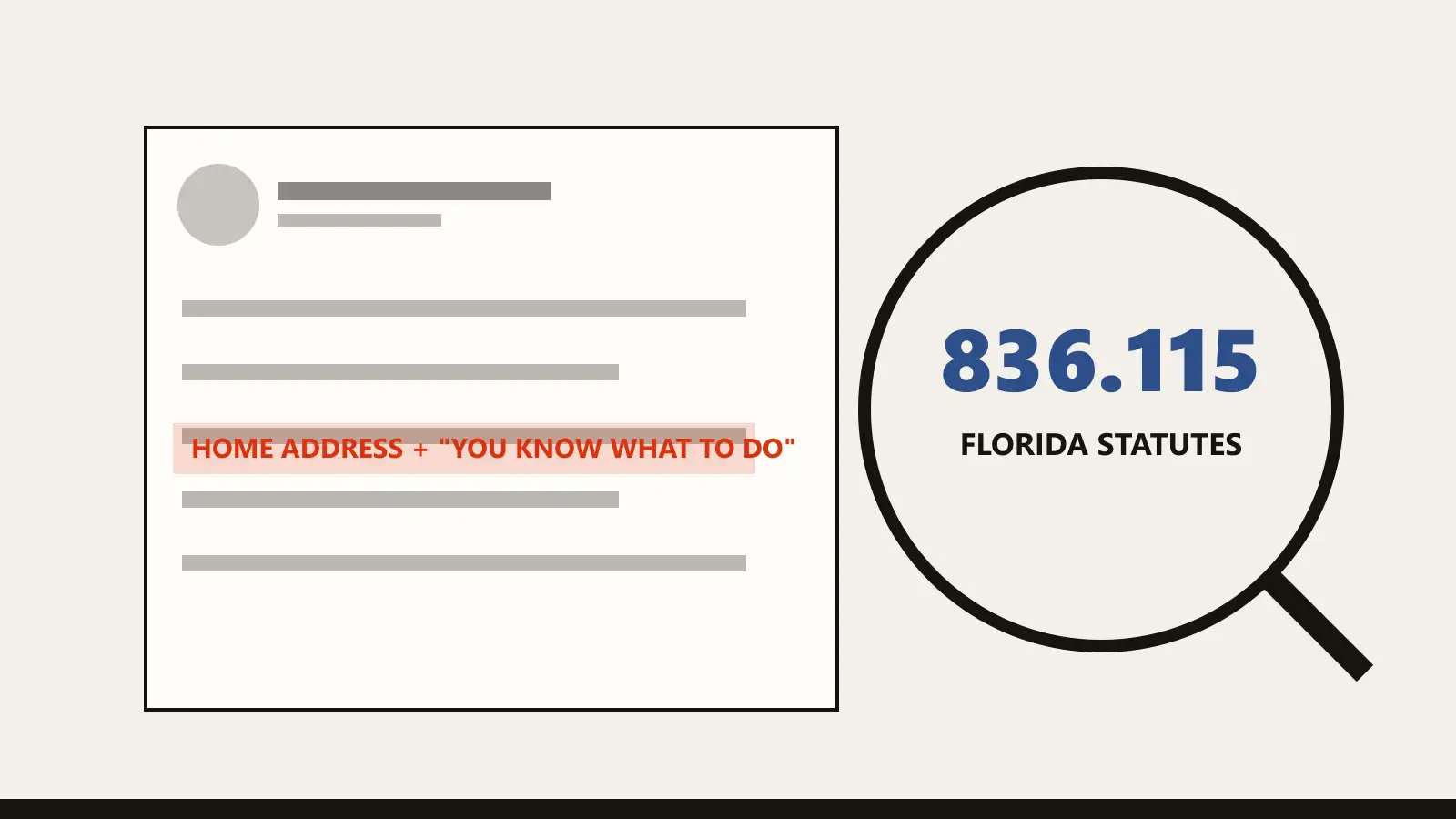
A post goes up at 11pm: is doxxing illegal in Florida here?
Picture a screenshot: your full name, your street, the school your children attend, and a line underneath saying "you know what to do". It was posted from an anonymous account and has been shared forty times by morning.
Is doxxing illegal in Florida in that situation? Almost certainly, yes. The post publishes personal identification information and the caption invites strangers to act on it. That combination is what the Florida Legislature targeted in 2021, when it created section 836.115 of the Florida Statutes, titled "cyberintimidation by publication". Florida does not use the word doxxing in its statute book. It uses that phrase instead, and the conduct it describes is close to what most people mean by the term.
Now change the facts. The same address appears in a local news article about a planning dispute, with no call to action and no threat. That is not a crime. Doxxing in Florida is defined by intent, not by the information itself, and that single distinction decides most cases we see.
Obscura is a UK content-removal firm. We help people in Florida get posts, profiles and listings taken down, and we work alongside their lawyer and the police rather than in place of them. Nothing here is legal advice; see our disclaimer.
Is doxxing a crime in Florida? Reading s. 836.115 line by line
Short answer: yes, it is a crime when the poster intends violence, a crime, threats or harassment against you. It is a first-degree misdemeanour.
The statute is short, so it is worth reading closely. Subsection (2) makes it unlawful to electronically publish another person's personal identification information with the intent, or with the intent that a third party will use the information, to do one of two things. Either to incite violence or commit a crime against the person, or to threaten or harass the person, placing them in reasonable fear of bodily harm.
The three elements, in plain terms
First, "electronically publish". The statute defines it as disseminating, posting or otherwise disclosing information to an internet site or forum. A social post, a forum thread, a paste site and a group chat with a public link all plausibly fit.
Second, "personal identification information". The section borrows the definition from s. 817.568, Florida's identity-fraud statute, which is broad: names, dates of birth, addresses, phone numbers, account numbers and similar identifiers.
Third, intent. This is where cases are won or lost. The prosecutor has to show the poster wanted the information used against you, or wanted someone else to use it that way. A caption, earlier messages, the audience a post was aimed at, and what followers did next are the usual evidence.
So is doxxing a crime in Florida if the poster never threatened you directly? It can be. The statute expressly covers the poster who intends a third party to do the harm, which is exactly how most doxxing works.
A first-degree misdemeanour in Florida carries up to one year in jail and a fine of up to $1,000 under ss. 775.082 and 775.083. That ceiling matters, because it is why prosecutors often reach for a second statute instead.
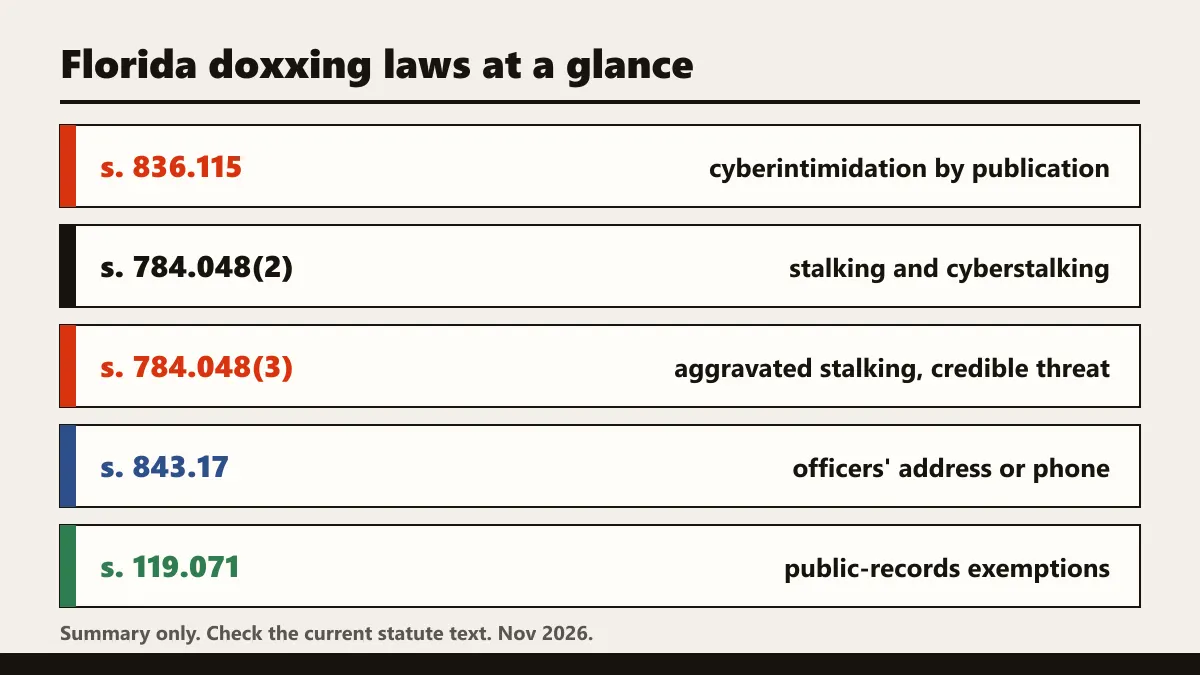
Florida doxxing laws beyond the cyberintimidation section
Three other parts of the statute book do much of the work when the facts go beyond a single post.
| Section | What it covers | Grade |
|---|---|---|
| 836.115 | publishing personal identification information to incite violence, threaten or harass | first-degree misdemeanour |
| 784.048(2) | stalking, including cyberstalking, done wilfully, maliciously and repeatedly | first-degree misdemeanour |
| 784.048(3) | aggravated stalking: the same conduct plus a credible threat | third-degree felony |
| 843.17 | maliciously publishing a law enforcement officer's home address or phone number, naming them as an officer | first-degree misdemeanour |
Doxxing laws Florida prosecutors pair it with: cyberstalking under s. 784.048
Florida's stalking law defines cyberstalking as a course of conduct in which someone sends electronic messages or content to, or about, a specific person, causing substantial emotional distress and serving no legitimate purpose. When doxxing is one step in a campaign (a leaked address followed by weeks of messages), cyberstalking is often the better fit. Add a credible threat and it becomes aggravated stalking, a felony.
Officers and public officials
Section 843.17 protects law enforcement officers specifically. Separately, s. 119.071 exempts the home addresses and certain other details of many public employees, including officers, judges and prosecutors, from Florida's public-records disclosure. The list of covered roles is long and changes most sessions, so check the current text before assuming you are on it.
Anyone searching doxxing laws Florida should also know one thing about the future. In 2025 the House considered HB 781, which would have raised the 836.115 offence to a felony and added a civil claim for victims. We have not confirmed that it became law, so treat any article that says Florida victims can now sue under 836.115 with caution, and check the Florida Senate statute pages for the current wording. A civil claim for defamation, invasion of privacy or intentional infliction of emotional distress may still be open to you under general Florida law; that is a question for a Florida lawyer.
Doxxing in Florida: what to do in the first 48 hours
Speed matters, but order matters more. Taking a post down before you have saved it can cost you the evidence a prosecutor needs.
- Save everything first: full-page screenshots with the URL and date visible, the profile page of the poster, and any replies that show people acting on the information.
- Call 911 if there is any immediate threat to your safety. Otherwise report to your local police department or sheriff's office and ask for a case number.
- Report the post to the platform under its private-information policy. On X, the steps to report doxxing on X are quicker than most people expect.
- Ask a lawyer about an injunction for protection against stalking, which Florida courts can issue in serious cases.
Some places are harder than others. Anonymous boards rarely respond to reports, and doxxing threads on 4chan often spread to people-search listings within days, so those listings need their own opt-outs. If the poster runs a fake site about you, the guide to services for removing fake websites covers registrar and host complaints. When images are involved and someone is demanding money, blackmail image removal is a separate track with its own forms.
On video platforms, people often ask does YouTube tell you who reported your video, because they fear retaliation. It does not name you.
What we refuse, and why volume does not work
Doxxing victims are sometimes offered "mass reporting" as a fix. We do not sell it, and Florida doxxing laws are one reason why: organised false reports against an account can themselves look like harassment.
Platforms decide on the content, not the number of flags. Read what a Discord mass reporter actually does, or why the best WhatsApp ban service claims fall apart, and the pattern is the same. One accurate report, citing the private-information rule, beats a hundred vague ones.
The same logic applies to accounts. You can get someone's account deleted on Instagram only when it breaks a rule, and how to ban a TikTok account depends on the harm shown, not the reporter's persistence. The honest answer to whether you can delete someone's Snapchat account is that only Snap can. For groups, a page admin can ban someone from a Facebook group straight away, which is often the fastest fix when the post sits in a local community group.
Doxxers also tend to hide behind lookalike handles. If one copies your name, it helps to check Instagram username availability, understand how to get an inactive Instagram username, and why offers to buy IG handles usually breach the platform's terms. Artists face a version of this too; our note on account reporting for stolen work on DeviantArt shows how impersonation reports differ from harassment ones.
If a post about you is still live, send us the links and the screenshots you have saved. We will tell you which platform rule and which Florida statute it most likely engages, and what removal is realistic, before you pay anything. Ask for a confidential review and we will reply within one working day.