The myth: "Texas has no doxxing law"
You will read online that Texas has no doxxing law. That was never quite true, and since September 2025 it is plainly wrong.
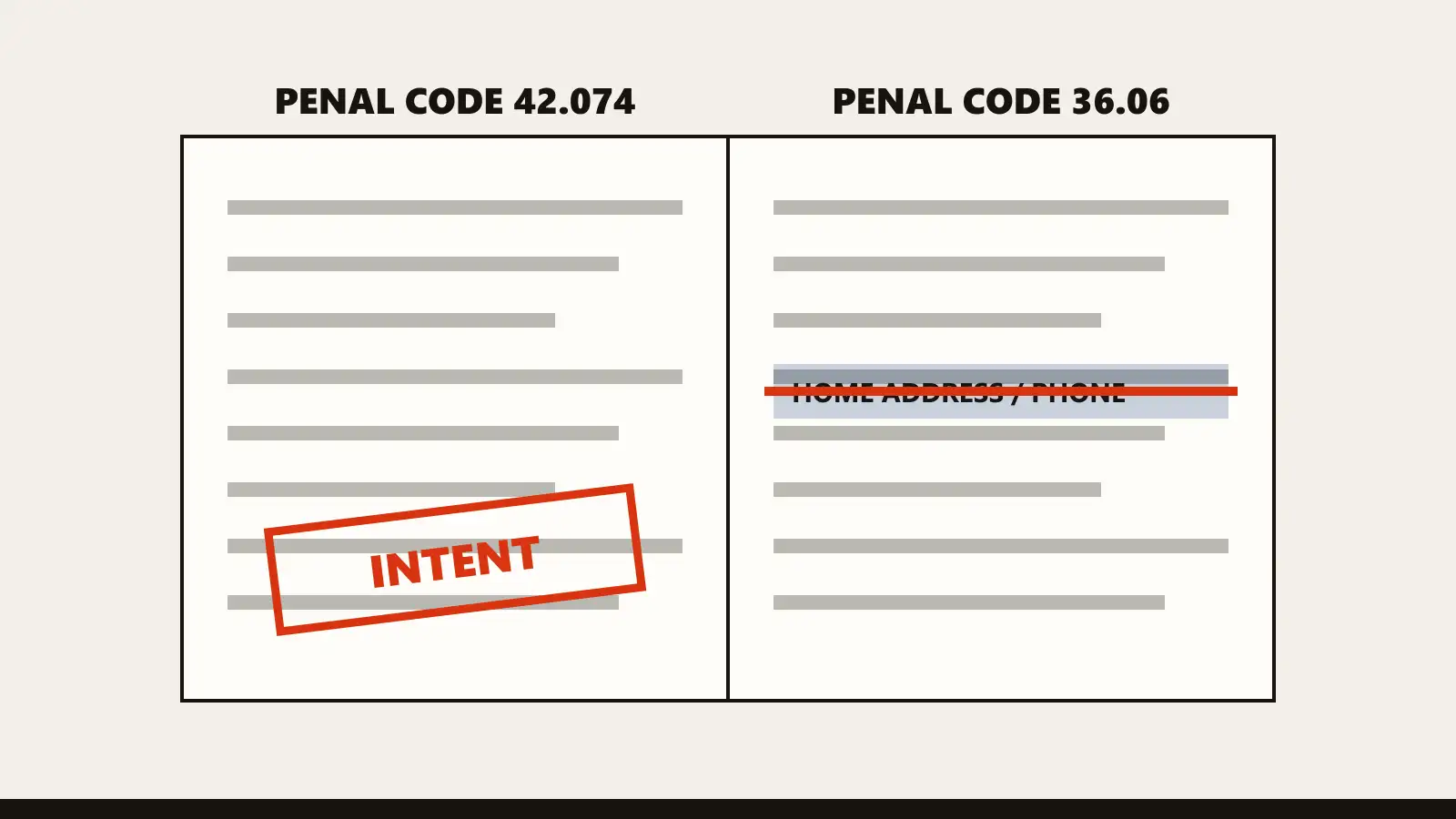
Texas does not have a statute with "doxxing" in its title. What it has is a set of Penal Code sections that, read together, cover most of what people mean by the word. Section 42.074 makes it an offence to disclose a person's residence address or telephone number with intent to cause harm or a threat of harm. Section 36.06 punishes posting a public servant's address for the same purpose. Harassment under 42.07 and stalking under 42.072 catch doxxing that is part of a repeated campaign. In 2025 the Legislature passed HB 3425, effective 1 September 2025, which rewrote parts of 42.074 and 36.06 so that they reach electronic messages as well as public website posts. So the honest answer to "is there a texas doxxing law" is yes, in several pieces, with intent as the common thread.
Obscura is a UK content-removal firm. Obscura handles the platform and search side of Texas doxxing cases; criminal charges and lawsuits stay with Texas police and lawyers. Most searches for doxxing illegal texas come from people in the middle of it, so practical steps follow the law.
Is doxxing illegal in Texas?
Yes, when the poster intends to cause harm or a threat of harm. Sharing information without that intent usually is not.
The question "is doxxing illegal in texas" has the same shape as in most states: the information is rarely secret, so the law turns on purpose. A neighbour quoting your address from the county appraisal roll in a dispute about a fence is not committing a crime. A stranger posting the same address next to your photo and telling followers to "pay a visit" is the conduct 42.074 targets. Prosecutors read the post in context: earlier messages, the audience, and anything that happened after it went up. Is doxxing a crime in texas when the target is a judge, police officer or other public servant? The bar is the same but the stakes rise, because 36.06 sits in the chapter on obstruction and retaliation, and failing to take a post down within 48 hours of a written request from the public servant counts as evidence of intent to harm. Doxxing that forms part of repeated threats is usually charged as stalking, the most serious option.
Which doxxing laws Texas prosecutors actually use
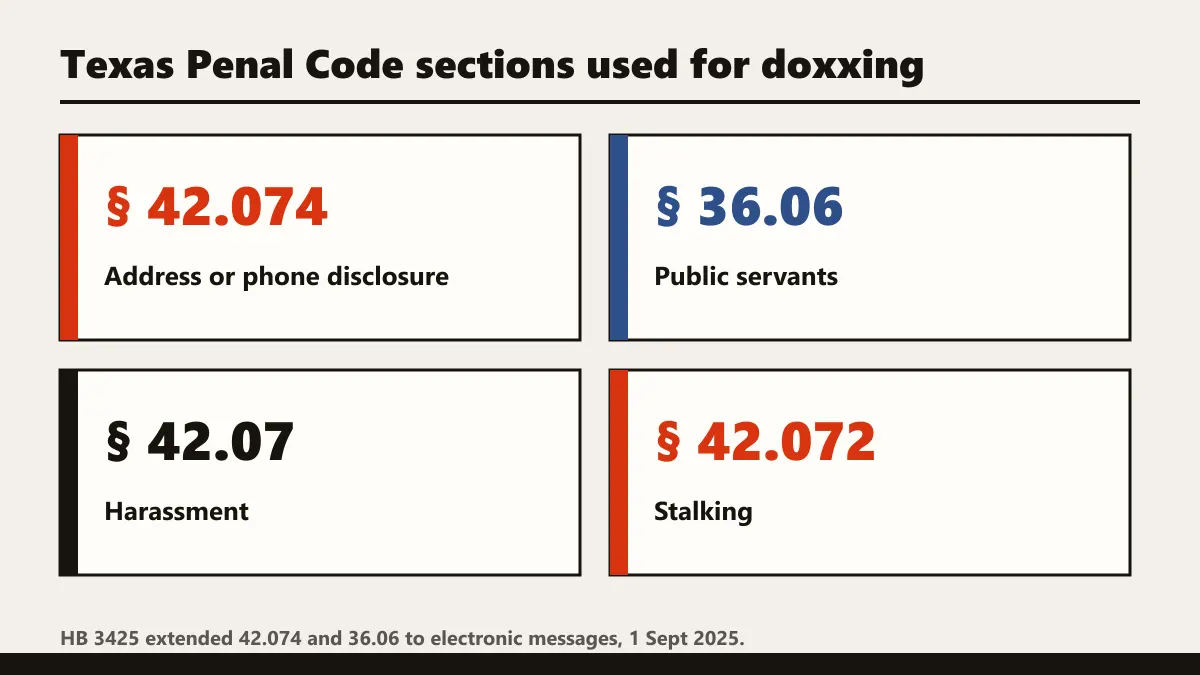
Four sections do most of the work, and each one fits a different kind of case.
| Section | Covers | Typical case | Grade (check current text) |
|---|---|---|---|
| Penal Code 42.074 | disclosing a residence address or phone number with intent to cause harm | address posted to incite a crowd | criminal offence, grade set by statute |
| Penal Code 36.06 | posting a public servant's address or phone with intent to cause harm | a judge's home posted after a ruling | generally a felony |
| Penal Code 42.07 | repeated electronic messages meant to harass, alarm or torment | a flood of messages with your details | misdemeanour |
| Penal Code 42.072 | stalking, a course of conduct the target sees as threatening | doxxing plus following plus threats | felony |
The doxxing laws texas police lean on depend on the facts, and the table is a map rather than legal advice. The doxxing texas penal code picture also includes protections outside the Penal Code: judges and peace officers can keep their home addresses out of public records, and county appraisal districts can withhold some addresses on request. Statute wording changes most sessions, so read the current text on the Texas Constitution and Statutes site and the enrolled HB 3425 bill before you rely on a single line here. One gap is worth naming plainly. Texas, unlike California since 2025, has no general civil statute that lets every doxxing victim sue for doxxing as such. Civil claims are still possible through existing torts, such as invasion of privacy or intentional infliction of emotional distress, but they rest on older law.
What happens to the posts while the case runs?
Nothing, unless someone asks for removal. A criminal charge does not delete a single page.
That surprises people. Doxxing in texas gets reported to police, an officer takes a statement, and weeks later the address is still on the forum, the mirror sites and Google. Removal is a separate track, and it runs on platform rules rather than Texas law. Every major platform bans posting someone's private information in a way that could lead to harm, often with a lower bar than any statute. Google delists results containing contact details or doxxing content under its personal information policy. Our guides on how to remove a fake X account and on BeenVerified removal cover two of the most common sources: the post itself, and the people-search listing it was copied from. When Obscura runs one of these, the evidence capture comes first, because a deleted post the police never saw is a weaker case. Then each URL gets one report under the rule it breaks. A court order, if one arrives, goes to the stubborn hosts last.
What we will not do, and why volume fails
Doxxing victims are often angry, and some ask for retaliation. Obscura declines it.
We do not dox the doxxer back, and we do not flood their accounts with reports. Services selling a WhatsApp ban service or a Discord server mass report promise that volume forces a platform's hand; platforms review the content, not the count, and coordinated reporting can get the reporters' own accounts suspended. A single precise report usually does better, which is the real answer to does reporting a YouTube video do anything. We also will not claim that a critical review or a news article is doxxing when it is not, because lawful speech about your public conduct stays up, and a false claim can expose you to liability. We never ask for passwords or two-factor codes, and we do not promise outcomes that only a platform or a court can grant. Our disclaimer lists the full limits.
The account side: fake profiles and stolen handles
Many Texas doxxing cases come bundled with impersonation, and the platform route is often quicker there.
If the doxxer also runs a profile in your name, report it as impersonation: our notes on how to get someone's account deleted off Instagram and on how to ban a TikTok account that posts your details explain which report category matters. Art and photo sites use the same rules; it is how people ban an art thief's DeviantArt account. If you deleted your own account to escape the harassment and someone took the handle, check if an Instagram username is available before assuming it is lost, and read what works for an inactive Instagram username. Do not answer messages offering to sell it back; why it is a bad idea to buy an IG handle from a stranger is covered separately. On Snapchat, can you delete someone else's Snapchat account has a short answer: only Snapchat can, and only for a rule breach.
Fake sites built to spread your details are a host and registrar matter, which is the work our comparison of the best services for removing fake websites quickly covers. Videos of you re-posted without permission can go through copyright infringement video removal when you own the footage. And if the post sits in a group you run, the Facebook how to ban someone steps let you remove it and the poster at once.
Doxxed in Texas and unsure where to start? Send Obscura the links. We review them confidentially, tell you which posts can come down and through which route, and only then talk about fees. Request a confidential review.