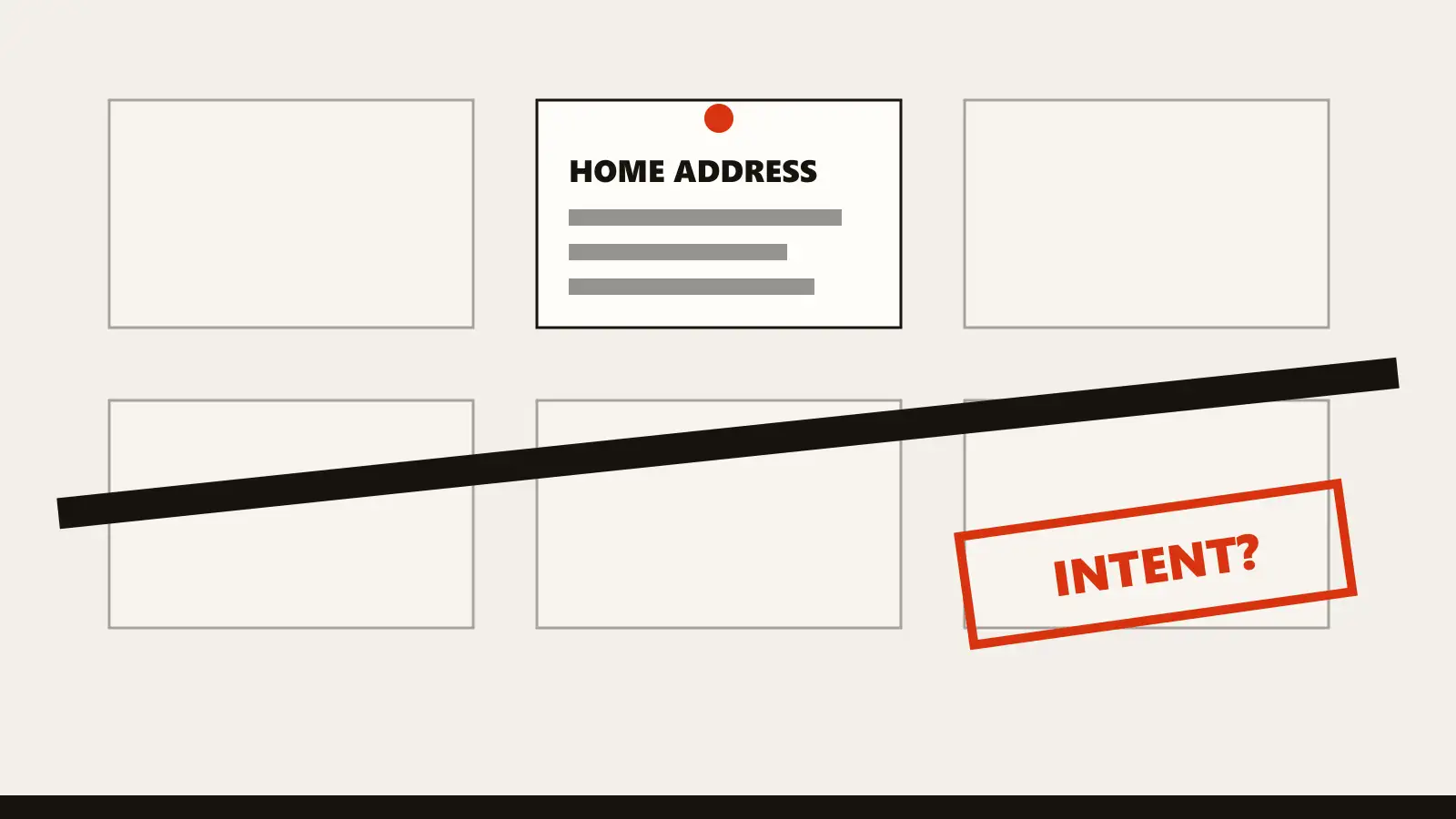
Myth: posting someone's address is legal if the address is public
It often is not, and the "it was already public" defence is weaker than people think.
Doxxing means publishing someone's private or identifying details, such as a home address, phone number, workplace or real name behind a pseudonym, usually to expose, punish or invite others to act against them. So what is doxxing and is it illegal? In the United States there is no single federal crime called doxxing. Instead, the act becomes a crime when it meets the elements of another offence: stalking, harassment, threats, or a state statute written for doxxing. Several states now have those. Washington's civil doxing law, for example, says outright that information being publicly available is no defence. The answer to "is doxxing illegal" therefore depends on three things: where the people involved are, what was posted, and why it was posted, meaning whether there was intent to threaten, harass or put someone in danger. Context and intent decide the question far more than the source of the address.
Obscura is a UK firm that removes and de-indexes doxxing content. Obscura is not a law firm, and this briefing is general information on US law as of November 2026, not legal advice for a specific case.
Is doxxing a crime under federal law?
There is no general federal doxxing law, but federal crimes reach some doxxing.
The closest thing to a federal doxxing law is 18 U.S.C. § 119. It makes it a crime to knowingly publish the "restricted personal information" of a covered person, or of their immediate family, with intent to threaten, intimidate or incite a crime of violence against them. Restricted information means a Social Security number, home address, home or mobile phone number, personal email or home fax. Covered persons are narrow: federal officers and employees, jurors, witnesses, informants, and state or local officers assisting a federal investigation. The maximum sentence is five years. For everyone else, the usual federal route is cyberstalking under 18 U.S.C. § 2261A, which covers using the internet or electronic communications, with intent to harass or intimidate, in a course of conduct that causes reasonable fear or substantial emotional distress. Its baseline maximum is five years, rising with injury. So is doxxing a federal crime? Only when it fits one of those boxes.
Is doxxing a federal offense for posting about a judge or officer?
More readily. Beyond § 119, the Daniel Anderl Judicial Security and Privacy Act, passed in December 2022, lets federal judges ask for their home details to be taken down and bars data brokers from selling them. Several bills aimed at doxxing law-enforcement officers and political figures were introduced in Congress in 2025 and 2026; as far as the public trackers showed in November 2026, none had become law. Federal doxxing law therefore stays a patchwork.
Doxxing laws by state: where it is a named offence
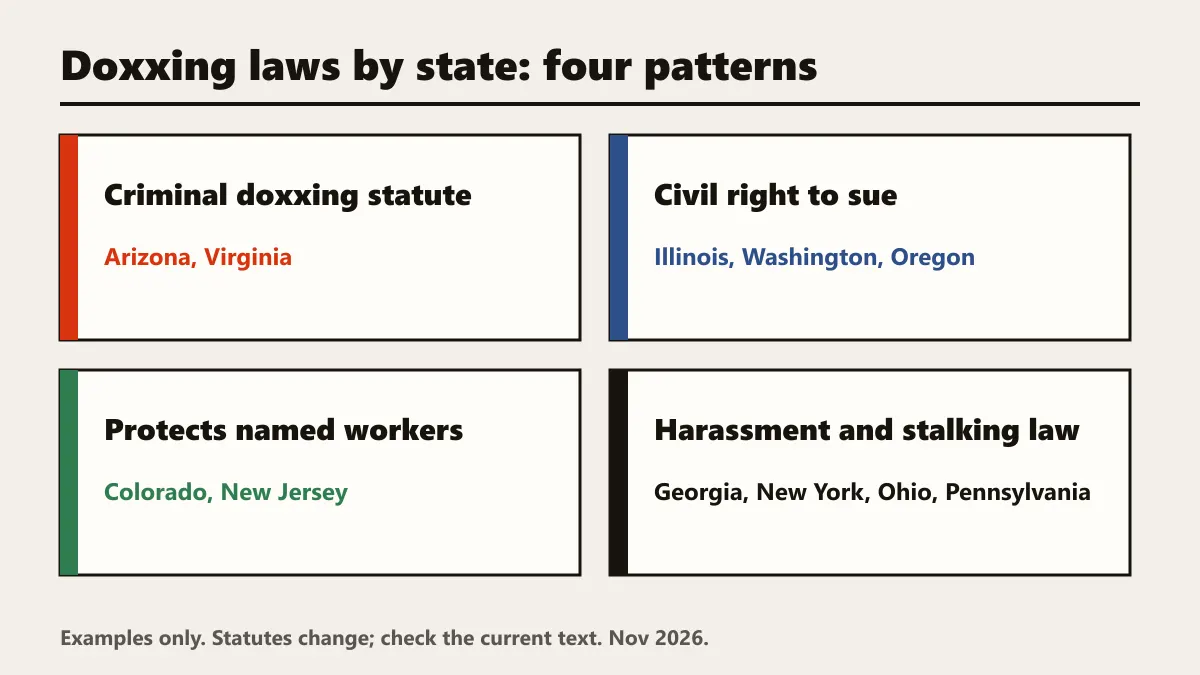
State law does most of the work. Four patterns show up when you read doxxing laws by state: a criminal statute aimed at doxxing behaviour, a civil law letting victims sue, a law protecting only certain workers such as judges, police or teachers, and states with none of those, where prosecutors use harassment and stalking statutes. The table covers the states people ask about most.
| State | Doxxing-specific law? | Type | What it says, in short |
|---|---|---|---|
| Illinois | Yes, 740 ILCS 195 (in force 1 Jan 2024) | Civil | Victims can sue the doxer for damages, fees and an injunction |
| Arizona | Yes, A.R.S. § 13-2916(A)(4) | Criminal | Posting identifying info to cause harassment or harm by others; class 1 misdemeanour |
| Virginia | Yes, § 18.2-186.4 | Criminal | Publishing identity and address to coerce, intimidate or harass; felony if the target is police or a judge |
| Colorado | Partly, C.R.S. § 18-9-313 | Criminal | Protects listed workers, extended to educators and health workers in 2024 |
| New Jersey | Partly, Daniel's Law (2020) | Civil and criminal | Protects judges, prosecutors, police and their families |
| Michigan | No named law | Criminal | MCL 750.411s, posting messages that lead others to harass |
| Georgia, New York, Ohio, Pennsylvania | No | Criminal | Harassment and stalking statutes |
Rows marked "partly" protect certain people only. Statutes change quickly, so check the current text before relying on any row.
Is doxxing illegal in Illinois?
Illinois made doxxing actionable through the Civil Liability for Doxing Act, in force since 1 January 2024. It is a civil law: a victim sues the person who doxxed them, and anyone who directed it, for damages, legal fees and an order to stop. Criminal charges still depend on stalking and harassment law.
Is doxxing illegal in Arizona?
Yes, in a defined form. A.R.S. § 13-2916 makes it an offence to use electronic communication to distribute a person's identifying information without consent, so that others imminently harass or harm them, a class 1 misdemeanour.
Is doxxing illegal in Virginia?
Virginia's § 18.2-186.4 covers publishing a person's name or photo together with identifying details such as their home address, with intent to coerce, intimidate or harass. It is a class 1 misdemeanour, rising to a class 6 felony where the target is a law-enforcement officer or judge.
Is doxxing illegal in Colorado?
For protected groups, yes. Colorado's statute covers posting personal information about judges, police, prosecutors, public defenders and, since a 2024 amendment, educators and health-care and human-services workers, where it poses an imminent and serious threat. For anyone else, harassment law applies.
Is doxxing illegal in NJ?
New Jersey's Daniel's Law (2020) bars publishing the home addresses and unlisted phone numbers of judges, prosecutors, police and their families once they ask. There is no general New Jersey doxxing statute, so other residents rely on harassment and cyber-harassment law.
Is doxxing illegal in Michigan?
Michigan has no law named after doxxing, but MCL 750.411s makes it a felony to post a message about someone without consent, knowing it could lead others to harass or threaten them. That covers much of what doxxing is.
Is doxxing illegal in Georgia, New York, Ohio and Pennsylvania?
Is doxxing illegal in Georgia? Not under a named statute yet: the Georgia Anti-Doxxing Act (SB 27) passed the state Senate in March 2025 but had not become law by November 2026. Is doxxing illegal in New York? Bills to criminalise doxxing police have stalled in committee, so New York relies on aggravated harassment and stalking. Is doxxing illegal in Ohio? Ohio prosecutors typically use menacing by stalking (R.C. 2903.211) and telecommunications harassment (R.C. 2917.21). Is doxxing illegal in Pennsylvania? Pennsylvania uses its harassment statute (18 Pa.C.S. § 2709), which includes cyber harassment, and stalking (§ 2709.1). In each of those four, the post itself is rarely the whole case; prosecutors look for a threat, a pattern, or harm.
Elsewhere, Washington (2023) and Oregon (2021) give victims civil claims, and California's Penal Code § 653.2 covers distributing someone's identifying information electronically to incite harassment.
Is doxxing illegal in the US when nobody makes a threat?
Sometimes not, and that gap is where most frustration lives. Is doxxing illegal in the US if a person simply posts your address with a sneering caption? In many states, a single post with no threat, no call to action and no pattern does not meet the elements of stalking or harassment, which usually require intent and either repetition or a credible threat. Three things change the answer. First, intent: a post saying "go visit her" or "you know what to do" is evidence of incitement. Second, pattern: a run of posts, messages or calls turns a single act into a course of conduct. Third, location: Illinois, Washington and Oregon let you sue without a criminal conviction, and Washington says publicly available information is no defence. Defamation claims can also apply when the post includes false statements. So is doxxing illegal in the United States as a blanket rule? No. Is doxxing illegal in America when it threatens or incites? Usually, yes.
Quick answers on doxxing legality
| Question people search | Short answer, as of November 2026 |
|---|---|
| What is doxxing and why is it illegal? | Posting someone's identifying details to expose or endanger them; illegal when it threatens, incites or harasses |
| Is doxxing legal if the details are public? | Not reliably; Washington rejects that defence outright |
| Is doxxing against the law in every state? | Some form is, through stalking and harassment statutes |
| Is doxxing a criminal offense or a civil wrong? | Either: Arizona and Virginia charge it, Illinois and Washington let you sue |
| Is doxxing a crime in the US at federal level? | Only for protected people (18 U.S.C. § 119) or as cyberstalking |
| Is doxxing illegal in USA federal law generally? | No general offence; doxxing federal law is a patchwork |
| Is doxxing illegal in US civil courts? | In Illinois, Washington and Oregon, yes |
| Where is an anti doxxing law in force? | Arizona, Virginia, Illinois, Washington, Oregon, plus worker-protection laws |
The short version: doxxing is illegal where intent and harm line up, and laws against doxxing are spreading state by state. Calling it doxxing legal or illegal without knowing the state is guesswork, and a doxxing crime charge still needs a prosecutor to agree. Where it is charged, doxxing is a crime like any other harassment offence.
How illegal is doxxing, in practice?
Penalties run from a civil damages claim up to years in prison, and the gap between them comes down to targets and harm. A post in Arizona that leads to harassment is a misdemeanour carrying up to six months in jail under Arizona's sentencing rules. Federal cyberstalking carries up to five years, and far more when someone is injured. Doxxing a federal juror or witness can mean five years under § 119 alone. Civil exposure can be real money too: Washington allows statutory damages of $5,000 per violation on top of actual losses. The ADL's 2024 survey found 22% of US adults reported severe online harassment in the previous year, a category that includes doxing, up from 18% in 2023. Doxxing is common; prosecutions are not. That gap is why platform reports and search removals often move faster than a criminal case, and why many victims run both at once.
Doxxed and not sure where to start? Send Obscura the links for a confidential review; you will hear which host, platform and search requests apply before anything is charged.
Is doxxing a cybercrime, and who do you report it to?
Is doxxing a cybercrime? When it is done online and meets a criminal statute, it is treated as one, and the FBI's Internet Crime Complaint Center accepts reports of cyberstalking and online threats. A useful way to think about doxxing cyber crime is in layers, each with its own office:
- Immediate danger: call 911 or local police first, and give them screenshots with URLs and timestamps.
- Threats or a pattern across state lines: file with IC3 or the local FBI field office.
- The posts themselves: report to the platform under its private-information rules. X's private information policy bans posting home addresses and phone numbers without permission, and the walkthrough on how to report doxxing on Twitter shows the steps.
- Search results: ask Google to delist pages under its doxxing removal policy, which applies when your contact details appear alongside threats or calls to harass.
Doxxing on fringe sites needs a different playbook, covered in the guide to 4chan doxxing removal and archive clean-up. When the doxxer posts on a mainstream app, the platform report usually comes first: a post can be removed through an X tweet removal service request or X's own form, an anonymous profile raises whether you can delete someone's Snapchat account, and a repeat offender on Instagram is covered by how to get someone's account deleted on Instagram. A video naming your street goes through YouTube's privacy complaint, and the note on does reporting a YouTube video do anything explains what happens next. In a group you moderate, remove the post and ban someone from a Facebook page or group before screenshots spread. Doxxing that comes bundled with threats to release intimate images needs the blackmail image removal service route and the police, and a fake site built to publish your details is handled like any other clone, as in the comparison of best services for removing fake websites quickly. False claims that ride along with a dox, such as an invented accusation on Q&A sites, can be pursued through Quora defamation removal.
Is doxxing someone illegal if you think they deserve it?
Yes, the same law applies, whatever the motive. Revenge is one of the commonest reasons people ask whether doxxing someone is illegal, and it is also the reason that makes prosecution likelier, because intent to punish or expose is close to intent to harass. Is doxxing people illegal when they doxxed you first? Retaliation is not a defence, and it hands the other side evidence for a claim of their own. Is doxxing someone online illegal in a dispute over a handle? The same rules apply, and username fights are a recurring trigger. The lawful paths to get an inactive Instagram username or buy an Instagram handle never involve pressure on the owner. The same goes for paid services offering to wipe out an opponent: a WhatsApp ban service or a Discord mass report tool does not turn a grudge into a policy violation. Genuine account reporting works on what an account did, not on how many people complain.
What Obscura can and cannot do about doxxing
Obscura removes and de-indexes doxxing content through the routes above: host and platform reports, Google's doxxing and personal-information requests, and the opt-outs that stop people-search sites republishing an address. Obscura does not identify anonymous doxxers, does not dox anyone back, and does not file reports against accounts that broke no rule. Unmasking an anonymous poster usually needs a lawyer and a subpoena, and criminal charges are for police and prosecutors. Obscura files the request; the platform, search engine or court makes the final decision, and no outcome is promised. Truthful public records, such as a property filing, generally stay where they are even when copies elsewhere come down. The disclaimer page sets out those limits in full.
For UK readers: Britain also has no offence named doxxing. Harassment under the Protection from Harassment Act 1997 and offences under the Data Protection Act 2018 do the work.