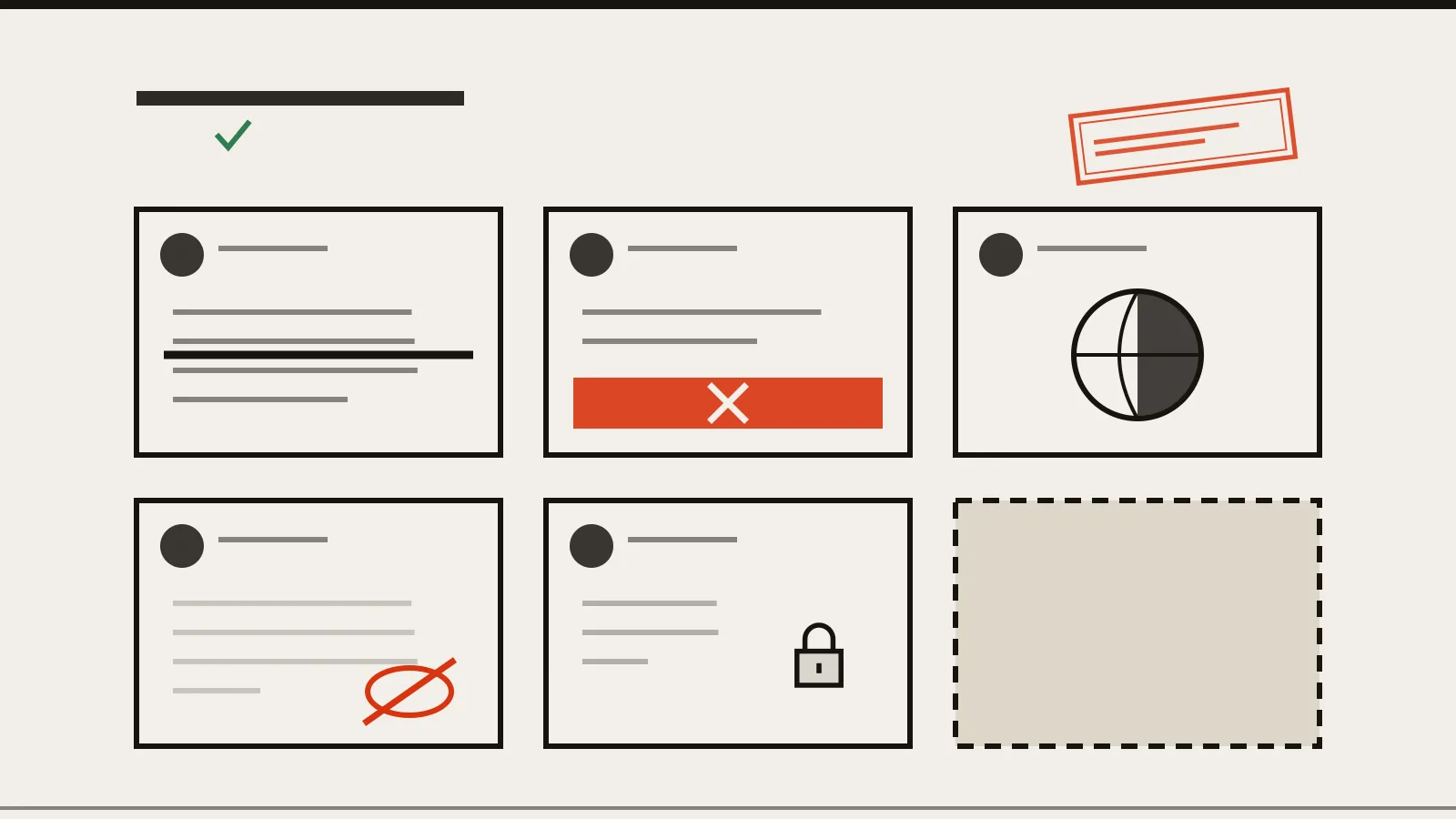
What does "taken down" actually look like on X?
"Taken down" on X is not one outcome. As of October 2026 a post or an account that has gone from view sits in one of six states, and a different hand produced each of them. The author can delete a post or deactivate an account. X can remove a post under its rules and keep the author in read-only mode until they delete it. A legal demand can withhold a post or a whole account in one country while it stays visible everywhere else. X can leave a post up but limit its reach behind a label. X can suspend the account, which hides every post at once. And an account can disappear for good through deletion after deactivation, or through the deceased-user and inactivity routes. Anyone shopping for an x account takedown service or an x tweet removal service is really paying for a push toward one of those six screens, and only some of them can be reached from outside the account.
| What a visitor sees | Whose hand flipped it | What it took |
|---|---|---|
| "This post was deleted by the post author" | The author | Their own decision, sometimes after a request |
| "This post violated the X Rules" | X, under its rules | A report or X's own systems, then the author deleting it to unlock |
| "Withheld in [country] in response to a legal demand" | X, under local law | A legal notice, regulator request or court order |
| A "visibility limited" label on a live post | X, under its rules | A rule breach X judged too mild for removal |
| "Account suspended" | X, under its rules | Repeated or severe breaches, spam, fake identity |
| "This account doesn't exist" | The author, an estate, or time | Deactivation plus 30 days, a family request, or inactivity |
Read the table from the middle column. It decides whether anything you file can reach the outcome you want.
Most of the searches that land on this page ask for the bottom row. What a stranger can actually reach is rows two, three and five, and the second row still ends with the author pressing delete. That gap between what people search for and what the platform allows explains most of the disappointment we see at intake. It also explains why so many paid offers in this space quietly promise the bottom row and deliver nothing.
The same logic holds off X. A removed YouTube video leaves an address with a notice on it, which is why guides on how to see taken down YouTube videos start by asking which notice the page shows. On X the notice is the evidence too. Screenshot it before anything else changes.
Only the author can delete a tweet
Nobody but the author can delete a tweet. That one sentence answers how to delete someone else's tweet, how to delete someone's tweet, and the blunter search "delete someones tweet". No button, form or paid route deletes another person's post from their account. What does exist is pressure from two other hands. X can remove the post under the X Rules, and when it does, the author's account stays locked until they delete the post themselves, so even an enforced removal is technically the author's deletion. A court or regulator can also order the post withheld or removed. Short of that, the honest options are to ask the author, to block or mute, and to report. One polite written request, sent once and kept, ends more disputes than people expect, and when it fails it becomes evidence that you tried the cheap route before the legal one.
That request matters more in defamation cases than anywhere else. A letter that asked first reads better in front of a judge than one that threatened first.
Delete a tweet for someone who asked you to
Sometimes the person asking is the author. A relative, a former employee or a client wants a post gone and asks you to delete a tweet for someone who cannot face logging in. The clean path runs through their own login, on their own device, with them present. We never ask for passwords, and we would not advise anyone else to collect them either. A sign-in from a new place is the kind of signal that gets an account locked behind a phone or email check, and the author then has two problems instead of one. Where the author cannot act at all, X has separate doors.
How to delete someone else's twitter account
There are three doors, and none of them is a report. The first is for a deceased user: an estate representative or verified immediate family member files with ID and a death certificate, and X deactivates the account without ever giving anyone access. The second covers an incapacitated user and needs a power of attorney. The third is time. X tells users to log in at least every 30 days and says an inactive account "may be permanently removed", although it does not release inactive usernames to anyone who asks.
Everything else, including how to delete someone's twitter account and how to get someone's twitter account deleted, ends at suspension rather than deletion. Suspension is X's decision under its rules, made on the evidence, not a service anyone sells. The same split between what the owner can do and what the platform can do runs through our guide on how to delete someone else's TikTok account, and the answer there is the same.
How do you get a tweet taken down by X itself?
To get a tweet taken down by X, report the post itself rather than only the profile. In the app, open the post, tap the three-dot menu, choose Report, and answer the first question X asks: whether the post targets you, someone else or a group, or everyone on X. That answer matters. X's abusive behaviour reporting page says the platform sometimes needs to hear from the person targeted, and a bystander report on a personal insult often stalls for exactly that reason. When X agrees, it usually removes the post and locks the author in read-only mode until they delete it, and the removal notice stays visible for 14 days. For milder cases it leaves the post up behind a "visibility limited" label. Either way the reporter sees the post replaced by a note saying they reported it.
So how often does a report become a takedown tweet? X's own figures are blunt. In its DSA transparency report for April to June 2025, X received 178,028 illegal-content notices from the EU. Of the 170,376 it closed, 55% found no violation, 34% ended with the post withheld in one country, and 11% ended with deletion worldwide under the X Rules (X DSA transparency report, 2025). One notice in nine produced a global removal.
That is the number to keep in your head when a seller tells you otherwise.
Report abusive tweets one by one
To report abusive tweets from the same account, report each post. An account report lets X ask you to "select posts from that account", but a report that names five specific posts carries more weight than one that names the profile and hopes. Keep the post URLs, the time each was posted, and a screenshot showing the handle. If the abuse runs across platforms, the lanes differ: our breakdown of an Instagram report harassment case shows how wording decides which queue a report lands in, and X behaves much the same way.
When the law takes a post down: withheld in one country
The third row of the table belongs to the law, not the rules. A post X will not remove under its own policy can still be withheld in a single country after a valid legal demand. In the EU that means the illegal-content form X runs under the Digital Services Act. In the UK it means the Online Safety Act report form, where X says it "does not disclose information about the person who submitted the complaint" (X UK resources). Above both sits a court order, which can demand removal outright. Withholding is narrow by design: the post vanishes for readers in that country and stays up for everyone else. For a defamatory post aimed at a UK audience that can be enough. For a post that follows you abroad it is half an answer, and the remaining half usually needs a court, a search-engine delisting, or both.
Copyright is the fastest legal lane and the least private one. X's copyright notice goes to the poster in full, name and email included, which is why the standard advice is to file through an agent. The mechanics match any DMCA takedown website notice: identify the work, identify the copy, sign under penalty of perjury. A signed agent can file it for you, which is the legitimate core of any GitHub DMCA takedown service or its equivalents. X's repeat-infringer policy names no strike number, unlike the fixed count behind a Vimeo copyright strike.
A court order is a different instrument again. When people read about an FBI website takedown, the hand on the switch is a judge, and nobody else can borrow that hand.
The twitter trademark report form, field by field
Brand problems go through the twitter trademark report form at help.x.com/en/forms/ipi/trademark, not through copyright. It needs no X login. As of October 2026 it asks for:
- Your job title and an official email address at the brand.
- The reported username and the exact registered mark.
- The registration number, plus the class (1 to 45) and the office that issued it.
- Optional ID or authorisation documents.
Pending applications are not enough, only the holder or a representative may file, and use outside the registration's territory or class does not count as infringement. Outcomes run from a chance to comply up to permanent suspension. X does not hand the username over. The same sorting between copyright and trademark decides a Redbubble copyright infringement complaint, so a brand owner who learns it once can use it everywhere.
Report a Twitter account: what happens next?
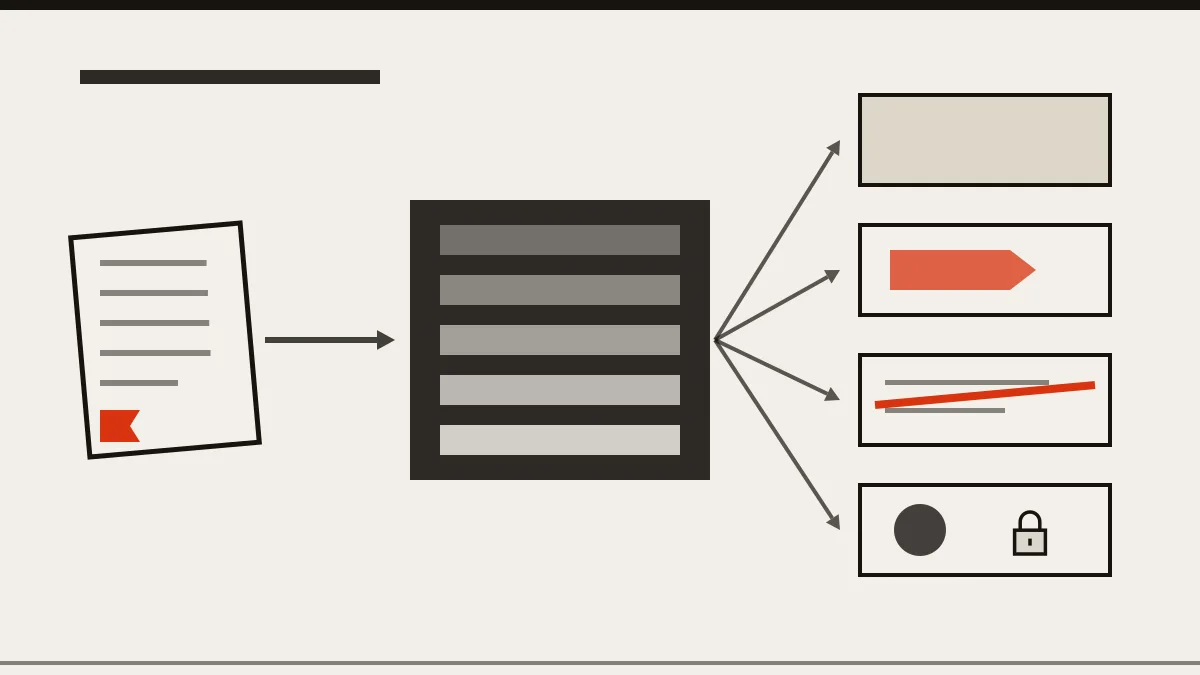
Here is how to report twitter account abuse in the current app. Open the profile, tap the three-dot menu, choose Report, then pick the category that fits. You can report a twitter account or report an x account through the same flow, because the platform renamed itself and kept the menu. X may then ask you to pick posts from the account as evidence. For spam, the route to report twitter account bot activity is the spam category on the same menu; the standalone spam form says reports "cannot be created using this form" and sends you back to the app.
What happens when you report a twitter account is mostly waiting. X says it acknowledges reports within 24 hours and resolves most in a few days, though some take up to thirty. Any in-app notice you later see "may or may not be related to your report". The account owner is not told who filed. The decision itself rests on the policy, the target, the account's history and severity, not the number of people who complained.
Report twitter account to ban: what a ban looks like
People who report twitter account to ban it usually mean permanent suspension. That is the rarest outcome. A twitter account ban runs on a ladder: visibility limits first, then post removal with read-only mode, then a temporary lock, and permanent suspension at the top, which X reserves under its abuse policy for accounts dedicated to harassing. A permanent notice names the policy and the content, and the owner may not open new accounts.
Scale shows where suspensions really come from. In April to June 2025, X suspended 27,834,297 accounts on EU-relevant grounds, and 27,729,263 of those were its own automated detections, almost all spam. User reports led to 104,301 (X DSA transparency report, 2025). In September 2026 the EU's DSA Transparency Database logged 650,812 account suspensions by X, of which 570,678 were for scams or fraud (DSA Transparency Database, 1 to 30 September 2026). Reports matter at the margin, on clear cases with a named target.
That is also why piling on does not help. X's authenticity policy counts duplicate or false reports "in large numbers" as engagement spam, and it names "using or promoting third-party services" in the same clause. We covered what X actually receives from a mass report Twitter account bot separately; the short version is that the account doing the reporting is the one at risk.
Does Twitter tell you who reported your account?
No, not for a rules report. X does not tell the reported account who filed, and its UK guidance says so in plain words. X releases account information only under valid legal process. There are two exceptions, and both are deliberate. A copyright notice reaches the poster in full, with the filer's name and contact details. The trademark policy also warns that X may share the reporter's name. People asking "does twitter tell you who reported your account reddit" are usually reading threads where somebody received a copyright notice with a name on it and assumed every report works that way. It does not. A report made in the app about abuse, spam or a fake profile stays anonymous to the person reported, though a person who knows they argued with only one other user can often guess.
How to take down a fake twitter account
Start with the question X asks: is the fake pretending to be you, or is it a made-up person? X's authenticity policy treats both as deception problems, and anonymity alone is allowed. If the account copies you, use the impersonation route. X's impersonation help page says "you or your authorized representative can file a report", that a bystander can report from the account's profile, and that you do not need an X account to file. That is how to report a fake x account with the best odds: the person copied files, with ID, a link to the real profile, and the URL of the fake. A parody, commentary or fan account escapes only if it meets all four of X's labelling rules: the label, a different avatar, the word "parody", "fake", "fan" or "commentary" at the start of the display name, and the same in the bio. Miss one and it is fair game.
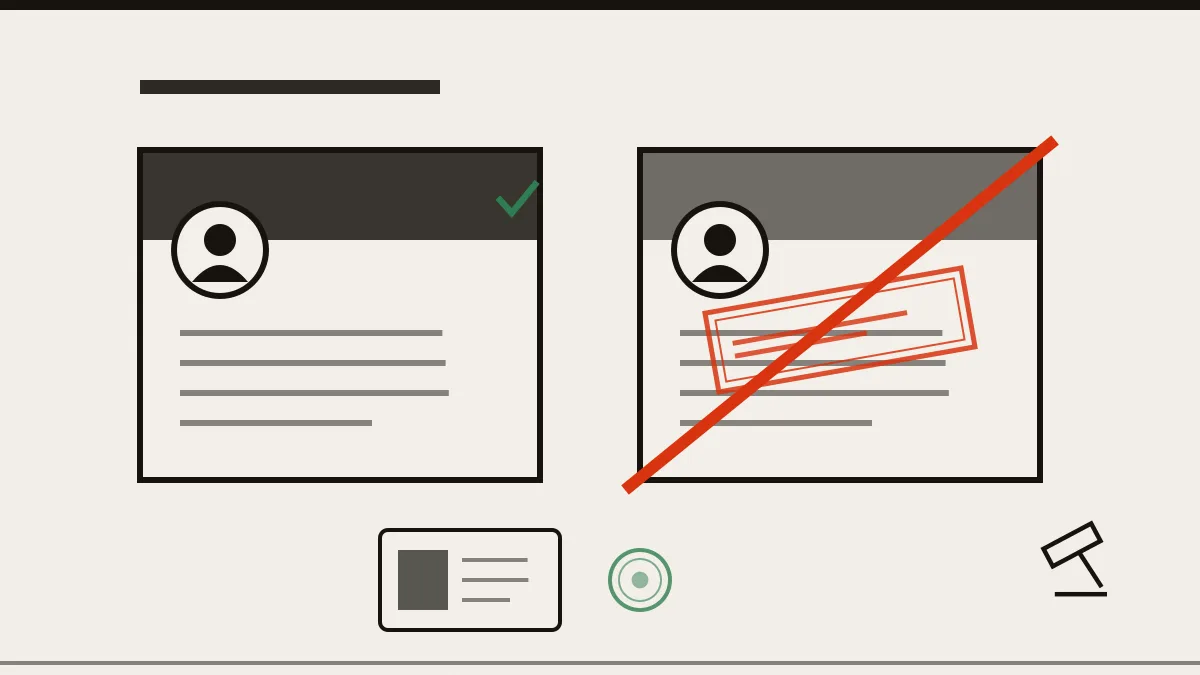
X's outcome is either suspension or an order to change the profile. It never transfers the handle. A brand that wants to remove fake twitter account clones is told to use the trademark route instead, which brings the registration number back into play.
Two cross-checks help. The evidence that wins an Instagram fake account report is the same side-by-side proof X wants. Dating fakes follow the same pattern; a Grindr fake profile report also turns on who is filing. If the clone also runs a lookalike site, that is an impersonation website takedown with its own hosts. And if the fake profile pushes a phishing link, report the link to X under its malicious-URL rule and treat the domain as a separate malicious domain takedown, because removing the profile leaves the site running.
How to delete an X account when it is suspended
This one is about your own account. If you are working out how to delete x account when suspended, the order is fixed: appeal first, deactivate second. X's suspended accounts page says you must log in to the suspended account, open a new browser tab and file the appeal; the appeal form shows nothing to a signed-out visitor except a note that you are not logged into a suspended account. Once the appeal is resolved, or the account is restored to a state that allows it, deactivation starts a 30-day clock, after which the account is deleted and the handle freed. X Money balances are lost only after child-safety or violent-extremism suspensions. A permanent suspension also bars new accounts, and X treats a replacement as ban evasion "regardless of when the other account was created". Deleting a suspended account does not reset that.
What an x account takedown service can, and cannot, do
Strip away the marketing and a legitimate x account takedown service does four jobs. It reads the case and tells you which of the six end states is reachable. It builds the evidence file: URLs, timestamps, screenshots with handles, a timeline. It files where an agent is allowed to file, which means copyright notices signed as your authorised agent, impersonation reports as your authorised representative, trademark reports for a brand, and legal notices under the EU and UK regimes. And it escalates, to counsel for a court order or to search engines for delisting when the post cannot come down. An x tweet removal service is the same desk aimed at a single post. A twitter account takedown on x is the same job under the new name. A twitter harassment report service can draft and organise, but some harassment reports must come from the target's own account, and no agent can stand in for that.
Speed is real but narrow. Searches for an agency to take down malicious tweets quickly are not naive: X's EU figures put median handling for harmful-speech and defamation notices at two to three hours (X DSA transparency report, 2025). That clock starts when a valid notice arrives, though, not when you pay someone. Getting the notice valid is the slow part.
When we file an impersonation report as an authorised representative, X usually replies by email and the reply names one of two outcomes, suspension or a profile change. When the reply says no violation, the next step is better evidence or a different route, never the same report again.
Why no one can sell a guaranteed twitter takedown
A guaranteed twitter takedown does not exist, because the decision is X's, or a court's, and neither is for sale. Treat the word "guaranteed" as the first red flag, and add three more: a request for your password, payment demanded upfront in crypto only, and any promise to "mass report" the account. Some offers will also promise to get a twitter account taken down within hours by volume. The authenticity policy names those services as spam, and reports filed that way can put the buyer's own accounts at risk.
There are also things nobody should take down. Truthful reporting, genuine public records and protected opinion stay up; the lawful answer there is suppression in search, not removal. We never forge or bluff a legal notice, because a fake notice invites a lawsuit and draws more attention to the post than it ever had. Our disclaimer sets out the limits in full. If you want to take down a twitter account that is defaming or impersonating you, send us the links for a confidential review and we will tell you which row of the table you can reach before anyone charges a penny.
Paid posts sit slightly apart. A Promoted post on X is an ad and goes through ad review as well as the rules, which mirrors the who-may-file logic we set out for anyone trying to report a YouTube advert. Report it in the same menu; the ad desk reads it too.