Myth first: does Yelp delete bad reviews if you ask?
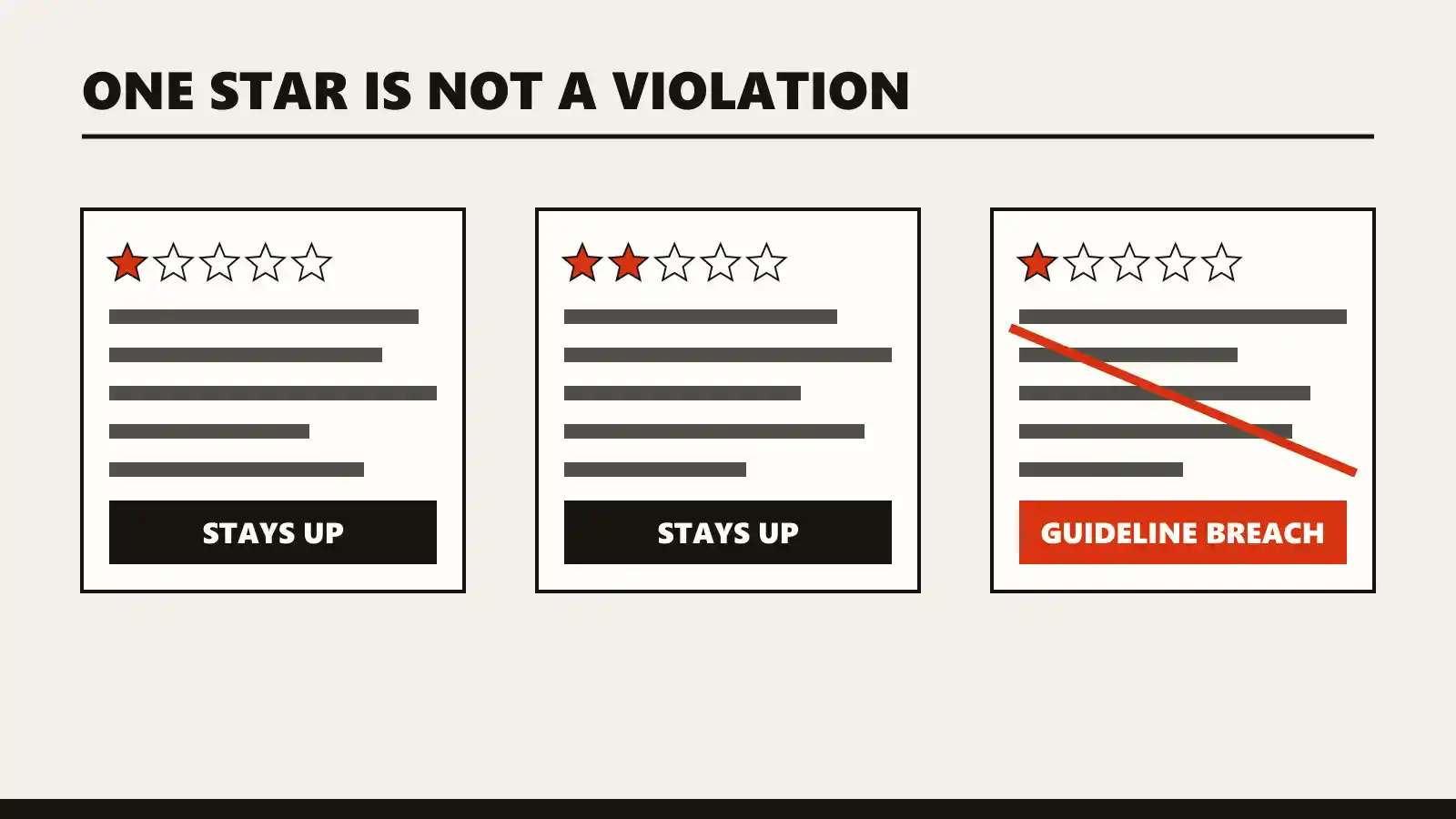
No. A one-star rating is not, by itself, a reason for Yelp to take anything down, and no amount of asking changes that.
Yelp is a review platform that publishes first-hand accounts of businesses and removes only contributions that break its own rules. Those rules live in the Yelp Content Guidelines, which group the general standards under six headings: Relevance, Inappropriate content, Conflicts of interest, Privacy, Promotional content, and Post your own content. A review that is harsh, unfair in tone or simply wrong about how good your food was sits inside those lines. A review written by a competitor, posted by someone who never visited, or carrying a staff member's home address does not. That split is the whole subject of this briefing. Bad Yelp reviews fall into two piles, and the work is deciding honestly which pile each one is in before you touch the report button. Owners who skip that step tend to waste their one credible report on a review Yelp was always going to keep.
What do the numbers say about yelp negative reviews?
The figures show that most content stays up and a real minority comes down. According to Yelp's 2025 Trust & Safety Report, published in February 2026, contributors posted about 22 million reviews in 2025. Roughly 70% were recommended, 17% were not recommended, 11% were removed by Yelp's User Operations team and 2% were deleted by the reviewers themselves.
Two details matter for anyone dealing with yelp negative reviews. First, Yelp says it removed more than 193,700 reviews after they were reported, and about a quarter of those were taken down because they did not describe a first-hand experience (Yelp Trust & Safety Report, 2025). Second, the same report says nearly 500,000 reviews showing AI-generated characteristics were filtered. So reports work, but they work on grounds: a reviewer who was never a customer, a coordinated campaign, machine-written text. Disliking the review is not a ground.
The third bucket confuses people. A review in the not-recommended section has not been deleted, yet it does not count towards your star rating.
Which bad reviews on Yelp actually break the rules?
A bad review breaks the rules when it fits one of the guideline headings, and you can show it. The table maps each heading to the kind of evidence an owner can realistically supply.
| Guideline heading | What it catches | Evidence that helps the report |
|---|---|---|
| Conflicts of interest | Competitors, ex-employees, people paid to post | Name match to a rival owner, staff records, a dated dispute |
| Relevance | Rants about politics, a different business, the chain's policy | The review text itself, pointing to the off-topic part |
| Inappropriate content | Threats, harassment, hate speech, lewd material | Screenshots with dates and the reviewer's profile link |
| Privacy | Named private individuals, home addresses, phone numbers | Which line exposes whom |
| Promotional content | A review used to advertise something else | Links or offers inside the review |
| Post your own content | Copied text, or reviews written or revised with AI | Matching text found elsewhere, timing of a burst of reviews |
The Post your own content heading is newer than most guides admit. Yelp's guidelines now tell contributors not to use AI or chatbots to create or revise their reviews, which gives owners a ground that did not exist a few years ago, provided there is something concrete pointing to it.
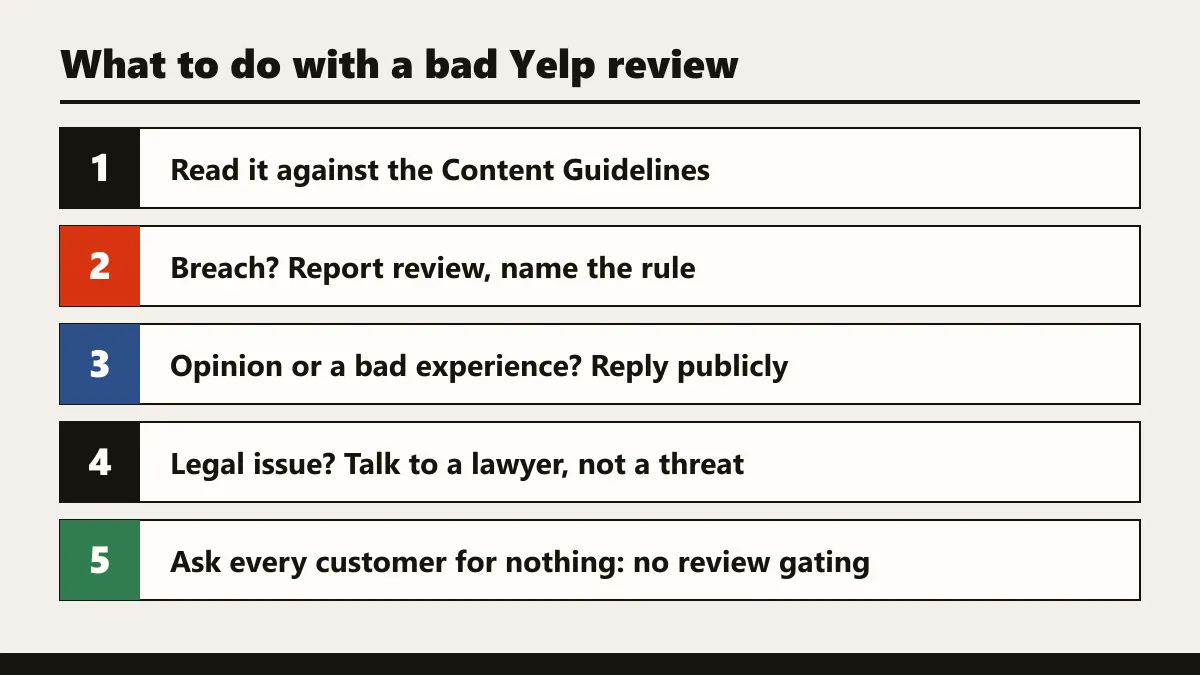
What is missing from the table is just as useful. "The reviewer exaggerated", "they were rude to my staff" and "this is not how it happened" are disputes of fact or opinion. Yelp is not a court, and it does not adjudicate them. Those bad reviews on Yelp are answered, not reported.
How do you report negative reviews on Yelp?
You report from the business account, one review at a time, and you choose a reason. The US Federal Trade Commission's guide to reporting suspicious online reviews (September 2022) describes the owner route this way:
- Sign in to the Reviews page of your business account at biz.yelp.com.
- Find the review and click the three dots in its right-hand corner.
- Select Report Review.
- Choose the reason from the drop-down list.
- Click Submit.
A consumer who is not the owner uses the review's More Options button and then Report review. Either way, the report goes to Yelp's moderators, and the decision is theirs.
Here is how Obscura handles one of these when a business brings it to us. We read the review against the six headings before anything else, and roughly speaking we sort it into "reportable", "reply only" or "legal question". For a reportable one, Obscura writes the explanation around a single named guideline and the evidence for it, because a report that lists five vague complaints reads like a grudge. We do not file several reports on the same review, and we do not ask friends or staff to flag it. Negative reviews on Yelp that are genuine stay where they are; our job then shifts to the reply.
One honest caveat: Yelp publishes no fixed response time for reports, so any guide quoting a number of days is quoting experience, not policy.
Why did a review land in "not recommended" instead?
Because Yelp's software, not a person, decided it knew too little about the reviewer or the review. Yelp's own explainer on its recommendation software says the system weighs hundreds of signals of quality, reliability and user activity, and that a review can be set aside simply because the software does not know enough about the person who wrote it.
Three consequences follow. Not-recommended reviews do not count towards the star rating or the review count, though anyone can still read them through the link at the foot of the page. Their status can change, in both directions, as the reviewer becomes more active. And Yelp states that no employee can override the software, and that advertising on Yelp has no connection to how it treats a business's reviews.
That last point closes a door people often try. Buying ads will not move a one-star review out of the recommended section, and anyone who sells you that idea is selling something Yelp says does not exist. If a damaging review has been filtered already, the sensible move is usually to leave it alone.
What can backfire: legal threats, review gating, paid reviews
Three tempting reactions to bad Yelp reviews carry real risk, and two of them can leave a public mark on your page.
Threatening the reviewer. Yelp runs a set of Consumer Alerts, banners placed on a business page to warn readers. One is the Questionable Legal Threats Alert, used where a business appears to be abusing the legal system to intimidate or silence a reviewer. Yelp issued six of those in the US in 2025, alongside 128 Compensated Activity Alerts and 363 Suspicious Review Activity Alerts (Yelp Trust & Safety Report, 2025).
Clauses and gating. In the US, the Consumer Review Fairness Act of 2016 voids form-contract terms that bar or penalise honest reviews. The FTC's Rule on the Use of Consumer Reviews and Testimonials, in force since 21 October 2024, goes further: it bans suppressing reviews through groundless legal threats or intimidation, and bans hiding negative reviews selectively. The rule as published in the Federal Register carries civil penalties of up to $51,744 per violation (2024 figure).
Buying positive reviews to bury the bad ones. Paid praise breaks the Conflicts of interest heading, and it is exactly what the Compensated Activity Alert exists to flag.
When is a bad review a legal matter rather than a Yelp one?
A review becomes a legal matter when it states a false fact that damages the business, not when it expresses a harsh opinion. "The owner stole my deposit", if untrue, is a factual allegation. "Worst haircut of my life" is opinion, and opinion is protected in both the UK and the US.
In England and Wales, a company has a further hurdle. Section 1 of the Defamation Act 2013 says harm to a body that trades for profit is not serious harm unless it has caused, or is likely to cause, serious financial loss. That is a high bar for a single review.
In the US the target is the reviewer, not the platform. In Hassell v. Bird (2018), the California Supreme Court held that Section 230 barred an order forcing Yelp, which was not a party to the case, to remove reviews already found defamatory, although the order still bound the reviewer. Obscura coordinates with media-law counsel on cases like these; it does not draft threats of its own, and it will tell you when the honest answer is that the review is opinion.
The same rule applies on every platform
The logic behind yelp negative reviews is not special to Yelp. Every major platform removes content for what it is, not for how many people complain. It is the reason a Discord mass report tool cannot do what its sellers promise, and the reason the honest answer to does reporting a YouTube video do anything depends on the rule the video breaks. It is also the test we apply when people ask how to ban a TikTok account or how to get someone's account deleted on Instagram.
Other review sites follow the same pattern. Owners who need to remove fake review RateMDs listings face the same label-first question, and a landlord deciding whether to flag fake tenant review posts does too. Broader account reporting on creative sites, a ban service for a WhatsApp account, and even how to ban someone from a Facebook page all turn on a named rule, not volume.
Some review attacks escalate beyond reviews. When a disgruntled customer posts staff details on a forum, that is a 4chan doxxing removal problem, not a Yelp one; when the attack is a cloned site, compare the best services for removing fake websites quickly; when it involves private images, a blackmail image removal service route applies. Account-name disputes are a separate trade again, whether you want to buy an Instagram handle, claim an inactive Instagram username, or ask whether anyone can delete someone's Snapchat account.
What Obscura will not do with a bad Yelp review
Obscura reports a review only when it breaks a written Yelp guideline, and the platform makes the final decision. Within that, we decline a fixed list of requests:
- Removing a genuine customer's honest criticism, however painful it is to read.
- Mass flagging, organised reporting, or reports from accounts that have no connection to the review.
- Sending a reviewer a legal threat that has no basis, which is the behaviour the Questionable Legal Threats Alert exists to expose.
- Posting or buying positive reviews, or gating who gets asked to review.
- Asking for your Yelp password; you stay signed in to your own business account.
- Promising a removal or a timeline. Yelp publishes neither, and we will not invent one.
Some reviews cannot be removed at all because they are truthful, or because they are opinion. Those are answered with a calm, specific public reply, and where search results are the real problem, lawful suppression is the only honest option. Our disclaimer sets out those limits in full, and you can ask for a confidential review of the Yelp page before anything is filed.
If one review is doing measurable damage, send us the link. We will tell you which pile it is in before we suggest anything.