What is an Instagram mass report tool once the listing is stripped away?
An Instagram mass report tool is a piece of software, usually an Android file or a script with a login box, that claims to send many reports against one account so that Instagram removes it. That is the pitch. The product is something else.
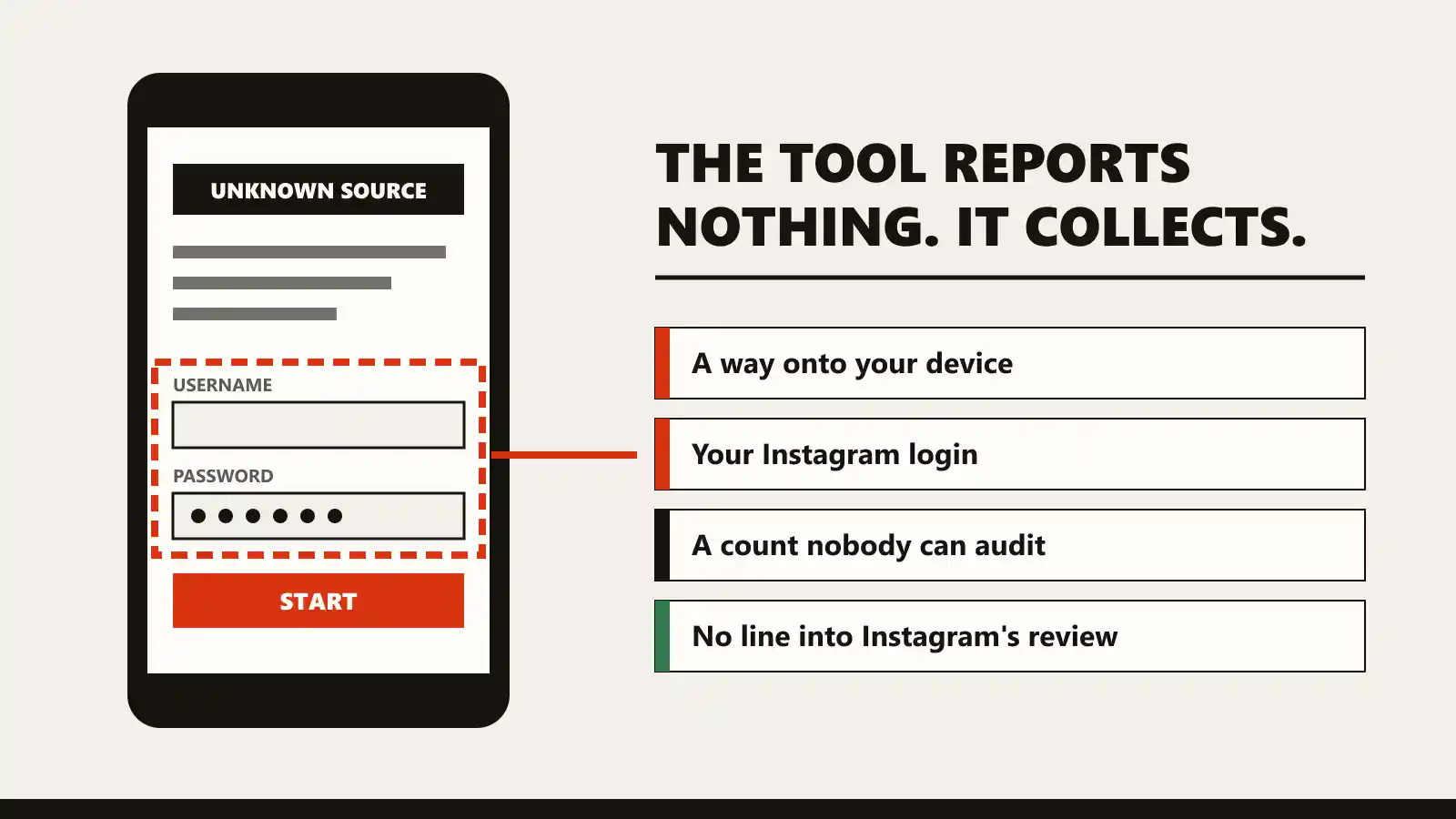
Whatever the label, the listings describe the same three working parts: a way onto your device, a field for an Instagram username and password, and a promise that cannot be checked from the outside. None of them has a private line into Instagram's review. Instagram's own Help Centre says so in plain terms: the same guidelines apply to each review, and the number of times something is reported does not determine whether it is removed (Instagram Help Centre, How Instagram decides what to remove, read 13 November 2026). So the buyer of a mass report tool Instagram is supposed to obey gets no result on the target and takes on real risk at home. This briefing follows the download from the installer's side of the screen, because that is where the consequences land.
We name no product here and link to none. Nor do we explain how to find, build or run one.
One product, many names: what each label is really selling
Search listings rename the same thing constantly. A seller who lists a "mass instagram report tool" on Monday will call it a "mass report instagram tool" by Friday, and the file underneath does not change. The table sorts the common labels by what is actually handed over.
| Label on the listing | What it usually is | What it needs from you |
|---|---|---|
| "instagram mass reporting tool", "mass reporting instagram tool", "mass reporting tool instagram" | A web page or desktop script with a target box | An Instagram login, often several |
| "instagram mass reporter tool", "instagram mass reporter", "mass reporter instagram" | The same script sold as a person or a service | Payment up front, then a login |
| "mass report instagram account tool", "instagram account mass reporter" | A panel that claims a pool of accounts | Payment, and trust in a count nobody can audit |
| "mass instagram reporting program" | A downloadable program for a PC | Running an unsigned file with your user rights |
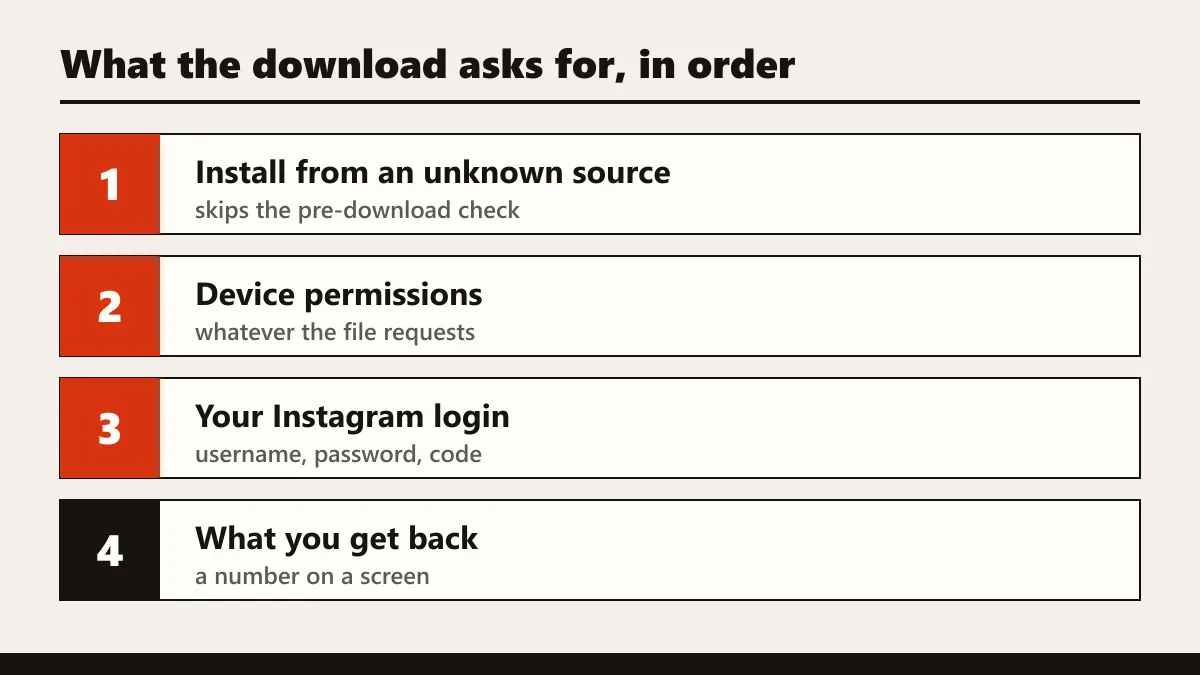
| "instagram mass report apk" | An Android app file from outside Google Play | Permission to install from an unknown source |
Five rows, one pattern. In each case the customer supplies access (to a device, an account or a card) and receives a number on a screen. The same trade runs on other platforms, which is why our notes on a mass report against a Kick or YouTube channel read so similarly, and why many of these listings reach people through unsolicited messages of the kind covered in our piece on Telegram mass DMs and what recipients can do.
What does an instagram mass report apk ask your phone for?
An APK is the file format Android uses to install an app. When that file comes from a chat group or a download page instead of Google Play, installing it is called sideloading, and it removes the first safety check in the chain.
Google describes that chain on its own support page. Google Play Protect runs a safety check on Play Store apps before you download them, checks the device for potentially harmful apps from other sources, warns about what it finds, and may deactivate or remove a harmful app (Google Play Help, Use Google Play Protect). The same page says Play Protect may block the installation of an unverified app that uses sensitive permissions commonly targeted by scammers to commit financial fraud. Read that list again with a report tool in mind: the pre-download check never happens for a sideloaded file, so the only protection left is the scan after it is already on the phone.
How much does the source matter? Google's Android team has published a figure. Its analysis found over 50 times more malware from internet-sideloaded sources than on apps available through Google Play (Android Developers Blog, 25 August 2025). On the back of that finding Google announced developer verification: from September 2026 in Brazil, Indonesia, Singapore and Thailand, apps installed on certified Android devices must be registered by a verified developer, with a global rollout planned from 2027. Anonymous files are the problem Google is designing against.
iPhones do not install APK files at all. A listing that offers an "iOS version" is normally pointing at a web page with a login form, which brings us to the part that matters most. If you have met a fake or copycat app in a store, the reporting routes are different again: see how to report a fake game to Apple and how to report a fake app or a counterfeit seller on eBay.
Why is the login box the real product?
Because a working Instagram session is worth more than a report nobody will count.
Any instagram mass reporting tool has to act from somewhere. In-app reports are filed by signed-in accounts, so the tool asks for yours, or for a list of them. From that moment the operator of the tool holds a username, a password and often the code that follows. What happens next is not in the buyer's hands. The account can be used to post, to message your contacts, to file reports you never read, or simply be sold on. Instagram's Terms of Use treat that whole trade as off limits: the section headed How You Can't Use Instagram bars soliciting, collecting or using other users' login credentials, and bars buying, selling or transferring any aspect of an account, the username included (Instagram Terms of Use, read 13 November 2026).
When someone contacts our team after using one of these, the first question we ask is which account it was logged in from. Everything else waits on that answer.
That is the practical asymmetry. The target of the reports keeps every right of review and appeal. The person who typed a password into an unknown program has given away the one thing Instagram's security model is built around. No lawful removal service asks for it; we never do, and you should treat any request for a password or a login code as the end of the conversation. People who wanted a handle freed up by force are a regular case here, and there are four fair routes to a taken Instagram username that need no login from anyone.
What do Instagram's terms say about the person who runs it?
Two clauses apply to the user of the tool, not only to its maker.
The first covers the reporting channel itself. Instagram's Terms of Use say you can't do anything to interfere with or impair the intended operation of the service, and they give misuse of any reporting, dispute or appeals channel as the example, naming "fraudulent or groundless reports or appeals". The second covers automation: creating accounts, or accessing or collecting information, in an automated way without Instagram's express permission is barred, whether or not the automation runs while logged in to an account. A mass instagram reporting program does both at once. It automates access, and it files reports with no view on whether the rule cited was actually broken.
The Terms give Meta the right to act against accounts that break them. So the realistic outcomes for the person running an instagram mass reporter are an account restricted or disabled for the reports it sent, plus whatever the software did to the device. A report filed that way also cannot be pulled back afterwards; our briefing on why there is no un-report button on Instagram explains what the two partial fixes are.
If a wave like this has been aimed at you, or you are trying to deal with an account that really does break the rules, you can ask our team for a confidential review before anything is filed. The review comes before any charge.
Why doesn't report volume decide Instagram's review?
Instagram reviews the content against a rule. It does not count hands.
The Help Centre page quoted above sets out the method: a combination of technology and user reports identifies content that may break the Community Guidelines, and removal is carried out by automated technology or a review team using the same guidelines each time. A report is a pointer. It tells the system where to look and which rule the reporter thinks applies. Ten thousand pointers at a post that breaks no rule still point at a post that breaks no rule. Our longer briefing on what moderators weigh when an Instagram account is mass reported walks through those checks one at a time, and how to look up why someone was banned from Instagram shows which rulebook each real ban traces back to.
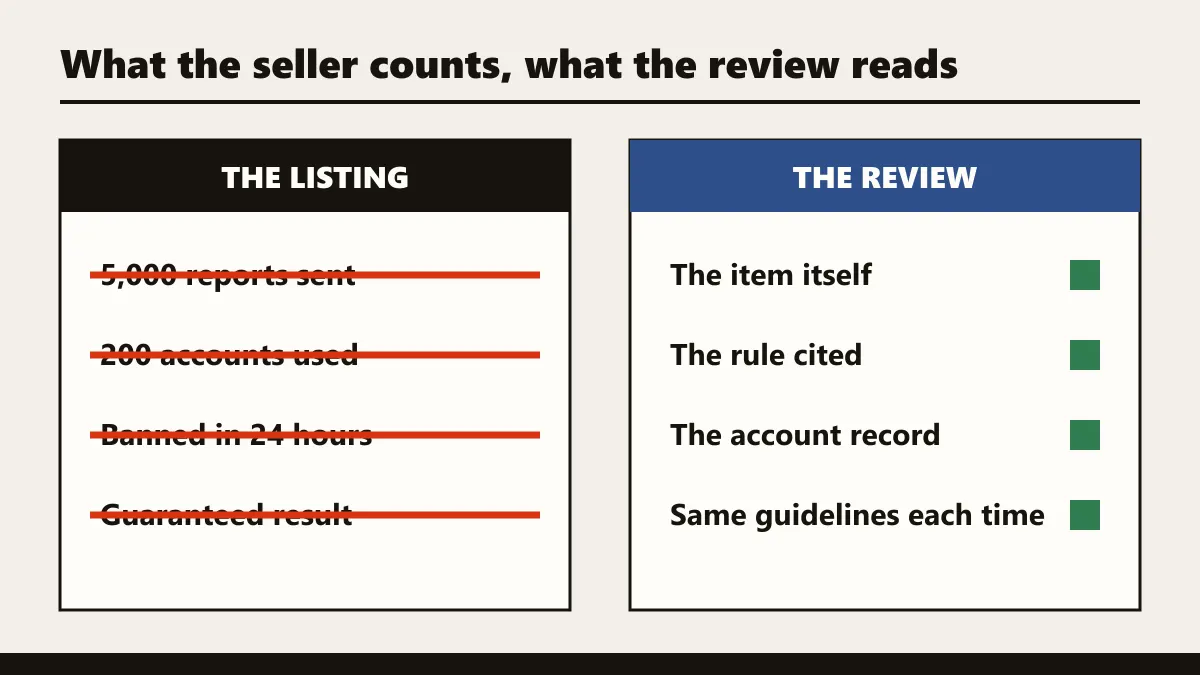
Bans do happen after bursts of reports, and sellers screenshot them. Look closer and the account had usually broken a rule that a single accurate report would have surfaced. YouTube works the same way, as our reading of what each YouTube ban and termination notice means shows.
Already installed one? What to do in the next hour
Work from the device outwards. None of this needs special software.
- Uninstall the app or delete the program, then run a Google Play Protect scan on Android and act on any warning it gives.
- From a different, trusted device, change your Instagram password and the password of the email account attached to it.
- Turn on two-factor authentication and review which devices are signed in to your account; sign out any you do not recognise.
- Check your recent activity for posts, messages or reports you did not make, and tell contacts who may have received something.
- If you paid by card, speak to your card provider about the transaction. If a seller is still messaging you, report the account: here is how to report a scam WhatsApp business number and how to report a spam bot or a seller on Facebook Marketplace.
Do it in that order. Changing a password on a phone that still carries the app only hands over the new one.
The genuine route: one report that names the rule
A real violation needs one accurate report from the person affected. That is the whole method.
On Instagram, the in-app report asks what the problem is and files it under a category of the Community Guidelines. The strongest reports come from the person with standing: the one being impersonated, harassed, or whose work was copied. If a profile is pretending to be you, the route is set out in impersonating someone on Instagram: report, prove, repair. The equivalent paths elsewhere are covered in our guides to reporting an impersonator or scam on Snapchat, reporting a troll account on Bluesky or Truth Social, reporting a YouTube video, Short or comment and reporting a YouTube channel from desktop or the app.
Three things make a single report land: the exact item (a link to the post, not just the profile), the rule it breaks in Instagram's own words, and evidence kept outside the app in case the content is edited. Where the harm is legal as well as a policy matter, such as copyright infringement or defamation, a formal notice goes through the dedicated form for that right, and it is sent by the rights holder or an authorised representative. Slower than a button that says 5,000 reports? Yes. It is also the only version that produces a decision someone at Instagram stands behind.
What we decline, and what no report removes
Obscura does not sell, run or recommend any mass report tool Instagram users are offered, and we do not file reports against accounts that are merely disliked. We do not forge notices and we never ask for a password.
Some things cannot be removed by any route. Truthful reporting, genuine public records and honestly held opinion stay up on Instagram as they do elsewhere; where they rank in search, lawful suppression is the only honest answer, and it is slower than removal. Our disclaimer sets those limits out in full, and the team page shows who reads your case. A competitor's account that follows the rules is not a removal case at all.