What NCMEC Take It Down actually is
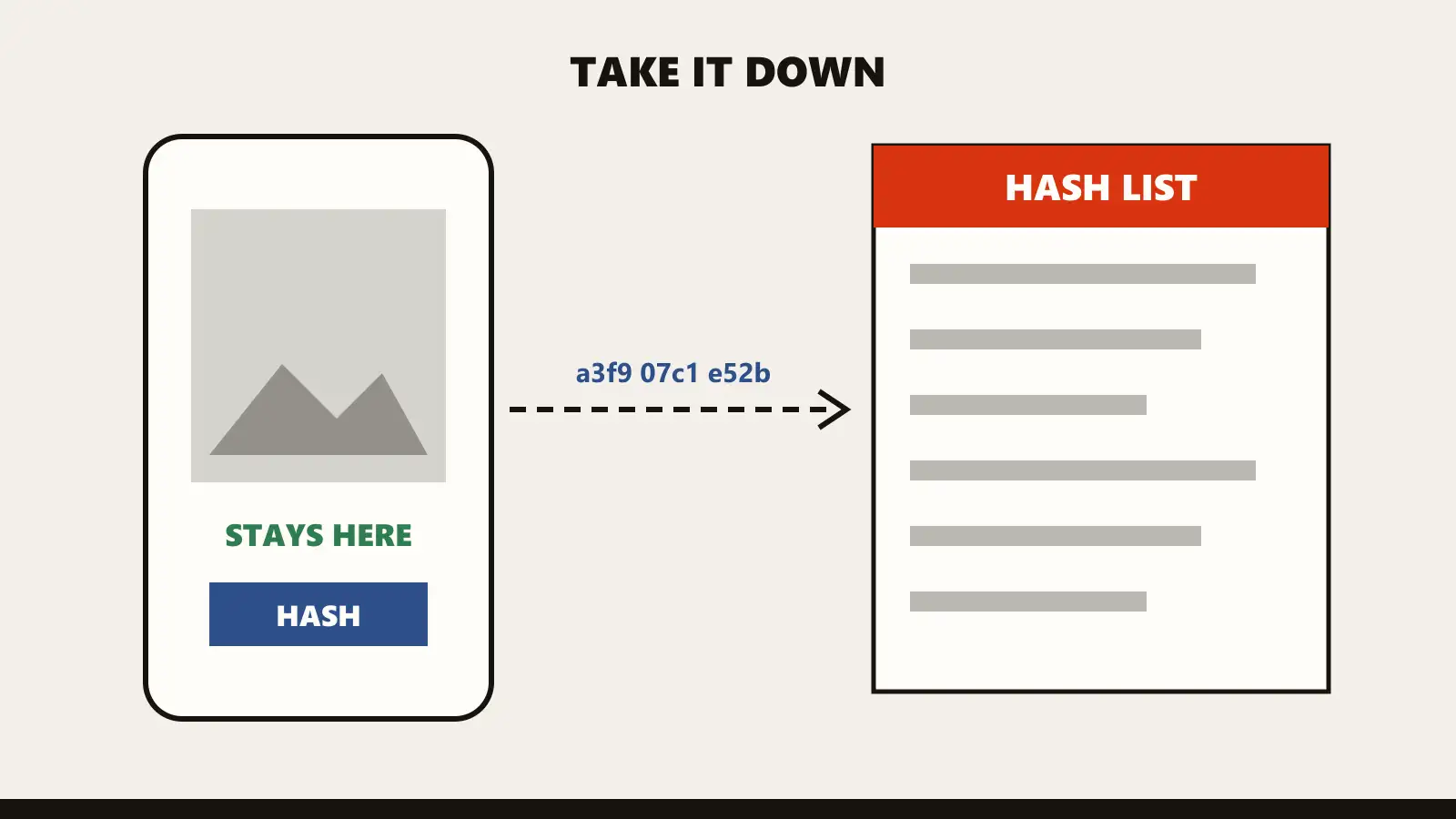
NCMEC Take It Down is a free tool run by the National Center for Missing & Exploited Children that turns an explicit image of a minor into a fingerprint, so platforms can block it without anyone viewing the file.
The idea is simple, and it is worth understanding before you press anything. You choose the photo or video on your own phone or computer. The Take It Down page calculates a hash value from it, a short string of characters that acts like a fingerprint for that exact file. Only that string goes to NCMEC. The picture stays where it is. According to the official Take It Down page, NCMEC keeps the hashes on a list shared only with participating online platforms, which then scan public or unencrypted content for matches and remove or block what they find. You can stay anonymous. Nobody at NCMEC, at a platform, or at a firm like ours needs to see the image for the process to work, and that is the point of the design.
People search for it both ways, ncmec take it down and take it down ncmec, but it is one service at one address: takeitdown.ncmec.org.
Who can use Take It Down, and who should use something else?
The test is the age in the image, not your age today.
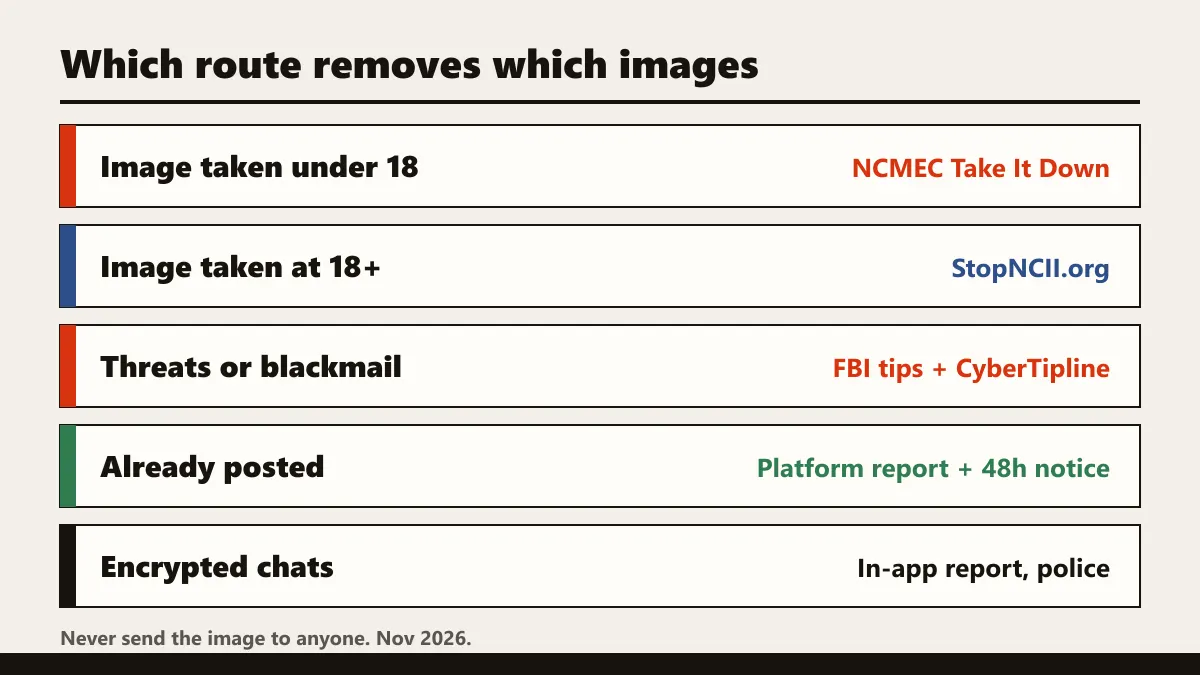
If the photo or video shows you nude, partially nude or in a sexually explicit way, and it was taken when you were under 18, you qualify. That holds whether you are 15 now or 34 now. A parent or another trusted adult can help a young person through the steps. If the image was taken when you were 18 or older, NCMEC itself points you to StopNCII.org, the adult equivalent run by a separate charity, which uses the same hash-on-device approach with its own list of partner companies. The two services are siblings rather than rivals: same mechanism, different age line, different partner lists. If you are not sure whether the content has been shared at all, the official page says you can still submit, because a hash on the list blocks future uploads as well as existing ones. One practical warning from the same page: submit only files already on your device, and never download, send or re-share an image in order to hash it.
How the hash list works, step by step
Five steps, all on your own device until the last one.
- Open takeitdown.ncmec.org in a browser on the device that already holds the file.
- Answer the short eligibility questions about the age in the image.
- Select the image or video. The page generates the hash locally.
- Submit. Only the hash values reach NCMEC.
- Participating platforms compare new and existing public uploads against the list.
Then wait, and do not post the content anywhere yourself. The official page notes that future posts of a hashed file may be flagged, which can get the account that posts it blocked, including yours.
NCMEC Take It Down program: remove explicit images of minors, officially and for free
Searches like "ncmec take it down program remove explicit images minors", "ncmec take it down remove explicit images minors official" and "ncmec take it down remove nude images minors official" all lead to the same free tool, and the word "official" matters. There is no paid tier, no agent who files on your behalf for a fee, and no version of the service that asks for the image. Any site or account that offers to "submit to Take It Down for you" and asks you to send the photo is not NCMEC. The genuine route takes a few minutes, costs nothing and keeps the file on your phone.
Which platforms take part, as of November 2026
The list is public and it changes. When we checked the participants page in November 2026 it named 25 participants, among them Facebook, Instagram, Threads, TikTok, Snap Inc., YouTube, OnlyFans, Fansly, Pornhub, Patreon, Bumble, yubo and character.ai, plus a few safety vendors such as Safer by Thorn. That covers a large share of the places where a teenager's image is likely to be reposted, but it is not the whole internet.
What the list does not include tells you where to look next. Messaging apps with end-to-end encryption cannot scan message contents, so a hash will not stop a photo moving through private chats; for that side, our note on whatsapp blackmail covers what the app's own report button can and cannot reach, and our guide to a ban service for a whatsapp account explains why paid "ban" offers do not change that. Forums and image boards that never signed up are another gap. If a copy turns up on one, the 4chan doxxing removal guide sets out how moderators and hosts are reached instead.
What Take It Down cannot do
It is a strong tool with clear edges, and pretending otherwise helps nobody.
A hash matches a specific file. If someone crops, filters or re-encodes the image heavily, a match is less certain, and the official pages do not promise that edited copies will be caught. The service only works on public or unencrypted platforms that have agreed to participate, and NCMEC says plainly that platforms may have limited ability to remove content already posted. It does not identify the person who shared the image, and it does not start a criminal case. Those jobs belong to the CyberTipline, which accepts reports online or by phone on 1-800-843-5678 at any hour, and to the police.
The honest limits apply to our own work too. We cannot remove lawful reporting, public court records or opinion; where that is the problem, the answer is suppression, not deletion, and our disclaimer sets out the boundaries. We never forge legal notices, never ask for passwords, and never ask for or handle intimate images, of anyone, at any age.
Take It Down the service versus the TAKE IT DOWN Act
Same name, different things. The service is NCMEC's hash list. The Act is a US federal law.
The TAKE IT DOWN Act was signed on 19 May 2025. It made publishing non-consensual intimate images, including AI-generated ones, a federal crime, and gave covered platforms a year to set up a notice process that removes valid reports within 48 hours. That platform duty applies from May 2026. So in November 2026 a young person in the US has two levers that work together: hash the image through NCMEC Take It Down so participating services block copies automatically, and file a removal notice under the Act with any covered platform that still shows it. The Act protects adults as well as minors. Our step-by-step plan to remove leaked photos from internet hosts walks through filing those notices in the right order.
Sextortion: how to remove blackmail images without paying
Do not pay. Payment almost never ends it, and it marks you as someone who pays.
Sextortion is the threat to share intimate images unless the victim sends money, more images or something else. The CyberTipline figures show how fast it has grown: NCMEC reports that online enticement reports rose from 44,155 in 2021 to 186,819 in 2023 (NCMEC CyberTipline data, 2023). The FBI's public guidance is consistent on the basics: stop replying, do not pay, keep the messages and usernames, and report to the FBI at tips.fbi.gov or 1-800-CALL-FBI. Minors, or adults helping them, should also report to the CyberTipline. Then hash the images through Take It Down so that, if the threat is carried out on a participating platform, the upload is caught.
To remove blackmail content that has already gone up, report it on the platform first. Our guides show the in-app routes to get a post taken down on Instagram, to take down a page on Facebook, and how to take down story on tiktok posts and videos. Where the blackmailer has also set up fake profiles, see how to take down an old instagram account and the steps to remove fake x account pages, which also cover reporting doxxing.
Where a removal service fits, and where it does not
Never in the image itself. Sometimes around it.
When we take on cases near this topic, the image is the one part we refuse to touch: the victim or their parent hashes it, NCMEC and the police handle the crime, and we stay out of the file entirely. What clients sometimes need from us is the surrounding mess, such as impersonation accounts, a copied video re-uploaded under a copyright claim, or a doxxing post with a home address. Our page on a blackmail image removal service explains why the honest version of that service never asks for the pictures. For copies on video hosts, the vimeo content removal service guide covers notice routes, and the rules on redbubble copyright infringement show when copyright helps and when it does not. Repeat harassers on marketplaces and art sites are a separate problem; our notes on account reporting, on how to take down poshmark listing pages, and on how to remove fake greatschools review posts cover those routes.
If any of that surrounding material is still live after the official routes have been used, you can describe it to us, in words only, through our contact page. We will tell you plainly whether there is anything a removal firm can add.