Someone on WhatsApp says they will share your images. What now?
You are holding your phone, and your heart is probably going. A number has sent you a picture of yourself, or a list of your friends, along with a deadline and a price. This is WhatsApp blackmail, and when the threat concerns intimate images it is called WhatsApp sextortion. It is a crime against you. The National Crime Agency says a victim is "never to blame".
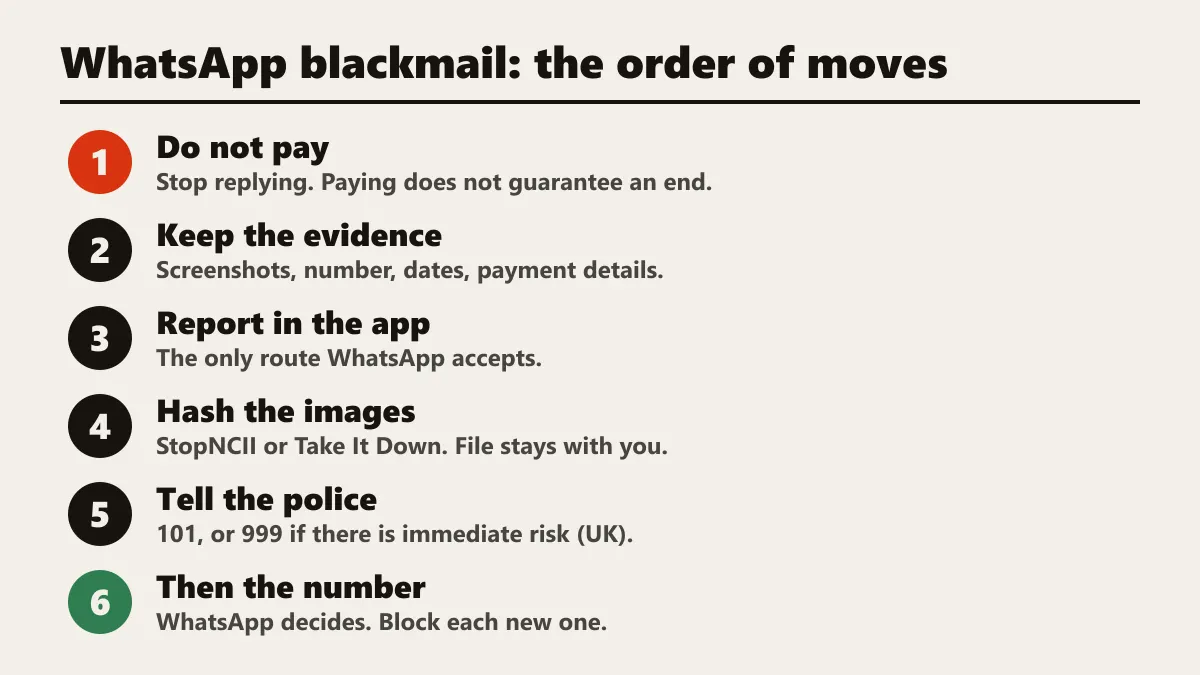
Work down this list, in this order:
- Do not pay, and stop replying. If you have already paid, do not pay again.
- Save the evidence. Screenshots, the number, dates, any bank or payment details.
- Report in the app. Then block.
- Hash the images with StopNCII if you were 18 or over in them, or Take It Down if you were under 18.
- Tell the police. In the UK that is 101, or 999 if there is immediate risk.
- Only then think about the number. That decision belongs to WhatsApp.
If any of this has you thinking about hurting yourself, stop reading and call your local emergency services, or in the UK Samaritans, free on 116 123, day or night.
The order matters because each move protects the next. Paying first hands over money and shows you can pay; the NCA says payment does not guarantee the threats will stop and that offenders often ask for more. Reporting before you have saved anything puts your record at risk, because one screen can block, exit a group or delete a chat. Hashing can happen at any point, since the file stays on your phone, though it will not touch the chat itself. And a ban, the thing most people search for first, is the one item here you do not control. WhatsApp makes that call, does not tell you the result, and the person can come back on another number. Treat the number as the last problem. You can finish everything above it tonight, in roughly the time this page takes to read.
You are far from the only person reading this tonight. The Revenge Porn Helpline recorded roughly 25,000 reports in 2025, its busiest year so far, and 53% of its male clients reported sextortion (SWGFL, July 2026).
If you are under 18, start here
Were you under 18 when the pictures were taken? Then there are services built for exactly this, they are free, and you can use them before you do anything else on this page. Take It Down, run by the US National Center for Missing & Exploited Children, makes a digital fingerprint of the image on your own device. The picture is not uploaded and you can stay anonymous. In the UK, Report Remove is run by Childline and the Internet Watch Foundation: you create a Childline account, your age is checked through Yoti, and the IWF works to get the content taken down, with a Childline counsellor there if you want to talk. The CEOP Safety Centre, part of the NCA, lets you report safely to a Child Protection Advisor. The NCA also tells under-18s to go to the police, so tell an adult you trust and ask them to help you make that call. If someone may hurt you, ring 999.
Do not send the picture to anyone, including friends, a parent's phone or a company offering help. Nobody who can help you needs to see it. Obscura will point you straight to these services, because they are the right door.
Why save the evidence before you tap Report?
WhatsApp's own block and report page puts this advice at the top: you "may want to take screenshots or back up a copy of your chat history". Read today, 5 November 2026, the same page says a chat stays in your chat list after you block someone, so blocking alone does not wipe it. The danger is the tap you make in a hurry. On Android, the report screen has a box to also block the sender or exit a group and delete the chat, and exiting a group offers "Exit and delete for me". Reporting a group removes you from it on Android, so whatever you did not save may be out of reach. Nothing comes back to you either: WhatsApp says it will acknowledge a report and "will not contact you again". The report gives WhatsApp its five messages and gives you no copy of anything. Your own screenshots are the only record you will hold.
Save the things the NCA lists: messages, images, the offender's profile details and bank account details. Add the contact info screen showing the full number, the dates, and any payment link or username they gave you.
Finding the chat unbearable to look at is normal. Archive it rather than deleting it; WhatsApp offers both.
One exception. WhatsApp says you cannot screenshot view once media, so if the threat arrives that way, note the time and sender in writing and report it from inside the open photo or video.
How to report sextortion on WhatsApp, and what the report carries
People search how to report someone whatsapp as if there were a form or an address. There is not. WhatsApp's reporting page says "the only way to report someone is to follow the in-app reporting process", and that contacting it any other way will not speed the review or change the decision. As of 5 November 2026 we could not find a WhatsApp help page on sextortion itself, so a WhatsApp sextortion report travels down the general route. On Android, open the chat, tap the menu, then More, then Report, tick the box only if you want the block as well, and tap Report. On iPhone, tap the name or number to reach Contact Info, scroll to the bottom, tap Report, and choose Report and block or Report. The steps WhatsApp publishes for a contact show no reason menu and no text box, and it says you need not add anything afterwards.
So you cannot explain yourself. The messages have to do that for you, which is a good reason to report while the threats are still the newest thing in the chat.
| A report sends WhatsApp | A report does not send or do |
|---|---|
| Up to five of the last messages they sent you | The rest of the chat, as WhatsApp describes it |
| Basic info on your last five calls, such as who called and for how long | What was said on those calls |
| The reported user ID | Any notice to that person |
| When each message was sent, and whether it was image, video or text | A copy or a progress update for you |
| Possibly how first contact began (Android page) | A promised ban: it "won't necessarily result" in one |
| A view once photo or video, if you report it from that view | A block: messages continue until you block as well |
That last row catches people out, since a report without a block leaves the person free to keep messaging you. Block in the same step once your screenshots are done. People also search what happens when you report whatsapp number, and the honest reply is short: a small packet goes to WhatsApp, the person is not told, and you hear nothing further. The silence does not mean you were ignored.
Not every frightening WhatsApp message is sextortion. One claiming an Instagram copyright violation on WhatsApp is a different trick with a different answer.
Hash the images, then tell the police
Hashing means your phone works out a digital fingerprint of the picture and sends only that. StopNCII is the adult service, for images in which you were over 18. The file stays on your device, and participating platforms use the fingerprint to find matches that break their intimate image rules. Its partners page, read today, lists Facebook, Instagram, Threads, Snapchat, TikTok, Reddit and Bing. WhatsApp is not there, and the StopNCII FAQ explains why: most messaging platforms use encryption, so "hashing technologies do not apply". Take It Down's list has no WhatsApp either. A hash cannot stop someone sending a picture privately to your cousin on WhatsApp. It guards the public places where a threat tends to end up, so it is still worth doing, and it is free. You need a copy of the file on your device, as the Revenge Porn Helpline notes. Write down your case number and PIN, because StopNCII says it cannot recover them.
Then the police. Threatening to share an intimate image is itself an offence in England and Wales under section 66B(4) of the Sexual Offences Act 2003, in force since 31 January 2024, so no picture has to have gone anywhere. The Helpline is candid that police options may be limited if the offender is abroad, and that a report still feeds national intelligence. In the US, the FBI takes tips at ic3.gov, and elsewhere your local police are the first call. UK adults can also ask the Helpline for advice; it covers over-18s in the UK only.
If an image does reach search results, Google has a removal request for explicit imagery. It says it tries to remove duplicates too, and that it can only act on its own results, not the host site.
When the threat moves off WhatsApp
Blackmail can start on one app, carry on in another and be threatened on a third. Meta wrote in July 2024, when it removed sextortion accounts on Instagram, that these scammers "don't limit themselves to any one platform". That article names Instagram and Facebook and says nothing about WhatsApp, and we found no newer WhatsApp sextortion figure from Meta. Each app has its own door. If they first found you on Instagram, how to report an Instagram account depends on the type of account, and a made-up profile needs the Instagram fake account report route, because the app has no button labelled fake. Threats in DMs belong under Instagram report harassment, and a copy of your profile under your name is an Instagram impersonation report. Keep the same habit everywhere: save first, then report the exact object that carries the threat.
Elsewhere the mechanics shift again. A Facebook account report depends on whether the threat sits on a profile, a page or a group. On Snapchat, how to report someone changes with the chat or profile you are looking at. If the picture appears on X, you report a tweet by its post ID and treat each copy on its own, while a clone of your account takes a Twitter impersonation report. Worried a Telegram user will find out? We set out whether they will know separately. TikTok acts on conduct too, as what gets someone banned on TikTok explains, and a fake profile on another network can go through the Bluesky impersonation desk. Blackmailers also like to quote your employer to frighten you, so if your work details are coming from a data broker, how to get removed from ZoomInfo cuts off one source.
What Obscura does here, and what it will not do
Obscura gives intimate image cases free, urgent triage, and Obscura never asks to see the material. We work from links, names and descriptions, so you do not send us the picture. If an image has reached a website or a search result, our part is takedown requests to hosts and platforms, search de-indexing, a plan for what evidence to hold, and pointing you to the police. Our part stops at WhatsApp's door. We cannot file your report, speed a review or get a number banned, and WhatsApp says "third party services" cannot ban an account. No cease and desist letter to the blackmailer, either. The FBI's April 2023 warning describes for-profit firms that charge victims exorbitant fees, sell letters that are not legally enforceable and may discourage contact with the police, and it reminds people that law enforcement and non-profits help at no charge. Everything in the numbered list above is free. You can do it without hiring anyone, us included.
If an image is already public and you would like a confidential review before any charge, contact us here.
We also tell people where the line sits. Removal takes a piece of content down; suppression only pushes it lower in search, and it is what remains for truthful reporting, genuine public records and protected opinion. We do not forge notices, we never ask for passwords, and no outcome is promised. Our disclaimer sets out the limits.
How to ban a WhatsApp number: there is no method for you
You may have searched how to ban a WhatsApp number, how to ban any whatsapp number, or how to ban someone in whatsapp, hoping for the switch that makes this stop. Here is the plain answer. No method exists for you to do it. WhatsApp's account ban page says "only WhatsApp can ban or unban" an account, and that third-party services cannot. So how whatsapp number banned, in practice, is this: WhatsApp forms a belief that the activity breaks its terms, gives examples such as spam, scams and putting users' safety at risk, and acts, and it keeps the right to do so without notice. Does whatsapp ban users? Yes, and its terms bar threatening, intimidating or harassing use. It publishes no number of reports that triggers a ban, and it warns that a report may lead to no action. Volume does not decide, the same point we make about how many reports to get banned on IG.
One honest report from you, carrying the threats, is what the system asks for.
False reporting can backfire. Those same terms forbid "fraudulent or groundless reports", so a campaign against a number puts your own account at risk. If what you want is a number banned over a grudge, Obscura declines that work, for you and for anyone else who asks.
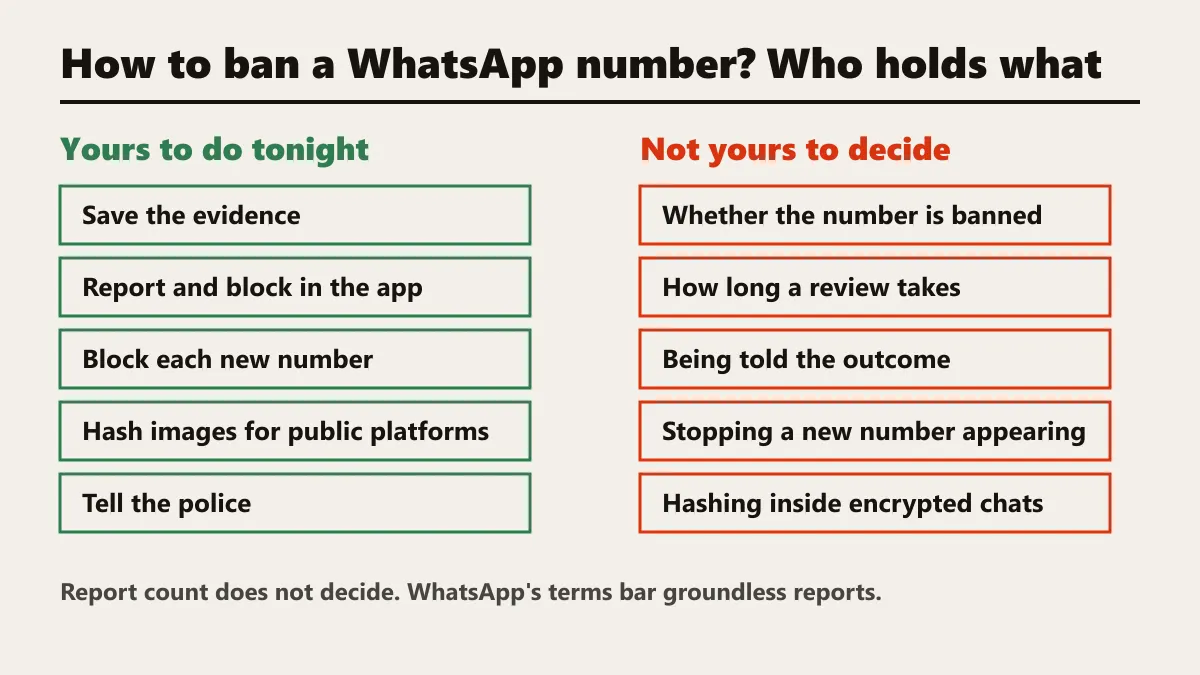
Expect the person to try again. A ban closes one number, and a new one costs them little. WhatsApp's advice is plain: if they contact you from new numbers, "you can block and report each new number". Add each one to your evidence note with the date, tell the officer dealing with your case, and do not reply. We cannot promise it will go quiet. You will still have your record, your report and your hash in place if it does not.