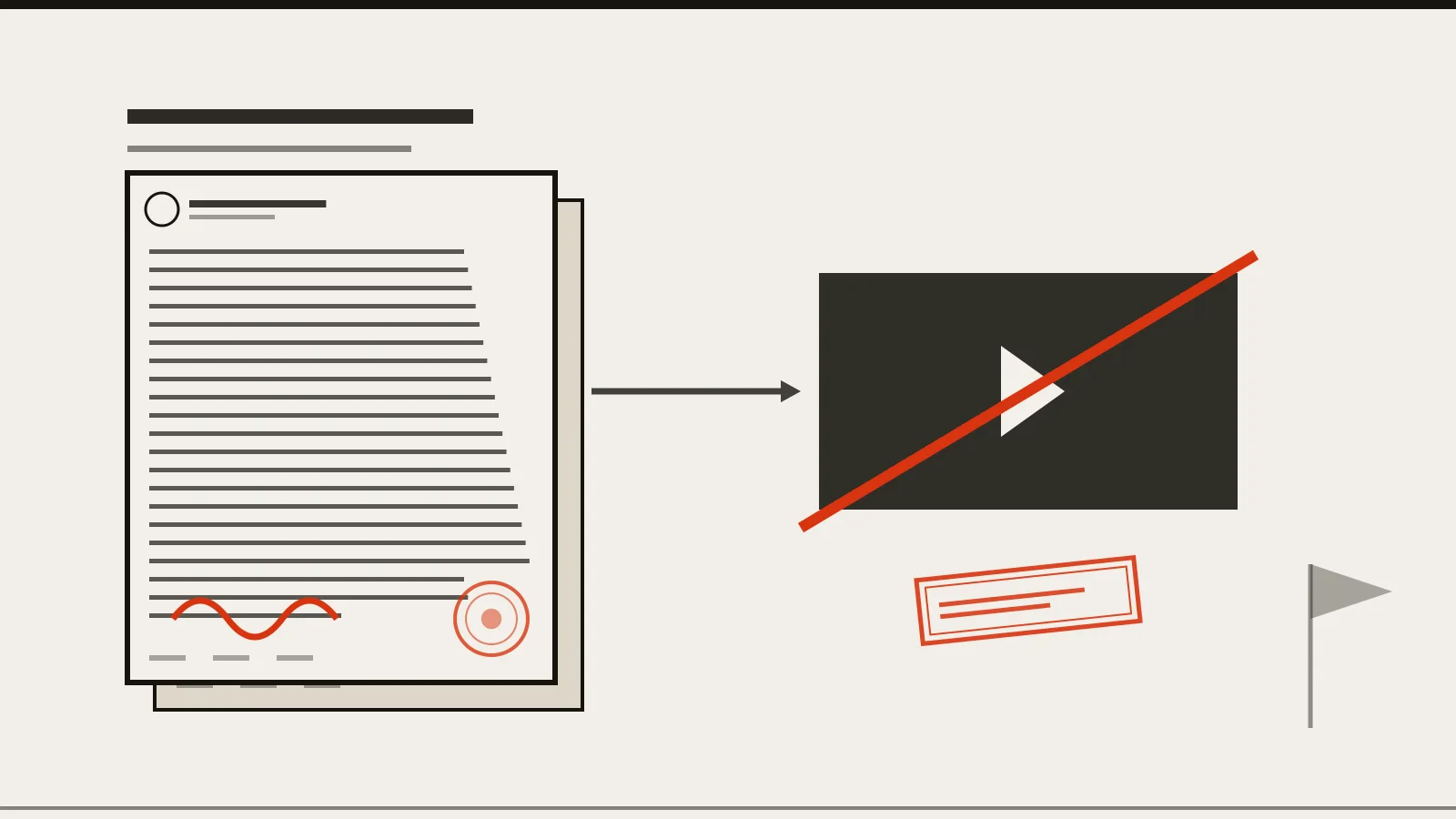
Is a takedown request just a louder report?
No. That is the most expensive misunderstanding in this whole field.
A report is a flag. You press a button, pick a reason, and a moderator decides whether the thing breaks the platform's own rules. Nobody signs anything, nobody swears to anything, and on most services the person you reported never learns your name. A takedown request is a legal document. Under the US Digital Millennium Copyright Act it has to identify the work, point to the exact copy, give your contact details, and carry two sworn statements and a signature, as set out in 17 U.S.C. § 512(c)(3). The platform does not judge it against its community guidelines. It checks that the notice is complete, removes the copy to keep its safe harbour, and forwards your notice to the person who posted it. One costs nothing and binds nobody. The other can be challenged, published, and used against you if it is false. Knowing which one a problem needs is most of the work.
That split explains why the same searches come in so many languages. Someone typing "запрос DMCA" in Russian, "בקשת DMCA" in Hebrew or "طلب DMCA" in Arabic is looking for the same signed document as someone searching in English. The word "request" is the clue. A запрос DMCA is not a complaint form or a flag; it is the notice itself, and the statute behind it is American whatever language the form screen is shown in. When we file these for clients outside the US, the drafting is the easy part. The hard part is deciding whether copyright is even the right right, because a great many of the problems people bring us (a cloned profile, a scam page, a rival's parody account) have nothing to do with copied work.
So this briefing starts with the YouTube request, because it is the cleanest example of the signed route, then sorts the other searches into request or report.
How do you submit a DMCA takedown request on YouTube?
Searches for the YouTube copyright complaint form, the YouTube copyright infringement form, the YouTube copyright removal request form, the YouTube DMCA form and the YouTube DMCA takedown form all land on one webform. YouTube calls it a copyright removal request. You need to be signed in to a Google account, and the form only accepts videos you can point to by URL.
- Open the video, click the three dots under it, choose Report, then the copyright option, which hands you to the webform. Or start from YouTube Studio under the copyright or removal-requests section, depending on which help page you read.
- Say who you are: the owner, or an agent authorised to act for the owner. A fan or a bystander cannot file.
- Describe the original work and where it lives, and give the URL of every infringing video. Timestamps help on long uploads.
- Choose when it comes down. Removal can be immediate, or scheduled seven days out so the uploader has a week to delete it without a strike.
- Tick the sworn statements, type your full legal name as a signature, and submit.
The youtube submit dmca takedown request step is the moment your name enters the record. YouTube's help page says your full legal name may be shared with the uploader, and the removed video's page shows the claimant's name unless YouTube has approved an alternative name; your address and phone number stay confidential. That is why we tell clients who fear retaliation to file through an authorised agent. The youtube takedown procedure after submission runs in a fixed order: YouTube reviews the notice for completeness, removes the video, issues a copyright strike to the channel, and emails the uploader, who can retract nothing but can counter-notify. If a counter-notice arrives, you have 10 to 14 US business days to show you have started court action, or YouTube may put the video back. Our longer note on how long a YouTube copyright strike lasts covers the 90-day clock from the uploader's side.
According to YouTube's own copyright transparency data for 2025, the public webform produced 2,969,817 removal actions, about 0.12% of all copyright actions that year. Content ID did nearly all the rest. The webform is the door for people without Content ID, which is to say almost everyone.
Will YouTube take down private videos?
Sometimes, and not by the route people expect. The webform needs a URL you can name, so a private video you cannot see is very hard to target with a request. YouTube's own systems are another matter. Content ID and the upload checks run whatever the visibility setting, and the community guidelines apply to private and unlisted videos as much as public ones. So will youtube take down private videos? It can, through its own scans or a guidelines breach, but your copyright request needs a copy you can actually point to. If someone has privately shared a link with you, that URL is enough to file.
Why does YouTube take down videos, and why do channels vanish?
Four different hands can remove a YouTube video, and the notice on the dead page usually tells you which one did it. That matters, because each has a different way back. Why does YouTube take down videos? In descending order of volume: its automated guidelines enforcement, Content ID matches, signed copyright requests like the one above, and legal or privacy complaints. The headline number is lopsided. In April to June 2026, YouTube removed 11,159,676 videos, and 98.6% were first detected by automated systems rather than by a person flagging them (YouTube Community Guidelines enforcement report, Q2 2026). User flags first surfaced about 1.1%. A video that has been taken down by YouTube is therefore far more likely to have tripped a classifier than to have been reported into oblivion, which is worth remembering before you blame a rival. The phrase people search, "youtube taken down", covers all four routes at once, and the page that replaces the video is the only reliable clue to which one acted.
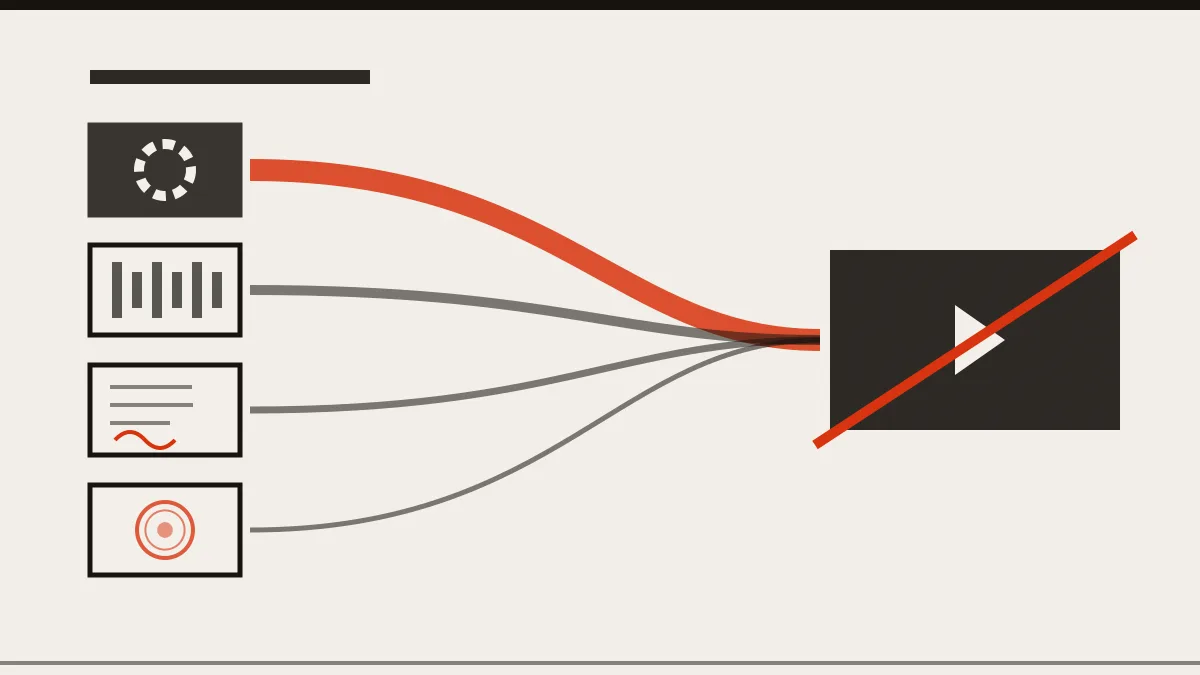
A youtube channel taken down is a different event from a single video. Three copyright strikes inside 90 days terminate a channel, as do three guidelines strikes in 90 days, or a single severe breach. In the same quarter YouTube removed 2,732,395 channels, and 2,310,181 of them (84.5%) went for spam, deceptive practices and scams. Channel terminations alone took 86,686,063 videos down with them.
If you are the person who wants to youtube take down a video and you are not the copyright owner, the request route is closed to you. The report button is open, and so is the privacy complaint if the video shows you. We walk through what remains visible after any of these, and how to see YouTube videos that were taken down, in a separate note; the related search for how to find taken down YouTube videos sits beside a briefing on seizure banners and FBI notices.
Request or report: the sorter for every search on this page
This table is the short version. Find the row that matches what was taken from you, then read across to see whether it needs a signed request or a plain report, and what the other side will learn.
| What happened | Signed request or report? | Who may file | What the other side learns | First door |
|---|---|---|---|---|
| Your video re-uploaded on YouTube | Signed request (DMCA) | Owner or authorised agent | Your name, from the notice | YouTube copyright removal request webform |
| Your photo or clip posted on X | Signed request (DMCA) | Owner or agent, logged in | Full notice incl. contact details | X DMCA form (help.x.com/forms/ipi) |
| An X account pretending to be you | Report | You, your representative, or a bystander from the profile | Not your identity | X impersonation report form |
| An X "parody" that hides the label | Report | Anyone | Nothing | Profile report under authenticity |
| Your registered brand used on X | Signed trademark report | Holder or representative | Possibly your name | X trademark form, registration number needed |
| A VK page using your name | Report | You, with proof of identity | Nothing | Report on the fake page |
| A website copying your content | Signed request (DMCA) | Owner or agent | Your notice, usually forwarded | The host's abuse or DMCA contact |
| A scam website taking money | Report, then police | Victim, anyone | Nothing | Registrar abuse desk, then police |
| A crypto scam that took funds | Crime report | The victim | Nothing until charges | IC3, Report Fraud, ReportCyber |
| A Twitch streamer you dislike | Report, once | Any viewer | Nothing | In-stream report |
The first column is the one people skip. Most of the bitterness we hear comes from someone sending a copyright notice about a cloned profile, or reporting a stolen video as "spam", and waiting weeks for a moderator to apply the wrong rulebook. The second column matters just as much, because a signed request carries consequences a report never does. It puts your name on a record, it can be published by the platform or forwarded in full, and if it is wrong it exposes you to a claim for misrepresentation under section 512(f). A report, by contrast, can be filed by almost anyone and costs nothing if the moderator disagrees. The rule of thumb we use is short. If you own the thing that was copied, sign. If you are the thing that was copied, report. If money left your account, go to the police before either.
If a row here matches what happened to you and you would rather not put your own name on a notice, send us the links in confidence. We read the case, tell you which column it belongs in, and say plainly if nothing lawful will move it.
X: DMCA form, impersonation report form, parody and brand
X keeps three doors, and they rarely overlap.
The x dmca form sits at the IP form branch on X's help centre. It asks whether you own the work, act for the owner, or neither, and "neither" ends the flow. The owner branch needs an X account. X's copyright policy says the poster receives the full notice, including your name, address, phone number and email, which is why many of the people who ask us about it end up filing through an agent. The policy also warns that a link to a profile page alone is not enough; you have to name the specific post or media. Our briefing on the DMCA takedown website journey versus the YouTube one explains why X's version behaves more like a host notice than a webform.
The x impersonation report is the second door, and it is a report, not a request. The x impersonation report form accepts filings from you or your authorised representative, and a bystander can report directly from the fake account's profile. You do not need an X account to use the form. Outcomes are suspension or an order to change the profile. Searches for x impersonation report help usually come from people whose first filing was closed without action, and the cause is nearly always proof: a clear photo of a government ID for individuals, and a link to the real account you are being confused with. A second filing that simply repeats the first, without new proof, tends to get the same answer. We cover the reporter's side of how to report X impersonation in more depth elsewhere.
A parody is the hard case. X's authenticity policy lets parody, commentary and fan accounts exist if they meet all four of its labelling rules: the X parody label, an avatar that is not identical to yours, a word like "parody" or "fan" at the start of the display name, and the same in the bio. An x parody account takedown works only when one of those labels is missing or when the account is used to deceive. Meet the four rules, and the account stays, however much it stings.
For companies, an x brand impersonation removal goes through the trademark form, which needs a registration number; a pending application is not enough. An x impersonation removal service cannot get round that. Any provider who promises otherwise is selling volume reports, which X's systems discount.
Website takedown: notice, request, or a different switch
A website takedown is never one action. It is a decision about whose switch to press.
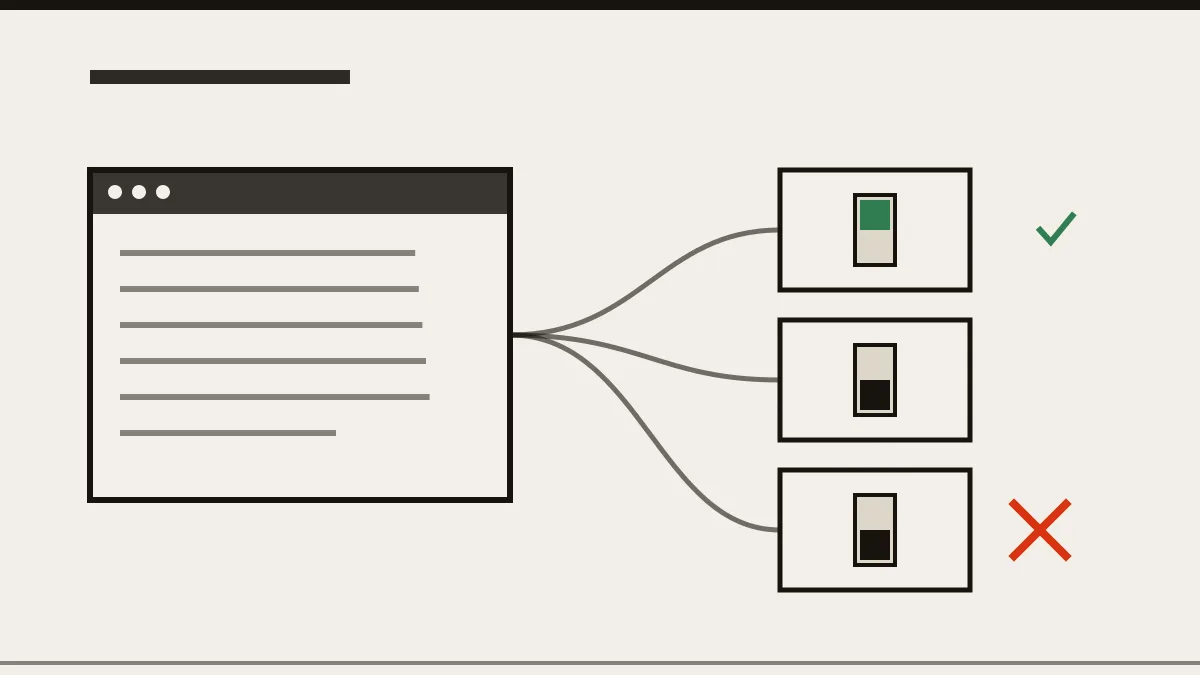
If the site copies your work, the website takedown notice is a DMCA notice sent to the host, and it has the same five elements as the YouTube webform. The host removes the page or forwards your notice to its customer, and a reputable one does both. If the site hides behind a CDN, the CDN will usually pass your complaint to the real host rather than act itself. A website takedown request that is not about copyright needs a different hook: phishing or malware goes to the registrar's abuse desk, which under ICANN's 2024 DNS-abuse amendments must act promptly on actionable evidence, while ordinary defamation or a harsh review goes nowhere near the registrar. Our note on malicious domain takedown sets out exactly which harms count as DNS abuse, and the guide to impersonation website takedown covers sites that clone a person or a shop.
What about a website takedown solution sold off the shelf? The honest description of any website takedown solutions provider, us included, is a firm that knows which of those switches applies and drafts the paper the switch-holder needs. Nobody holds a master key.
A website takedown australia search adds a fifth switch. Australia's eSafety Commissioner can issue removal notices under the Online Safety Act 2021 for serious cyber-abuse of adults, cyberbullying of children, image-based abuse and certain illegal material, and a provider served with one is expected to comply within 24 hours, or a longer period eSafety sets. For adult cyber-abuse, eSafety generally expects you to report to the platform first and steps in if nothing happens within 48 hours. That power does not reach copyright, ordinary defamation, or a scam shop selling fake goods; for those, the host, the registrar and the eSafety Commissioner's own guidance all point you elsewhere. Scam sites go to Scamwatch, run by the National Anti-Scam Centre, whose 2025 Targeting Scams report counted 481,523 scam reports and $2.18 billion in combined losses across its partner agencies (NASC, 2025).
The same "which right" logic runs through our notes on an Imgur copyright takedown request and on Redbubble copyright infringement, where a design can be pulled under copyright, trademark or publicity rights depending on what was copied.
Crypto scams and VK fakes: where reports go when nothing was copied
Here the request route is simply absent. Nobody owns a copyright in a scam.
Where can I report crypto scams? To the police first, and the platform second. In the US, the FBI's Internet Crime Complaint Center at ic3.gov is where crypto fraud reports belong; its 2025 annual report put crypto-related losses at about $11.4 billion from 181,565 complaints (FBI IC3 2025 report, as reported by The Block). The FTC takes consumer reports too, at ReportFraud.ftc.gov. In the UK, Report Fraud replaced Action Fraud for England, Wales and Northern Ireland from December 2025; Scotland reports to Police Scotland on 101. In Australia, ReportCyber at cyber.gov.au handles cybercrime losses. Who do you report crypto scam to after that? The exchange that received your funds, with the transaction hash, the wallet address and the time. An exchange can freeze an account still holding the money. Nobody reverses a confirmed on-chain transfer. Our briefings on how to report a crypto scam to the FBI and how to report a USDT scammer go through what each desk can return, and what it cannot.
People who search "where can i report crypto scams" often have a second problem by the time they find us: a "recovery agent" has offered to get the money back for an upfront fee. That is the scam's second act. No legitimate firm recovers stolen crypto by charging you first.
A vk impersonation report is a plain report. Open the fake page, use the report option for a fake or someone else's page, and be ready for VK to want proof that you are the real person, usually a link to your own page or an identity check. A bystander's report counts for little on its own. A copyright notice is the wrong tool unless the fake has copied your photographs, and even then it removes the pictures, not the page.
What a "twitch mass report tool" sells, and what no request can remove
A twitch mass report tool promises to bury a channel under reports. It cannot. Twitch's own reporting guidance says mass or repeated reporting of the same content does not speed anything up, and abuse of the report tool can lead to the reporter's suspension. What these tools actually do is risk the buyer's account and, often, steal the login they ask for. We have seen the same storefront sell a Twitch tool, a Discord tool and a YouTube tool from one script, which tells you how much platform-specific work goes into any of them. If a stream breaks a rule, one accurate report with a timestamp does more; if it uses your copyrighted material, the signed route is open, and our note on how to report a Twitch stream for copyright covers it, along with how to report a YouTube advert and how to report a YouTube ad on PC.
Now the limits, plainly. A signed request is powerful because it is narrow. It removes copies of work you own. It does not remove truthful reporting, genuine public records, or opinion, however unfair they feel, and filing a copyright notice against criticism invites a counter-notice, a lawsuit and a bigger audience for the very thing you wanted gone. Where removal is not available, the lawful tool is suppression: pushing accurate material above the result. We never forge notices, never bluff legal threats, and never ask for your passwords. Our disclaimer sets out what we will and will not attempt.
When we file a YouTube request for a client, the removal usually lands within a day or two of a complete notice. The long part is afterwards. In our experience the counter-notice window is where most cases are actually won or lost, which is why we never send a notice we would not be prepared to stand behind in court.