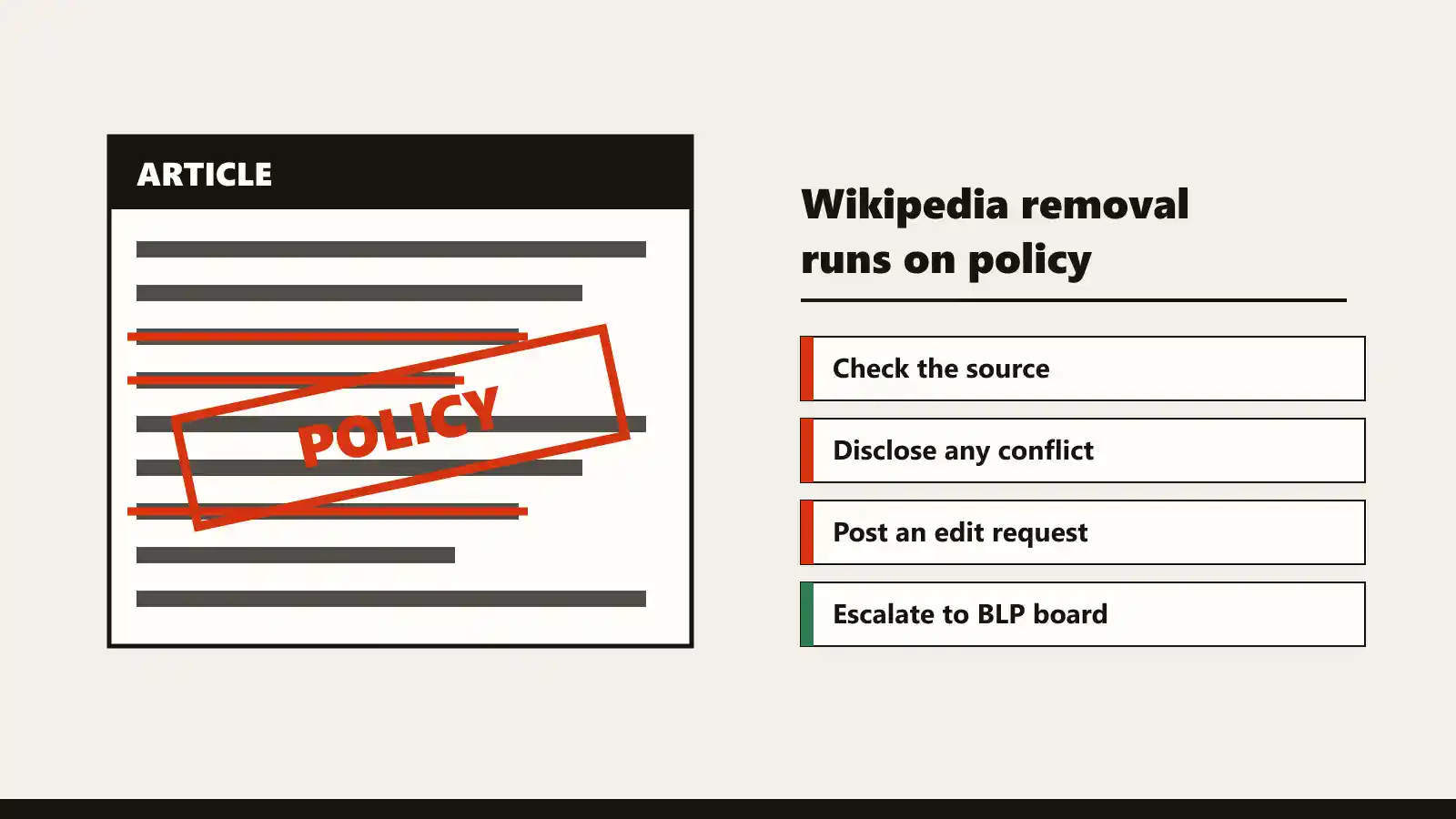
Who decides what stays in a Wikipedia article?
Volunteers do. Not the Wikimedia Foundation, not a paid agency, and not the person the article is about.
Wikipedia is written and policed by an open community of editors who apply a small set of core content policies: verifiability, neutral point of view, no original research and, for anyone alive, the policy on biographies of living persons. Obscura is a UK content-removal practice that handles defamation and takedown work across platforms, and Wikipedia is the one large site where our usual tools matter least. There is no report button that sends a complaint to a moderation queue. Changes are argued on talk pages, judged against sources and settled by consensus, which means content removal from Wikipedia articles succeeds only when the material in question fails one of those policies. A sentence that is unsourced, sourced to a blog, out of date or plainly wrong can go. A sentence that is accurate, cited to a reliable publication and relevant to why the subject is notable will almost always stay, however much it stings.
What Wikipedia will not take out, however hard you push
Start here, because it saves money. Accurate, well-sourced criticism stays. The English Wikipedia's own help page for article subjects says, in effect, that information is not removed because it makes the subject unhappy.
Passing mentions in other articles stay too, unless they are wrong or trivial. Nobody can lock an article to a preferred version, and administrators will not enforce one on your behalf.
Threats make things worse. Wikipedia's no legal threats policy means an editor who threatens to sue on the site is blocked until the threat is withdrawn, so the lawyer's letter belongs with the Foundation, never on a talk page.
Matching the problem to the right door
Every route below exists in written policy. The trick is choosing the one that fits the actual defect in the text.
| Problem in the article | Route | Who decides |
|---|---|---|
| Unsourced or badly sourced negative claim about a living person | Remove under BLP, or raise at the BLP noticeboard | Any editor; noticeboard regulars |
| Factual error, outdated detail, unbalanced section | Talk page edit request with the edit COI template | Uninvolved volunteer editors |
| Home address, phone number, date of birth of a private person | Revision deletion or oversight (suppression) | Administrators; oversighters |
| Whole article on someone with thin coverage | Articles for deletion (AfD) | Community discussion, closed by an administrator |
| Your photo, text or video copied without permission | Copyright notice to the Wikimedia Foundation | Foundation legal staff |
| Serious error the community has not fixed | Email to the Volunteer Response Team | VRT volunteers |
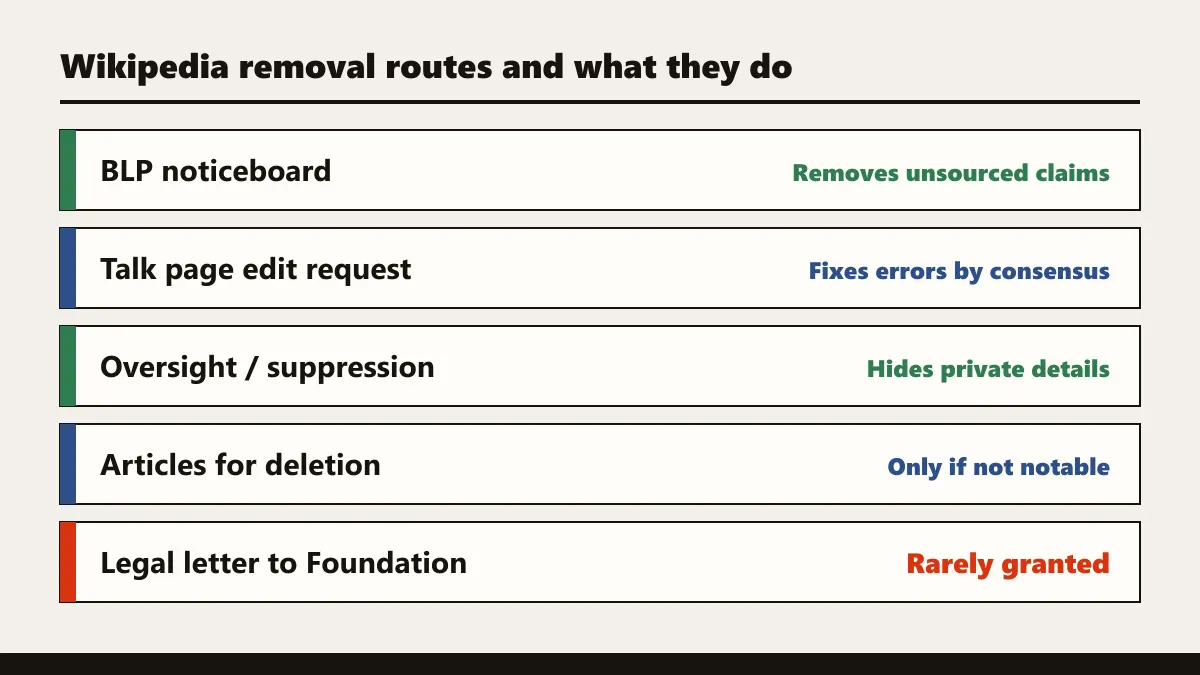
The biographies of living persons policy is the strongest lever most subjects have. It says contentious material about a living person that is unsourced or poorly sourced should be removed immediately, without waiting for discussion. That is unusually blunt language for Wikipedia. If a claim about you rests on a forum post, a self-published site or nothing at all, the policy is on your side, and the Biographies of living persons/Noticeboard is where experienced editors look at exactly that kind of complaint.
How a disclosed edit request actually works
Most useful corrections go through the article's talk page. You or your representative write a short request, place the edit COI template (written in double curly brackets) above it at the bottom of the page, cite the source that supports the change and sign it. A volunteer with no stake then reads it.
Disclosure comes first, and it is not optional. The conflict of interest guideline states that the Wikimedia Foundation requires all paid editing to be disclosed, and the Terms of Use spell out what that means: name the employer, the client and any relevant affiliation, on the user page, the talk page or in edit summaries. Editors with a conflict are strongly discouraged from editing the article directly. The narrow exception is an obvious error in a biography, such as a wrong date or vandalism, which the subject may fix.
When we prepare these requests, the ones that get accepted tend to look boring. One change per request. The exact sentence quoted, the proposed wording beneath it, a reliable independent source linked, no adjectives about the subject. Requests that read like a press release get declined, and the decline is public. Volunteers owe nobody a fast answer, so a request can sit for weeks; the Edit Request Wizard and a polite note at a relevant WikiProject are the honest ways to draw attention to it.
If you want a second pair of eyes on the wording before anything is posted, send Obscura the article link for a confidential review. Obscura does not edit Wikipedia articles covertly; it prepares disclosed edit requests and the evidence behind them, and you decide whether they go up.
Private details and libel buried in the page history
Deleting a sentence from the live article does not delete it from the revision history. Anyone can still click back and read it.
Two tools deal with that. Revision deletion lets an administrator hide the text of particular past revisions from the public, under a short list of criteria that includes blatant copyright violations and grossly insulting or degrading material. Oversight, also called suppression, goes further and hides the revision even from other administrators. Wikipedia's oversight policy reserves it mainly for non-public personal information: home addresses, phone numbers, workplaces, the real identity of a pseudonymous person. Suppression can also cover potentially libellous material, though the policy limits that to clear cases or advice from Foundation counsel. Requests go privately to the oversight team, not onto a public noticeboard, because posting the detail publicly to ask for its removal would defeat the purpose.
This is the closest thing Wikipedia has to the doxxing removal service work we do on forums and people-search sites, and the speed is often better.
Removing the whole article: notability and AfD
An entire article comes down through deletion, and the usual venue is Articles for deletion. Someone nominates the page, editors argue for about a week, and an administrator closes the discussion by weighing the policy arguments made.
The test is notability. Under the general notability guideline, a subject needs significant coverage in reliable sources that are independent of it. Being mentioned in passing, quoted once or listed in a directory is thin. A private individual swept up in one news event can fall short, and the deletion policy lets an administrator take a relatively unknown subject's own request for deletion into account when discussion ends without rough consensus.
What AfD cannot do is erase a genuinely notable person. If national newspapers have covered you at length, a deletion nomination is likely to fail and may draw more editors to the page.
Writing to the Foundation, and what it rarely grants
Wikipedia's help page for article subjects gives an email route, info-en-q@wikimedia.org, for corrections or serious concerns, with "Legal concern" in the subject line for legal matters. Those messages are answered by the Volunteer Response Team, trained volunteers who can fix clear errors or point you to the right venue.
Escalating to the Foundation's lawyers changes less than people expect. Its transparency report for January to June 2026 lists 953 requests to alter or take down content and 2 granted (Wikimedia Foundation Transparency Report, 2026). For concerns about living people, the Foundation says it first directs the requester to experienced volunteers. In other words, it sends defamation complaints back to the community process described above.
Copyright is the clearer exception. If a page uses your photograph or text without permission, a notice to the Foundation under the US DMCA can work, which is the same logic behind copyright infringement video removal on video hosts and a Vimeo content removal service. For ordinary defamation claims, the stronger UK route is usually against the original publisher of the source, a point covered in our note on Quora defamation removal.
Why secret paid edits backfire
Hiring someone to quietly rewrite your article is the most expensive mistake on this list. It breaks the Terms of Use, and editors are good at spotting it.
In 2013 a sockpuppet investigation into the firm Wiki-PR led to more than 250 accounts being blocked, and the community banned the company and its staff from editing; the Foundation's paid-contributions amendment to the Terms of Use followed in June 2014 (Wiki-PR editing scandal). In 2015 the Orangemoody case ended with 381 accounts blocked. Clients in both cases got press coverage they never wanted, and pages touched by banned accounts tend to be reviewed line by line afterwards, often by the editors least inclined to be generous.
Volume does not help either. Wikipedia has no report queue to flood, which is the same reason a Discord mass report tool fails on its own platform and why the honest answer to does report volume ban an account is no on most sites. Readers asking how many reports to ban a Facebook account, or shopping for a ban service for a WhatsApp account, run into the same wall. A rule decides, never a crowd. Whether someone can delete someone's Snapchat account, win back a profile through an Instagram ban removal service, or buy an Instagram handle legitimately all turns on the platform's written terms.
What Obscura can and cannot do with a Wikipedia page
Obscura reads the article against policy first and tells you which sentences have a real route out and which do not. Where a claim is unsourced or the source is weak, we draft the BLP argument or the disclosed edit request. Where private details sit in the history, we prepare the oversight request. Where the page itself is thin, we assess whether an AfD nomination stands up, and say so when it does not.
What we will not do: edit without disclosure, run sockpuppet accounts, threaten editors, or promise an outcome volunteers have not reached. Sourced, accurate content about a notable person cannot be removed, only balanced with other reliable sources or outranked in search by better material, and our disclaimer sets out those limits. The same honesty applies elsewhere: a mugshot removal services buyer, someone trying to flag fake tenant review posts, a client comparing an X tweet removal service or the best services for removing fake websites quickly gets the same answer about what policy allows.
Send the article link. We will tell you which door, if any, is open.