What TruthFinder is, and who actually controls your record
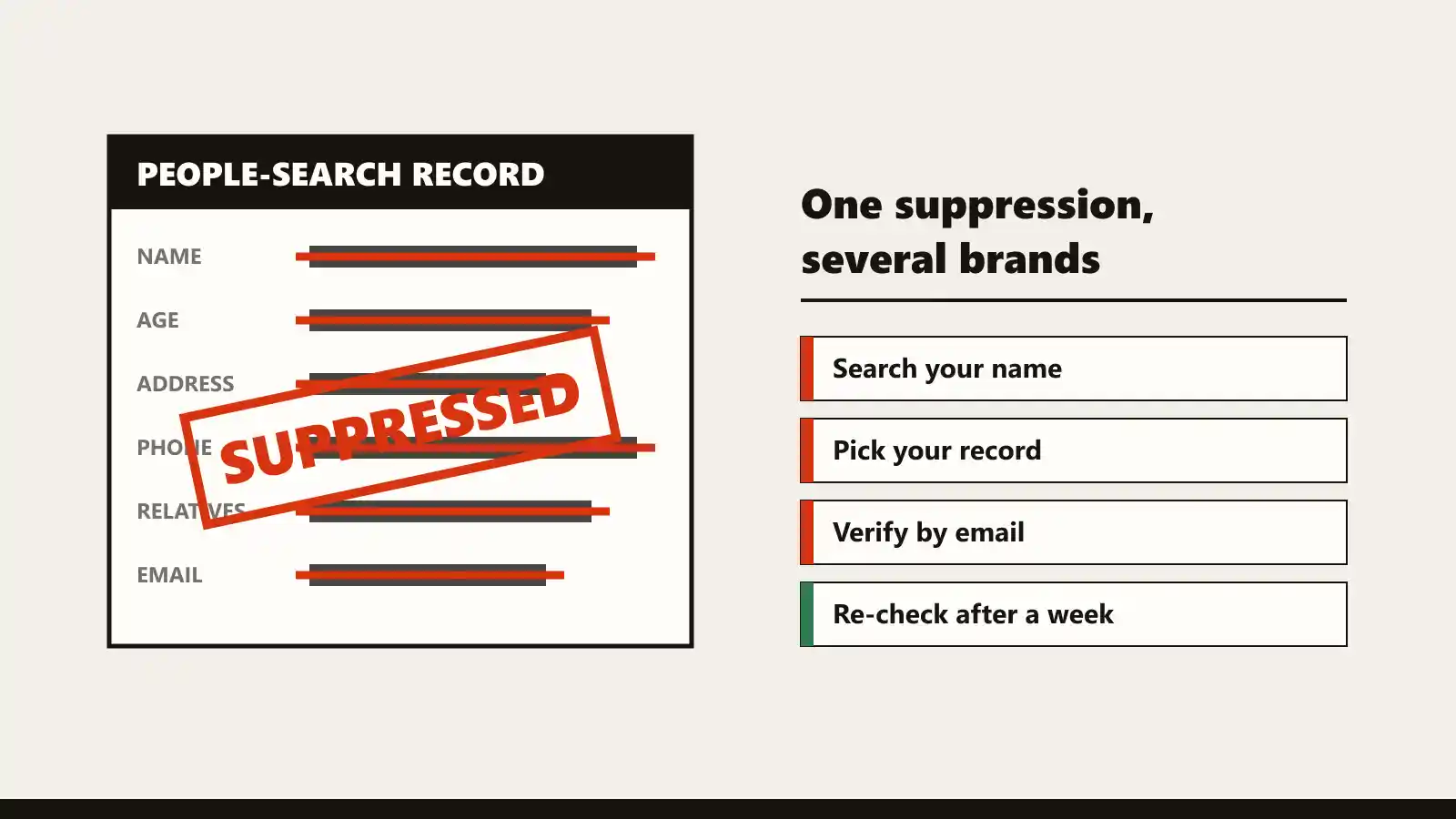
TruthFinder is a US people-search website that compiles public records and other data into background reports searchable by name. It is one brand in the PeopleConnect family, alongside Instant Checkmate, Intelius and US Search, and that ownership is the single most useful fact for anyone working out how to remove personal information from TruthFinder.
The reason is practical. When you open truthfinder.com/opt-out/ today, it forwards you to the PeopleConnect Suppression Center at suppression.peopleconnect.us, which we checked on 12 November 2026. One verified request there governs how your Background Report appears on all four sister sites. You do not file four times.
The tool's own explainer is plain about its scope. It says the Suppression Tool is free, and that a suppressed report "will not be provided" when someone searches you by name. It also lists what it does not touch, and that list is where most opt-out guides go quiet. We cover it below, because knowing the limits is what stops the record from quietly returning.
How do I remove my personal information from TruthFinder, step by step?
You verify an email address, find your record, confirm a one-time code, and set the record to Suppressed. The sequence below follows the Suppression Center screens as described in Optery's 2026 walkthrough and the tool's own first step, which we read directly.
- Go to truthfinder.com/opt-out/ or straight to suppression.peopleconnect.us. Under Free - Start Here, enter your email address, tick the Terms of Use and Privacy Policy box, and press Continue.
- Open the verification email and click its link. Nothing proceeds until you do.
- Enter your date of birth, then your first, middle and last name. You can add another name if records list you under a maiden name or a nickname.
- Pick your record from the matches. Look at the age, past cities and relatives to be sure it is you.
- Ask for a verification code by email or phone and enter it.
- Under Desired Behavior, choose Suppressed, then save.
That is the whole process to remove personal information from TruthFinder by yourself. It costs nothing. Expect a short wait before the change shows; third-party guides report anything from a day to about 72 hours, and PeopleConnect publishes no official figure.
Do it yourself, once, through the official tool. PeopleConnect's own route is free, and every reseller is filing into the same form.
Which page is the truthfinder opt out remove personal information official route?
The official route is the PeopleConnect Suppression Center, and only that. Anyone searching for the truthfinder opt out remove personal information official page wants the same reassurance: that the form they are typing into belongs to the company holding the data, not a lookalike collecting a fresh copy of it.
Three checks settle it. The address bar should read suppression.peopleconnect.us. The page should describe the Suppression Tool as free and name TruthFinder.com, InstantCheckmate.com, Intelius.com and USSearch.com as the covered sites. And it should never ask for payment, a Social Security number, or a copy of your ID for a standard suppression.
There is one separate official channel. The Suppression Center lists a judiciary and protected-person route by email for active or retired judges, law enforcement officers and other covered people in states whose laws let them demand removal. That route asks for the specific law and your protected status, and denials can be appealed to privacy@peopleconnect.us.
Removal services sometimes advertise TruthFinder coverage. DeleteMe's own help pages say PeopleConnect does not honour opt-outs submitted on someone else's behalf, so for this broker you are better off doing it yourself.
What the suppression does not remove
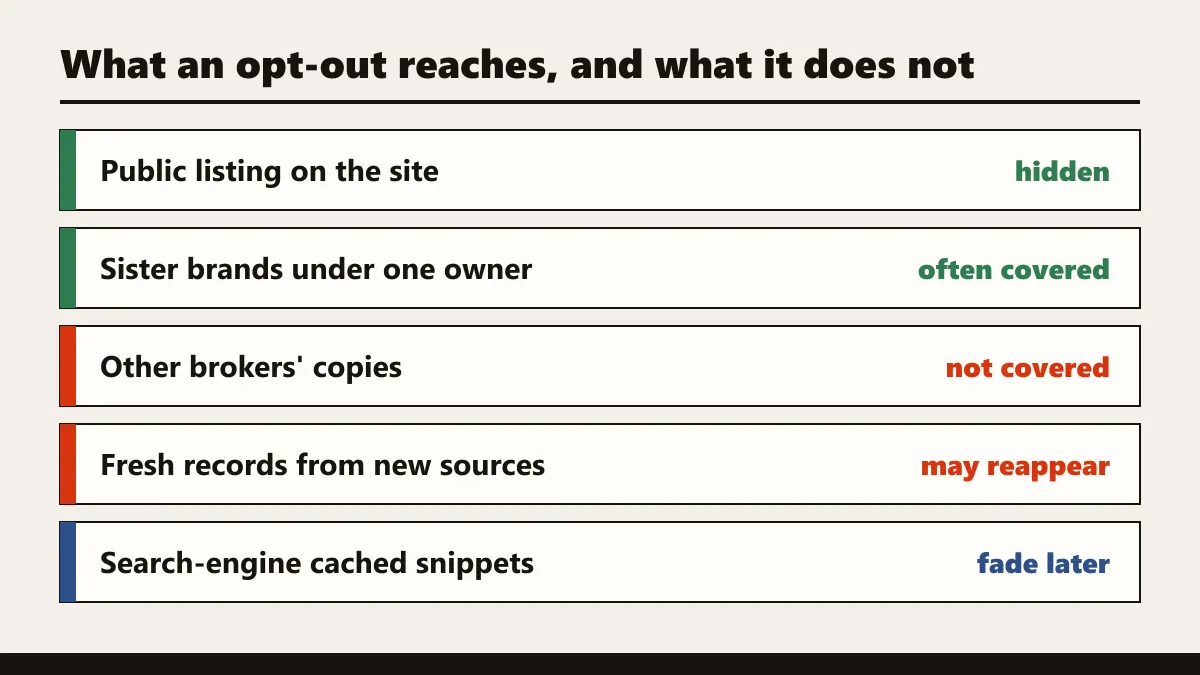
Suppression hides your Background Report from name searches; it is not a promise that the data is deleted. The Suppression Center spells out five limits:
- Search type. Your name and details may still appear in phone, address or email reports, which are searched by those criteria rather than by name.
- User Data. Information the sites collect about their own users is outside the tool.
- Other PeopleConnect sites. Classmates.com is named as not covered.
- The original sources. Courts, county records and other brokers keep their own copies.
- Imperfect matching. Small discrepancies in public-records data can leave fragments behind. PeopleConnect asks you to contact it if Public Data still shows after suppression.
So a full answer to "how to remove personal information from TruthFinder" includes a second pass. A week after suppressing, search your phone number and your address on TruthFinder as well as your name. Note what still appears, and use the contact route for those pieces. Keep a dated note of the email address you used, because returning to the Suppression Center with the same email lets you manage the same rules later rather than starting over.
Is there a stronger option than opting out?
For California residents, yes: the state's Delete Request and Opt-out Platform, known as DROP. It is a free government tool that sends one deletion request to more than 600 registered data brokers at once, according to the California Privacy Protection Agency's DROP page. Since 1 August 2026, brokers must check DROP at least every 45 days and begin processing deletion requests, and status updates can take up to 90 days to appear.
The difference from suppression matters. A DROP request asks brokers to delete, not hide, and to keep deleting your data if they collect it again. Eligibility is limited to California residents, verified through the state's identity gateway.
Readers outside the US have fewer levers here. TruthFinder's records are built from US public data, and UK or EU data-protection rights are hard to enforce against a US broker with no establishment in either. For most UK readers the honest position is that a TruthFinder record only exists if you have lived in the US, and the Suppression Center is still the practical tool.
One footnote on accountability: TruthFinder's terms say it is not a consumer reporting agency, yet in September 2023 its owner agreed a $5.8 million civil penalty with the US Federal Trade Commission over Fair Credit Reporting Act allegations involving TruthFinder and Instant Checkmate (FTC, 2023). The FTC's guidance on people-search sites is a sensible companion read.
How Obscura handles a people-search case, and what it declines
Obscura treats a TruthFinder record as one piece of a wider exposure. When a client brings us a case, we map where the same address and phone number surface, starting with the PeopleConnect sites and then the brokers that copy from the same sources. Where a client has asked us about a BeenVerified removal service or a doxxing thread, the TruthFinder record is usually one entry on a longer list. We then walk the client through the suppression themselves, because PeopleConnect will not accept it from us, and we keep a re-check schedule.
The urgent cases look different. If your address has been posted to harass you, start with the platform: our guide on how to report doxxing on Twitter covers X, and if images are involved the steps to remove leaked photos from internet sites come first. Review-site problems follow their own labels, as with a request to remove fake GreatSchools review listings, and so do impersonating domains, where the question is removing fake websites quickly. Private videos reposted without permission usually need copyright infringement video removal.
What Obscura declines is fixed. We will not ask for your passwords, submit forms in your name where the broker forbids it, or promise that a record stays gone.
Related questions we get alongside TruthFinder
People who come to us about data brokers often arrive with a platform problem too, and the same rule covers all of them: the platform removes content for what it is, not for how loudly it is reported. That is why the honest answer to does YouTube tell you who reported your video is no, why a Discord server takedown service can only file what the rules support, and why the guide on how to get someone's Instagram account deleted starts with the harm, not the headcount. The same applies to general account reporting, to anyone shopping for the best WhatsApp ban service, and to banning someone from a Facebook page or group.
Handle questions are a separate trade. If you plan to buy IG handles, learn how to get an inactive username on Instagram first, and if a fake profile is the problem, read whether anyone can delete someone else's Snapchat account.
Some records cannot be removed because they are genuine public records. Courts and county offices keep their own files, and no opt-out reaches them; those cases call for suppression in search, not removal. Our disclaimer explains those limits, and you can request a confidential review of your exposure before any work begins.