Is there copyright on TikTok?
Yes. People search "is there copyright on tiktok" and "does tiktok have copyright" as though the app ran a private system of its own, but copyright is ordinary law that follows a work onto the app. The US Copyright Office says a work is protected from the moment it is created and fixed in a tangible form, and that registration is generally voluntary. So, are TikTok videos copyrighted? Yours usually is, from the moment you record it, and so is the film clip or track inside it, which may belong to somebody else. TikTok's Help Center copyright page says much the same in platform terms: protection covers expression and not ideas or facts, and posting another person's work without authorisation or a legally valid reason breaks its rules. Keep the two layers apart. TikTok copyright laws, in the loose sense people search for, decide who owns what. TikTok's rules decide what happens to your account.
Blurring those layers produces the myth this page exists to retire: that a notice means you are about to lose the account.
It usually does not. So how does copyright work on TikTok from one notice to the next? A rights owner, or someone authorised to act for them, files a report. TikTok checks that the report is complete and comes from the right person, removes the content if it finds a breach of its Intellectual Property Policy (released 27 March 2025, effective 26 April 2025), and notifies both sides of the action. That policy and the Help Center page are where the working tiktok copyright rules live. People hunting for tiktok copyright guidelines tend to expect one rulebook, but the text is split between those two pages, the Terms of Service and the Community Guidelines.
Searches for "tiktok legal copyright" often mean something narrower: who owns my upload? TikTok's US Terms of Service, last updated 15 July 2026, describe a non-exclusive, worldwide, royalty-free licence to the platform and say you keep the right to use your content elsewhere. That is a licence, and other regions have their own terms.
This page is the receiver's ledger. If your work was the one copied, the other side of the desk is how to report stolen content on TikTok, and the off-platform version is set out in DMCA takedown website vs YouTube.
What is a copyright claim on TikTok, and what lands on your account?
What is a copyright claim on TikTok? It is someone's assertion that a post or sound uses their work without the right to do so. Taken alone, a tik tok copyright claim is a request, and it counts for nothing until TikTok acts on it. The IP transparency report TikTok published on 24 June 2026 shows why that matters. Between July and December 2025 it received 401,471 copyright removal requests, and 253,016 of them (63.0%) ended in a removal, a LIVE closure or an account suspension. Roughly 148,000 did not. As of 5 November 2026 that remains the newest edition on the page; we found no report for the first half of 2026. So does TikTok have copyright claims? Yes, but the word gets stretched over several different events, and each carries a different count. Your first job is to work out which row below you are on, because the answer to "will I be banned?" changes by row.
| Event | What lands on you | Counts toward the copyright three? | Your move |
|---|---|---|---|
| Muted sound | Video stays up, audio gone | TikTok's sound pages do not say so | View details, then change the sound |
| Claim filed | Possibly nothing yet | No, not by itself | Answer the owner if they write |
| Video removed for copyright | In-app notification | Yes, a strike is issued | Appeal, or ask for a retraction |
| Copyright strike | A 90-day record | Yes, this is the count | Check, log, stop reposting |
| Trademark strike | A 90-day record | No, separate count | Treat as its own ledger |
The muted row confuses people most. Under A sound was removed from my video, TikTok says that if you did not add the original sound you will not be notified, though the video shows the reason: tap View details and it reads copyright claim, Community Guidelines violation or both. If you uploaded the sound yourself the position is heavier. Under A sound I added to TikTok was removed, you are notified, every video using that sound is muted, and all of them stay muted while an appeal runs. Neither page mentions strikes. TikTok's strike wording refers to content removed for copyright infringement, so we would not tell you a muted sound adds one, and we would not promise you it cannot.
One more practical point. TikTok says a removal notice reaches you as an in-app notification, so an email or direct message claiming a copyright strike and asking for your password or a fee sits outside that flow. Open the app and look. If the link led to a lookalike login page, you are dealing with phishing, which is the territory of a malicious domain takedown, and has nothing to do with copyright.
How many copyright strikes are allowed on TikTok?
Two can sit on an account, and the third brings a permanent ban. That is the practical answer to how many copyright strikes on TikTok, and it comes from the worked example on the Help Center copyright page, read on 5 November 2026: 2 copyright strikes plus 2 trademark strikes is no ban, while 3 copyright strikes plus 1 trademark strike is a ban. TikTok issues a strike when content is removed for copyright infringement. Several reports leading to removal within a short period may be counted as a single strike, so a burst can land as one, although "may" is no promise. Accrued strikes expire from your record after 90 days, and TikTok may also remove a strike if the report is retracted or your appeal is approved. Two things are left unsaid. The page does not define a short period, and it does not say whether each copyright strike on TikTok runs its own 90-day clock.
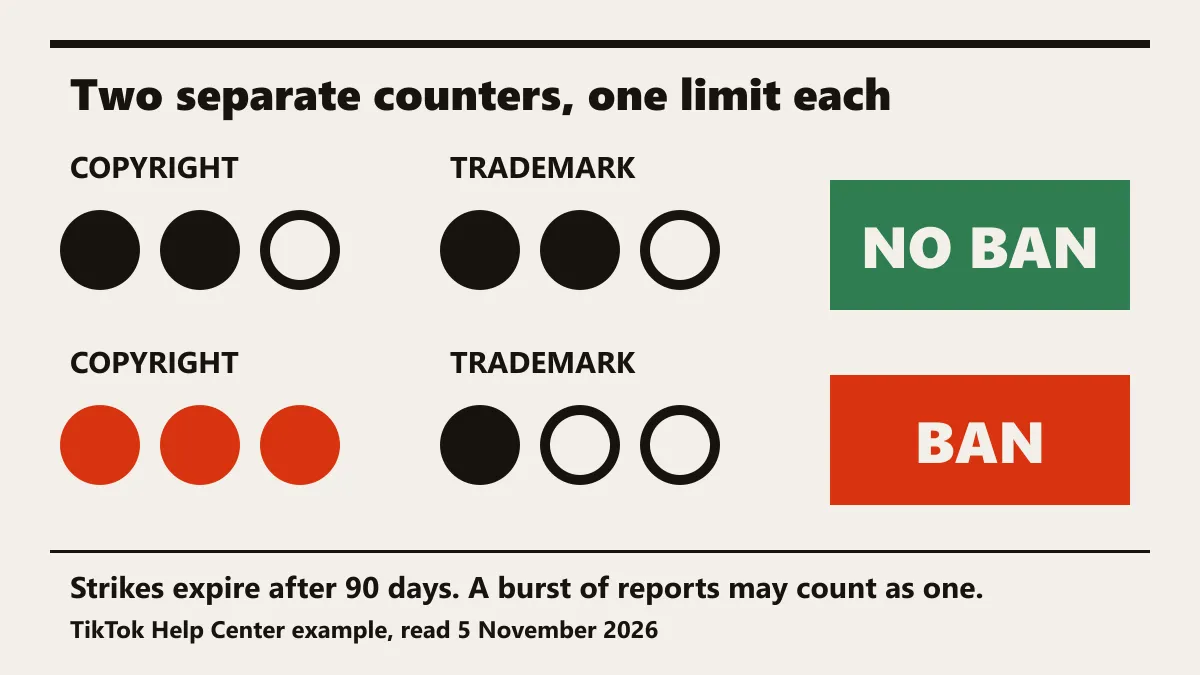
Does TikTok have copyright strikes as a formal mechanism? Yes, and the IP Policy calls it a repeat infringer policy. Three is not the only door to a tiktok copyright ban, though. The IP Policy reserves discretion to ban immediately for severe copyright violations, and the Help Center adds that any account can go for a Community Guidelines violation regardless of strikes. TikTok's report for the second half of 2025 describes its permanent bans as about 10% from repeat violations and about 90% immediate bans for severe ones. It logged 180,695 enforcement actions against accounts across all IP types in that period. Infringement during a LIVE may also cost you temporary access to the LIVE feature.
Where do you check? TikTok documents two paths on its account status page: Profile, Menu, TikTok Studio, More tools, Account check; or Profile, Menu, Settings and privacy, Support, Safety Center, Account check. Older guides call it Account status, and TikTok's help page still uses that heading.
Read that page closely, because it promises less than people assume.
It lists restrictions on login, posts, comments, profile and direct messages, each with a checkmark or a warning sign. It does not promise a running tally of copyright strikes, and we have not seen the screen on an account carrying one. So keep your own log: date, post, reason, and whether you appealed. The violations page gives the path for past notices (Inbox, System notifications, Account updates) and describes four status labels, Healthy, Fair, Severe and Banned, that reflect violations over the last 90 days.
Can a rival simply pile on? Volume is not the mechanism here, for the same reason how many reports it takes to get banned on Instagram has no number attached. A strike follows a copyright removal, and a valid report has to come from an owner or authorised representative. Anyone asking can you get someone banned on TikTok by flooding it, or eyeing a TikTok report bot, is on the wrong track. The ordinary ways to report a TikTok account, video, LIVE or comment under safety headings are judged under different rules, and how to get someone's TikTok banned has its own answer, one this ledger does not change.
Keep the counts in their own columns, too. A logo dispute feeds the trademark side, the same fork that divides an Instagram impersonation report from a copyright form. And nothing carries across services: a Vimeo copyright strike and how long YouTube strikes last are separate questions, an Imgur copyright takedown request or a Telegram copyright infringement complaint has a different reach, and being trade banned on Steam is decided under Steam's own rules.
When do an appeal and fair use actually apply?
An appeal applies when you can show a right to use the content: you own it, you hold a licence or permission, or a legal exception covers the use. The IP Policy accepts that not every unauthorised use infringes, and names fair use in the United States and fair dealing in the EU. Neither is a box you tick. The US Copyright Office says fair use turns on four factors, case by case, with no formula fixing a safe amount to take. For UK posters, GOV.UK's guidance on exceptions says fair dealing has no statutory definition and asks how a fair-minded and honest person would have dealt with the work. TikTok also lists five appeal reasons it generally rejects without valid supporting evidence: only a small portion was copied; other people post similar content; you do not claim to own the copyright; you did not know the rule; and freedom of speech. Crediting the creator alone does not appear on any list of defences we read.
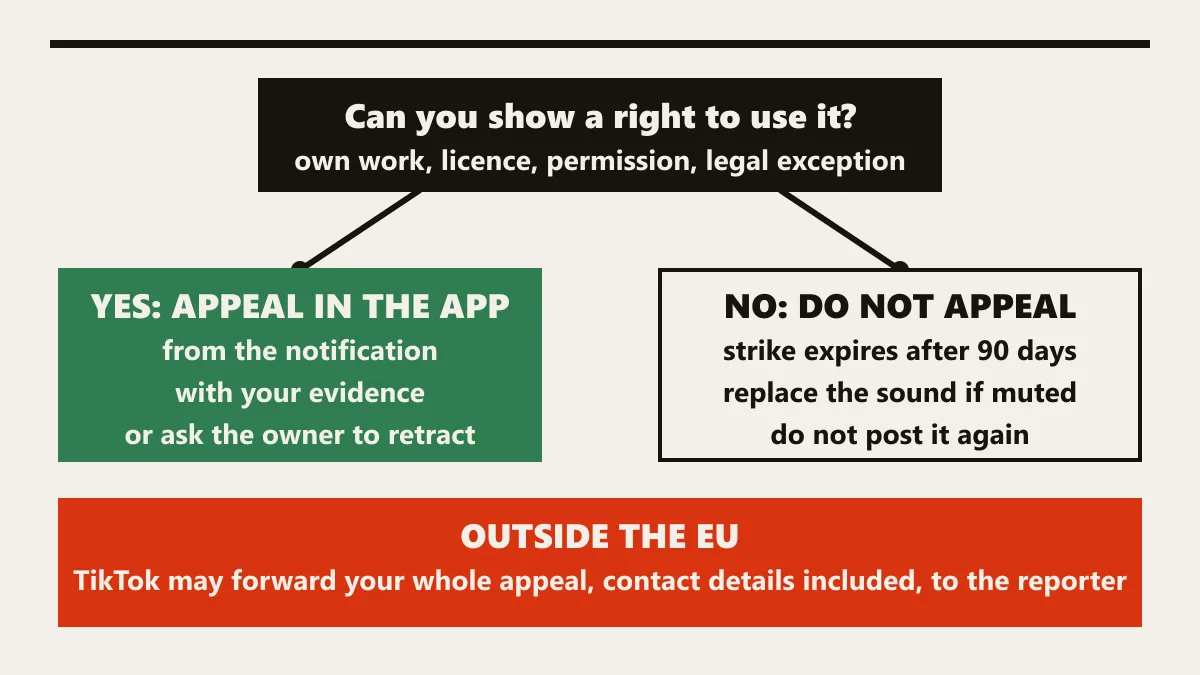
If you have a real basis, the sequence is short:
- Open the in-app notification now. The IP Policy warns that removed content is deleted after a period, and after that it cannot be reinstated.
- Write your basis in one sentence, then gather the proof: raw footage or project files, the licence, the written permission.
- Consider asking the rights owner for a retraction. The policy suggests this to users outside the EU, and a retraction may remove the strike.
- File the appeal from the notification, with your contact details and evidence. Incomplete appeals may be denied.
- Wait without reposting. If the appeal is approved, the content comes back and the strike may go; TikTok calls reinstatement its sole discretion.
Step 4 has a sting for anyone outside the EU. TikTok says it may forward your entire appeal, contact information included, to the original reporter, who may use it to file a lawsuit. Under the US process, the Copyright Office's section 512 summary describes restoration after ten to fourteen business days unless the sender reports a court action. TikTok's own pages give no clock.
Be careful with the published numbers. TikTok reports an appeal success rate of 0.98% for the second half of 2025, and it is tempting to read that as 0.98% of appeals winning. It is not. The report defines the figure as reversals relative to all reactive content removals, and its data file gives no count of appeals filed, so your odds cannot be worked out from it. Nor can they from its line that original decisions were correct in more than 89% of cases, since the page shows no working.
Reposting is not an appeal. The IP Policy lets a rights owner ask TikTok to stop future copies of a removed video, and we give no advice on getting a file past matching, in any form.
What can't be undone, and when do you need a lawyer?
Some notices are simply correct, and no appeal, agency or letter should pretend otherwise. If you used someone's work without a right to it, the honest course is to take the strike, replace the sound or stop posting the clip, and let the 90 days run. Obscura reads a notice the way this page does: which row of the ledger it sits on, what the in-app wording says, and what evidence of a right exists. Where an appeal has a real basis, Obscura helps you set out the facts so that you can file from your own app. Where it has none, we say so. We never ask for your password, we do not need access to your account, we do not forge or bluff notices in either direction, and we cannot promise any outcome. The same honesty applies beyond TikTok: truthful journalism, public records and protected opinion cannot be removed, only suppressed by pushing them down the results, as our disclaimer explains.
If you hold a notice and cannot tell which row you are on, you can send it to Obscura for a confidential review before you decide anything.
Get a lawyer, not an agency, in these situations. The claimant has threatened or started legal action. You are about to rely on fair use or fair dealing for a commercial post. Ads or TikTok Shop are involved, since the Help Center says those have dedicated IP teams and its page mainly covers user-generated content. A licence is genuinely in dispute, or the account is a business asset you cannot afford to lose. And think twice before an appeal hands your contact details to the other side. This page is general information, not legal advice.
A last word for anyone reading this with a rival in mind. A copyright report needs ownership or authorisation, and the IP Policy says an intentionally misleading or fraudulent one will be denied and may lead to liability for damages under section 512(f) of the DMCA. Volume does not decide the outcome, it can backfire on the person filing, and Obscura declines that work.