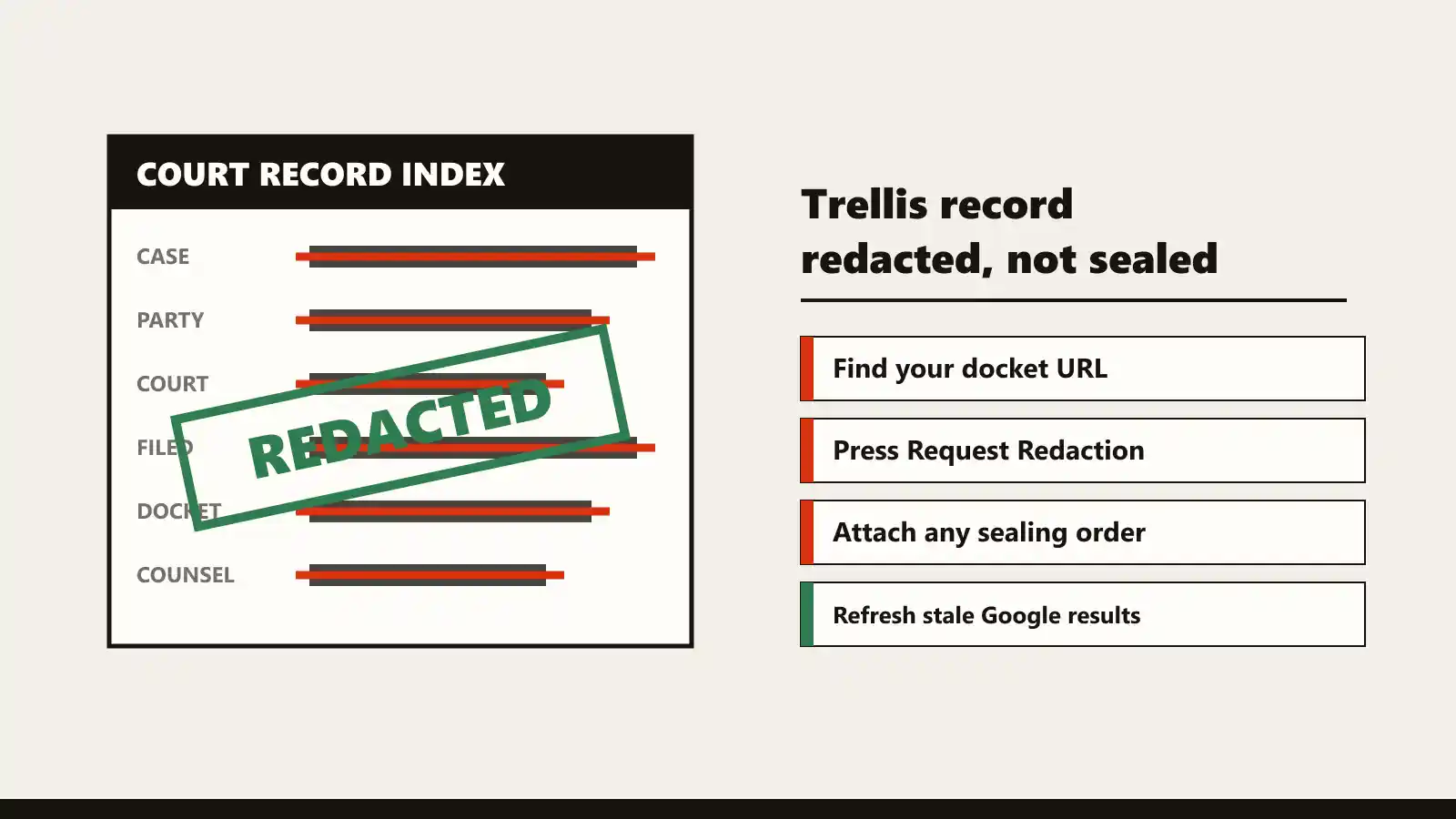
Is Trellis a data broker, or a window onto the court file?
Mostly the second. Trellis (trellis.law) is a legal research platform that collects state trial-court dockets and filings, makes them searchable by party name, and sells analytics on judges, lawyers and case outcomes to the legal profession. It does not build background reports from credit headers or phone records the way a people-search site does. What it publishes is the court's own paperwork, re-indexed so that a Google search for your name can land on a docket page.
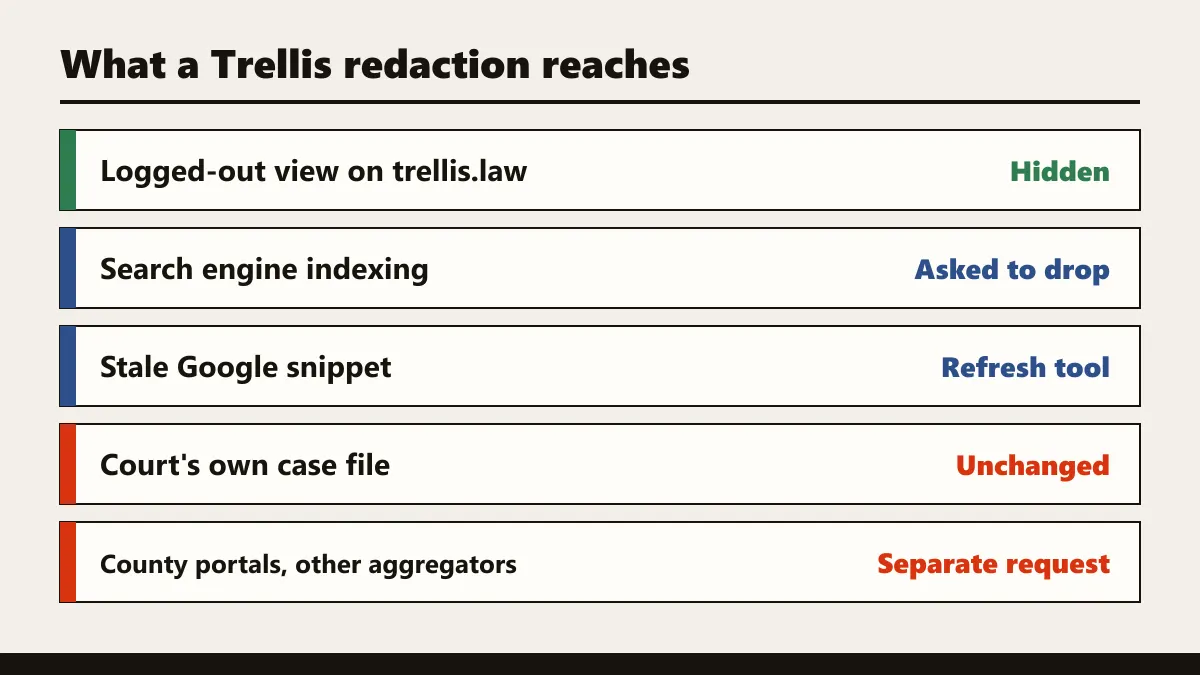
That distinction decides everything about a trellis law remove personal information opt out request. Obscura reads every Trellis case as two separate objects: the copy on trellis.law, which Trellis controls, and the original file at the courthouse, which only a judge controls. Most people who search for an opt-out want the first one gone and assume the second will follow. It does not.
Trellis says so itself. Its support page states that "all data on our site is a matter of public record" and that only a court order sealing the record removes it from the public record. So the honest plan has three parts, run in this order: ask Trellis to redact its page, ask the court to seal or expunge if you qualify, and clean up whatever Google still remembers.
How the Request Redaction form works, one URL at a time
You press a button on the exact docket page you want hidden, fill in a short form, and wait. There is no account to create and no fee.
The steps below follow Trellis's own support article on redaction requests, which we read on 14 November 2026:
- Search your name or case number at trellis.law/search and open the docket page.
- Find the "Request Redaction" button at the bottom right of that page. The request has to start from the URL you want hidden.
- Complete the "Request to Redact/Remove Records" form: your name, your email, whether the record is about you, and why you want it redacted.
- Upload a court order sealing the record, if you have one.
- Repeat for every other Trellis URL that names you. Each one needs its own submission.
Requests are worked in the order received, Trellis says, and it and emails you once access is limited. When a request succeeds, logged-out visitors can no longer open the page, and Trellis asks search engines not to index it. Emailed requests are not processed, and Trellis says it never charges for redaction, which is worth remembering when a site offers to "file it for you" for a fee.
Write the reason box carefully. Trellis calls redaction a courtesy and says it has no legal obligation to redact without a sealing order. A one-line "please remove this" gives the reviewer nothing to weigh. A specific harm does: a dismissed case that keeps surfacing in tenancy checks, a safety concern backed by a police report, an identity mix-up with someone who shares your name. The Discoverability Company's guide to Trellis removal makes the same point and reports a review time of at least 48 hours, with Google taking four to six weeks to catch up; Trellis itself publishes no turnaround.
If you would rather have someone check the docket list and draft the reason with you, you can ask Obscura for a confidential review before anything is filed.
Why a privacy-law request rarely reaches a court record
Plenty of opt-out guides tell you to send a CCPA deletion request to every site holding your name. With Trellis that usually misses. California's privacy statute excludes "publicly available" information from its definition of personal information, and the first category it lists is information lawfully made available from federal, state or local government records (Cal. Civ. Code §1798.140). Court dockets sit squarely in that category. A deletion request may still cover account data if you ever signed up for Trellis, but the docket page is a different matter.
Two other dead ends come up often. Data-broker suppression services, the kind sold as a personal information removal service, mostly target people-search sites and may not touch legal research platforms at all. And reporting the page as abusive gets nowhere, because nothing on it breaks a rule. A court index is not a social network; complaints, however many, do not change what a docket is.
That is the gap between removal and pressure. Courts, data brokers and platforms each decide under their own rules, and none of them counts heads. The same logic explains does report volume ban an account questions on social apps, why anyone asking is using a ban service against WhatsApp rules usually finds the answer is yes, and why the honest comparison of free reporting vs paid ban service offers favours the free, accurate report. Volume persuades no reviewer, at Meta or at a courthouse.
Sealing or expungement: the only route that changes the court file
A sealing order or an expungement is what actually takes a case out of public view. It is granted by the court that heard the case, under that state's rules, and once you have it every downstream copy has a reason to follow.
Trellis points readers to the sealing rules in four large states, among them California Rules of Court 2.551(b), Texas Rule of Civil Procedure 76a and New York's Uniform Rules section 216.1, plus the Florida equivalent. The standards are demanding. Courts start from a presumption that records are open, and a party usually has to show an overriding interest that outweighs it. Expungement is a separate, mostly criminal-side remedy with its own eligibility windows, and it varies more than sealing does from state to state.
Once an order exists, upload it through the same Request Redaction form. Trellis says a sealing order lets it process the request immediately, and it treats a sealed case still visible on its site as an error to report.
We are not a law firm, and this is the step where a local lawyer earns the fee. Obscura can map every place the case appears so the motion and the clean-up afterwards cover the same list, but the motion itself belongs with counsel licensed in that state.
Clearing what Google still shows after Trellis acts
Trellis controls trellis.law. It does not control Google, Bing or the snippets they cached last month, and its support page says as much.
After the page is redacted, a Google result can linger with an old title and description. Google's Refresh Outdated Content tool exists for exactly this: you submit the URL of a page that has been removed or changed, and Google re-checks it. If the snippet shows your phone number, home address or email, the separate Results about you process can ask Google to drop the result. Google is candid that an approved request "doesn't mean that the info is gone from the internet." It only changes what Search shows.
Mirrors are the other loose end. Trellis is one of several legal aggregators, and county portals publish the same docket. Each one has its own process, so a single redaction rarely clears a name search on its own. Search your full name in quotes, then with the county, then with the case number, and keep a dated list of every URL that appears.
What removal is not, and what Obscura will and will not do
Some readers arrive here from a very different problem. A court docket is handled by the court and by the sites that copy it. A defamatory post is handled under defamation law or platform policy, which is why defamatory tweet removal follows its own route. Intimate images shared without consent go to hash-matching and a takedown service for leaked images, not to an opt-out form, and photos used to threaten someone are usually a DMCA image takedown plus a police report. A false review is a moderation question, so the steps to remove fake review RateMDs entries look nothing like sealing. Neither does a cloned domain, where the job is a fake website takedown through the host and registrar.
Platform accounts are their own world again. Video privacy complaints have a dedicated form, covered in our note on how to report a YouTube video for privacy. Group admins already hold the tool they need, which our guide on how to ban someone from a Facebook group shows. A profile impersonating you calls for a Snapchat public profile takedown request, and the honest version of how to get someones account deleted on Instagram starts with a specific rule broken. Handle disputes are different again: any Instagram handle broker is selling a transfer Instagram may not honour, and whether you can you claim an inactive username on Instagram depends on its own rules, not on anyone's request.
Back to Trellis. Obscura will check which of your dockets are indexed, help you write a reason that a reviewer can act on, track the Google clean-up, and tell you plainly when only a court order will do. We will not ask for your passwords, file anything in your name without your sign-off, or promise that a genuine public record disappears. Truthful court records can be hidden from a site or pushed down in search; they cannot be wished out of the courthouse. Our disclaimer sets out those limits in full.