The short answer: is doxxing a felony?
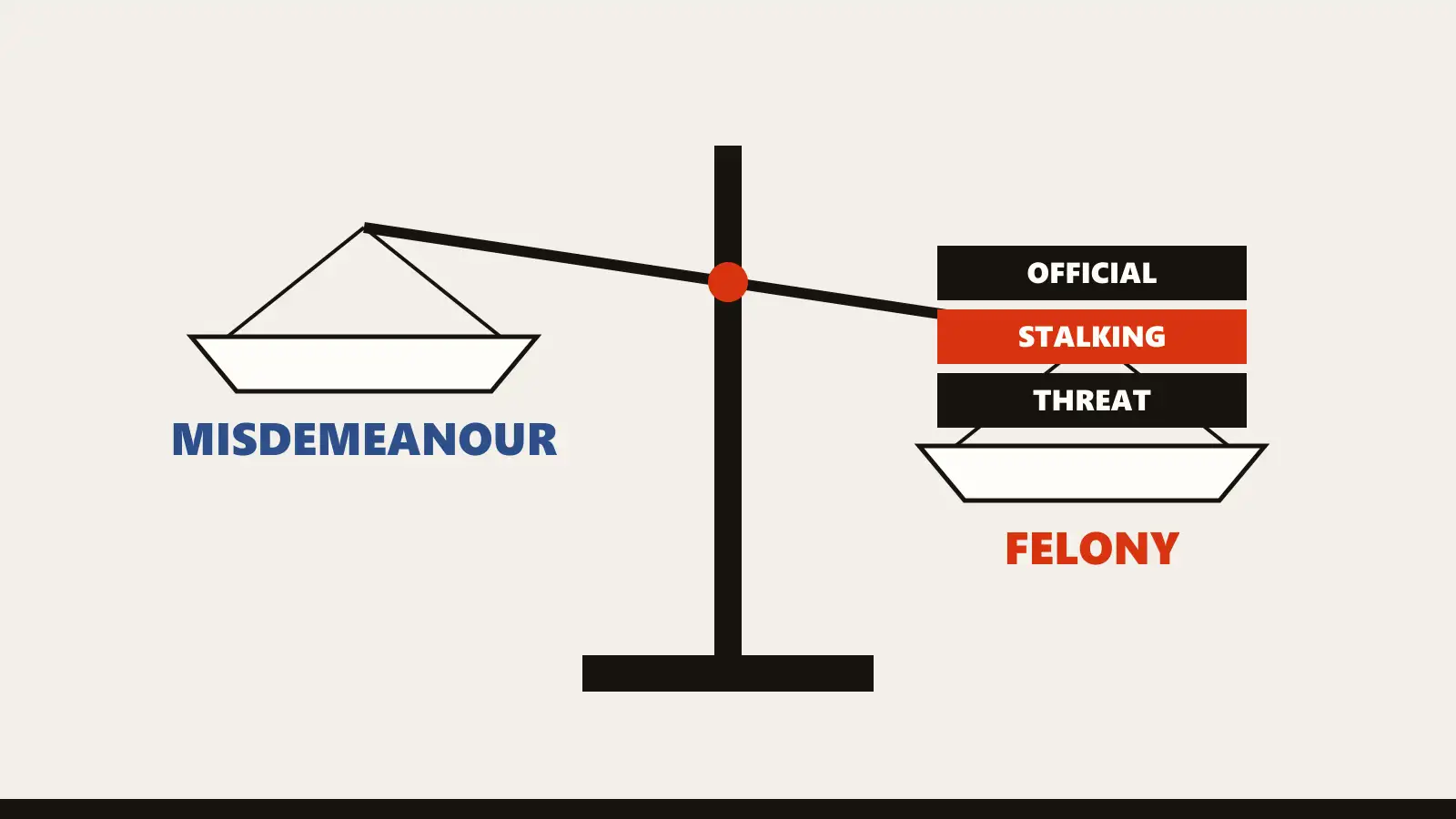
Usually not by itself. Doxxing becomes a felony when it is part of stalking, carries a threat, or targets a protected person.
Is doxxing a felony in the United States? There is no single answer, because there is no single doxxing law. Publishing someone's address or phone number is, on its own, often lawful, and where a state has written a specific doxxing statute it is most often a misdemeanour. California's Penal Code 653.2 is the clearest example: up to a year in county jail. The picture changes when the post is one step in something larger. A course of conduct that puts a person in fear can be charged as stalking, and stalking is a felony in many states and under federal law. A post that contains a true threat can be charged as a threat offence. A post that exposes a judge, a federal officer or a juror can fall under statutes written for exactly that. So the honest answer to "is doxxing someone a felony" is: it depends on what the poster did around the post, not on the post alone.
This guide is information, not legal advice; read our disclaimer and speak to a criminal lawyer in your state before acting on it.
What crime is doxxing, legally?
Doxxing is a description, not a crime name. Prosecutors charge it under whichever statute fits the facts.
People ask what crime is doxxing because the word appears in news reports but rarely in a charge sheet. When someone is arrested for doxxing, the paperwork usually names harassment, stalking, threats, or a specific disclosure statute. Criminal doxxing, in other words, is doxxing plus one of the elements those laws require: intent to cause fear, a pattern of conduct, a threat, or a protected victim. Without one of those, posting a fact that is already public is generally protected speech. That is why a reporter can print a company director's business address and a harasser who posts the same director's home address with "you know what to do" can face doxxing criminal charges. The difference sits in intent and context, which is what investigators look for in screenshots, earlier messages and what followers did next. If the poster also set up a fake profile to do it, the reporting route in our guide on how to remove a fake X account or report doxxing on Twitter runs alongside any police report.
When doxxing is a misdemeanour, and when it is a felony
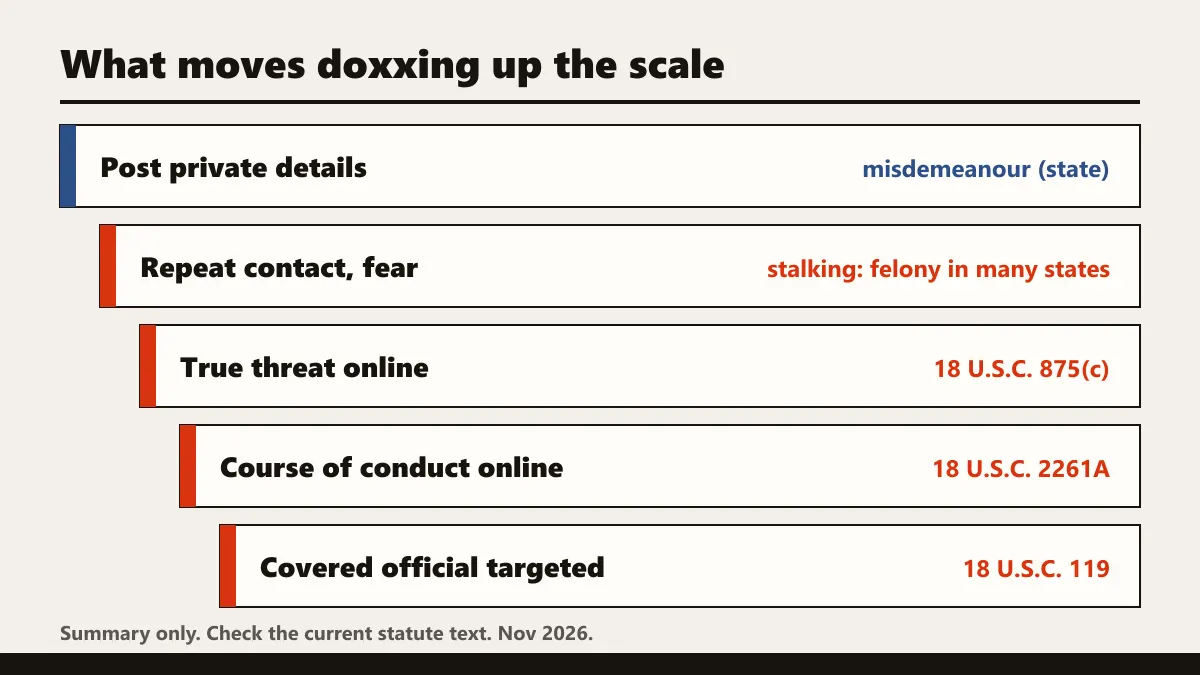
The default is misdemeanour. Four things push it up the scale.
| Situation | Typical charge | Usual grade |
|---|---|---|
| Posting private details with intent to frighten, one-off | state doxxing or harassment statute | misdemeanour |
| Doxxing as part of repeated contact that causes fear | state stalking law | felony in many states |
| Doxxing across state lines or online, with intent to harass | 18 U.S.C. 2261A | federal felony |
| Post containing a true threat sent across state lines | 18 U.S.C. 875(c) | federal felony |
| Publishing a covered federal officer's or juror's details to threaten | 18 U.S.C. 119 | federal felony |
| Posting a public servant's address in Texas with intent to harm | Texas Penal Code 36.06 | generally a felony |
The table is a summary; grades and wording change, so check the current text of each statute.
What elevates doxxing charges to a felony
The first lever is a course of conduct. One post is an incident; a post followed by messages, a visit, and another post is a pattern, and stalking statutes are built around patterns. The second is a true threat, a statement a reasonable person would read as a serious intent to cause harm. The third is the target: judges, officers, jurors, witnesses and, in some states, health workers and election staff are covered by their own statutes. The fourth is the interstate element, which is easy to meet online and opens federal jurisdiction. Doxxing charges that start as a misdemeanour can be refiled as a felony when any of these appears. That is also why the same platform report that gets a post down can matter later; we cover how platforms weigh reports in how many reports to get banned on IG, where strikes decide it.
Federal law: where criminal doxxing becomes a federal felony
There is no federal statute called doxxing. Three federal laws do most of the work.
The federal stalking statute, 18 U.S.C. 2261A, covers using the internet or any interstate facility, with intent to harass or intimidate, in a course of conduct that places a person in reasonable fear of death or serious injury, or causes substantial emotional distress. Under 18 U.S.C. 2261(b), the base penalty is up to five years in prison, with higher maximums where the conduct causes serious injury. The interstate threats statute, 18 U.S.C. 875(c), punishes transmitting a threat to injure someone across state lines with up to five years. And 18 U.S.C. 119 makes it a crime to publish the restricted personal information of a covered person, such as a federal officer, juror, witness or informant, with intent to threaten, intimidate or incite violence against them, again with up to five years. The Department of Justice prosecutes cyberstalking under these provisions.
So a doxxing criminal offence at federal level is almost always charged as stalking, threats or section 119, and each is a felony.
State law: misdemeanour by default, felony with aggravators
States differ more than people expect. A few examples show the range.
California treats doxxing under Penal Code 653.2 as a misdemeanour, with up to a year in county jail and a fine of up to $1,000, while stalking under Penal Code 646.9 can be charged as a felony. Texas has a disclosure offence for addresses and phone numbers and a separate public-servant offence, Penal Code 36.06, which is generally graded as a felony. Other states have added civil claims or protections for specific groups such as health workers or election officials, and those laws are amended often, so we do not list penalties we cannot check against the current code. Our state guides on whether doxxing is illegal in California and whether doxxing is illegal in Texas go section by section.
The pattern across states is the same: the disclosure on its own sits low; stalking, threats and protected targets sit high.
Doxxing penalty and doxxing punishment: what courts actually impose
Maximums are not sentences. Most first doxxing cases end well below the ceiling.
The doxxing penalty written into a statute is the top of a range. What a court imposes depends on prior record, the harm done, whether the poster complied with a protective order, and plea negotiations. A doxxing punishment for a first misdemeanour often means probation, a fine, a no-contact order and, sometimes, an order to take posts down. Felony stalking or threat convictions carry real prison exposure. So when people ask what is the penalty for doxxing, or what is the punishment for doxxing, the useful answer is two numbers: the statutory maximum, and what is common in that court for that fact pattern, which only a local lawyer can tell you.
Doxxing crime punishment beyond jail
The doxxing crime punishment is not only jail. A conviction can bring a criminal record, a restraining order, loss of a job that requires a clean record, and immigration problems for non-citizens. Civil exposure sits on top: in California, Civil Code 1708.89 lets victims sue for damages. Those consequences of doxxing often outlast the sentence. For victims, none of this removes the post; that still takes a platform report or a court order, the same routes we describe for 4chan doxxing removal and BeenVerified removal.
Doxxing jail time: how much jail time for doxxing?
Misdemeanour cases cap at about a year in most states. Federal felonies start at five years maximum.
Doxxing jail time depends on which law is used. For a state misdemeanour such as California's 653.2, jail time for doxxing tops out at one year, and many first offenders serve none. For state felony stalking, ranges vary by state and by aggravating factors. For federal charges under 2261A, 875(c) or 119, the base maximum is five years. That is the factual answer to how much jail time for doxxing, how long can you go to jail for doxxing, and how long do you go to jail for doxxing: the ceiling is set by the charge, and the actual term by the judge.
How many years in prison for doxxing?
How many years in prison for doxxing turns on the federal and state felony routes. Five years is the base federal maximum for stalking and threats; the stalking statute's maximum rises where the conduct leads to serious bodily injury or death. We do not quote average sentences, because no reliable dataset tracks doxxing as its own category. The doxxing sentence in any real case also depends on the sentencing guidelines and the judge, so treat any single figure you see online with caution. If you want to know what is the sentence for doxxing in your situation, ask a defence or victims' lawyer in that jurisdiction.
Can you go to jail for doxxing someone?
Yes. Can you go to jail for doxxing? Where the posting meets a criminal statute, yes, including for a misdemeanour.
Can you go to jail for doxxing someone who annoyed you online, once, with a fact already public? Usually not, though platforms may still ban the account. Can you go to jail for doxxing a person while threatening them, or as part of a campaign? Yes, and that is where the felony routes above apply. The same logic answers the question "can you get in trouble for doxxing someone?": trouble starts well before jail, with account bans, civil suits and protective orders. The moderation side is covered in pieces such as whether reporting a YouTube video does anything, and who knows and how to report a Grindr account or a Pinterest account.
Can you be arrested for doxxing?
Yes, when police have probable cause for a specific offence. Can doxxing get you arrested without a threat? Sometimes, under state disclosure laws.
Can you be arrested for doxxing that happened entirely online? Yes; arrests for harassment and stalking based on posts and messages are routine. Can you get arrested for doxxing someone in another state? Federal agents can act under 2261A, and state police can work across borders with warrants. People who search "can u get arrested for doxxing" or "can u go to jail for doxxing" usually want to know whether a single post is enough. One post with intent to frighten can be, in states with a specific statute. One post with no intent and no threat usually is not.
What to do if you have been doxxed
Save evidence, report to the platform, then report to police if there is a threat.
Screenshot the post with the URL, date and account name, and save the page before it is deleted. Report it to the platform under its privacy or doxxing policy; most major networks remove home addresses and phone numbers posted without consent. If there is a threat, or the person keeps coming back, report to local police and, for cross-state or federal matters, to the FBI at tips.fbi.gov. Group admins can act faster than the platform; see basic Facebook: how to ban someone from a page or group. Where the attacker has built a fake site to host your details, the options in the best services for removing fake websites quickly apply, and where intimate images are involved, see blackmail image removal service or video copyright removal.
Where removal fits next to the criminal case
A charge punishes the poster. It does not delete anything. Removal is a separate track.
That separation is the part victims most often miss. A prosecutor may take months; the post can be copied in hours. Copyright can help where the doxxer reused your photos, through routes similar to a GitHub DMCA takedown service and the YouTube strike clock or a TikTok copyright claim or strike. Art and portfolio sites have their own processes, covered in account reporting for an art thief's DeviantArt account.
Be wary of anyone selling instant bans. Paid "mass report" schemes break platform rules and can create liability for you; we explain why in our pieces on a Discord mass report tool or mass reporter, a ban service for a WhatsApp account, and whether you can delete someone else's Snapchat account. The same goes for handle disputes, where doxxing is sometimes used as leverage; see buying an Instagram handle and how handle sales work.
If your details are still online, you can contact Obscura with the URLs and your evidence file, and we will tell you which removal routes apply.