You searched your own name. Now what?
Most people arrive at this question the same way: a name search, a result on page one that should not be there, and a sinking feeling.
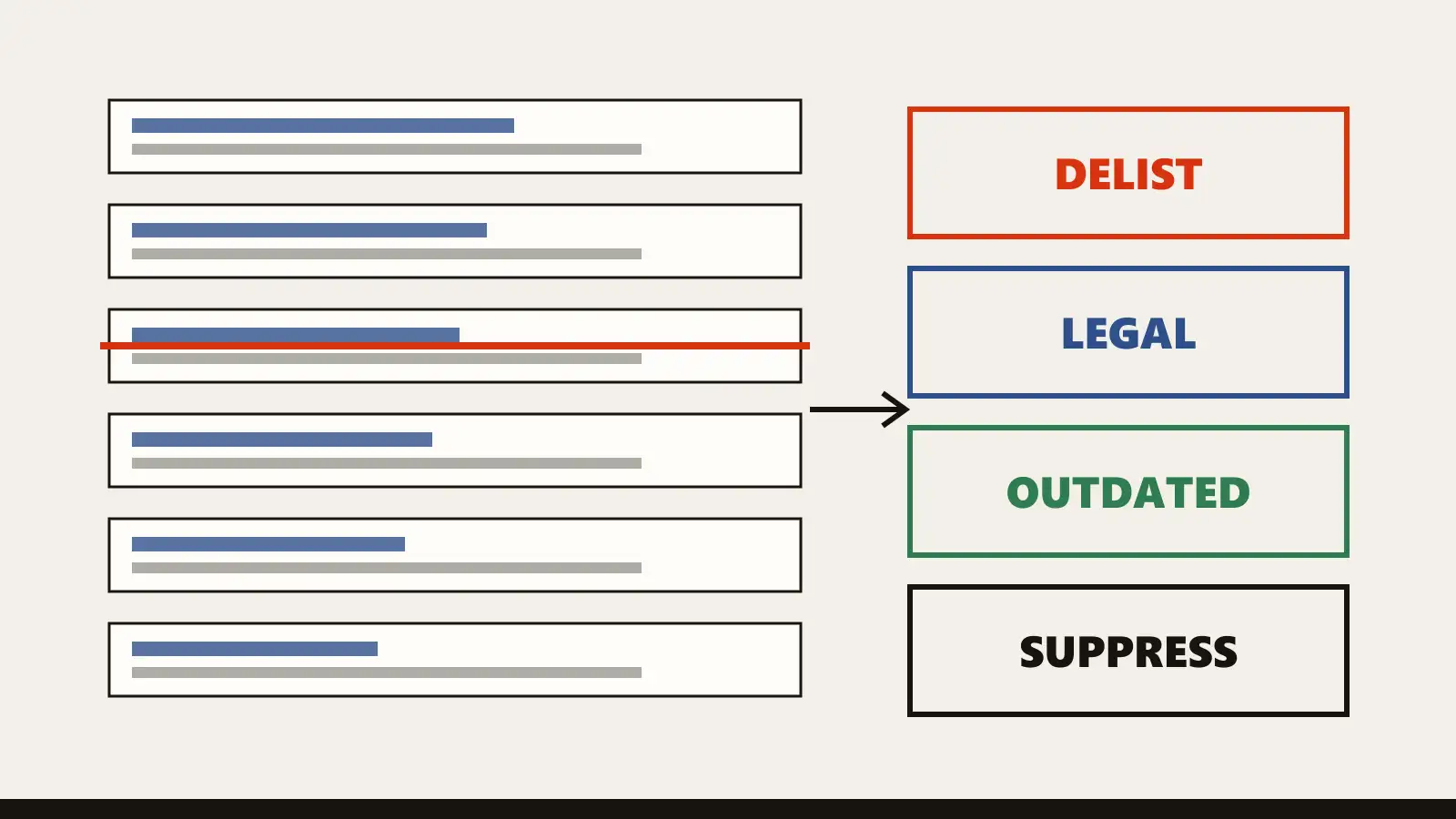
The instinct is to look for one button that makes it vanish. There is no such button, and the reason matters more than any tip. Google does not host the pages it lists; it indexes them. That splits every attempt to remove negative content from Google search into two separate jobs. One job is getting the page itself taken down by whoever hosts it. The other is getting Google to stop showing a link to it. Sometimes you need both, sometimes only one, and sometimes neither is available and the honest answer is to push the result down instead. People who skip this split tend to send an angry email to Google about a blog post Google has no power to delete, then conclude nothing works. The result is still there because they asked the wrong party. So before any form, the first step is sorting.
Obscura is a UK content-removal firm, and Obscura spends more time on that sorting than on the filing itself, because the right category decides which door opens.
What kind of negative result is it?
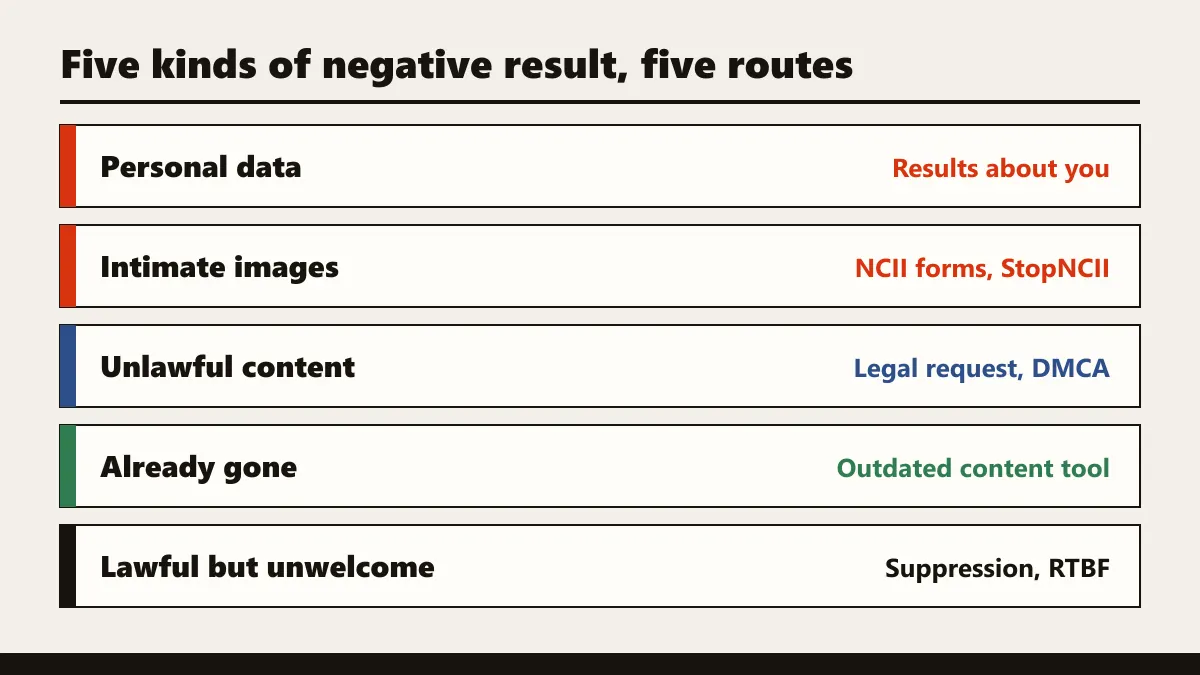
Negative results fall into five kinds, and each kind has its own route out of Google.
| Kind of result | Example | Route that fits | Who decides |
|---|---|---|---|
| Personal data | home address, phone, ID numbers, doxxing post | Google personal information policy, Results about you | |
| Intimate or exploitative | leaked images, deepfakes, sextortion pages | Google's NCII forms, StopNCII hashing, host report | Google and the host |
| Unlawful content | defamation, copyright breach, court-ordered removal | Google legal removal request, DMCA notice | Google's legal team, sometimes a court |
| Already gone | page deleted or edited, snippet still showing | Remove outdated content tool | Google, quickly |
| Lawful but unwelcome | accurate news, a bad review, public records | Suppression, right of reply, RTBF in the UK and EU | Usually no one removes it |
That table is the whole map, and most cases sit in more than one row. A forum thread that posts your address and calls you a fraudster is both personal data and possibly defamation. The personal-data route is faster and asks for no legal argument, so it usually goes first. If you want to remove negative links from Google because the post exposes where you live, the personal information policy is the door; the defamation question can wait until the address is off the results page. The bottom row is where false hope lives. Accurate reporting about a conviction, a negative but genuine review, a court listing: those are lawful, and no honest firm can make Google drop them in the US. In the UK and EU the right to erasure can sometimes reach old or irrelevant results, which is the one real exception. Everything else in that row means suppression, not removal.
How to remove negative information from Google search when it is about you
Google's own policy is the strongest tool most private people have, and it is free.
Under its policy for removing personal information, Google will consider delisting results that show your contact details, government ID or financial numbers, login credentials, non-consensual intimate imagery, involuntary fake pornography and content posted with intent to dox. The Results about you dashboard in the Google app runs the same policy as a workflow: you add the phone number, address and email you want watched, Google flags results that contain them, and you request removal from a list rather than pasting URLs one at a time. That is how to remove negative information from Google search when the harm is exposure rather than an opinion about you. Google judges each request; a home address on a news article about a planning dispute may stay, while the same address in a post urging people to "visit" you is a classic delisting. A delisted result disappears from Google only. The page stays live, so for doxxing on a forum or social network, the host report runs in parallel.
Our guides on how to report doxxing on Twitter and on 4chan doxxing removal cover those host-side steps.
People-search sites are the same row. When a listing broker puts your work history online, the opt-out goes to the broker, and our note on how to get removed from ZoomInfo walks one of those forms.
How to remove bad search results built on false claims
A false statement of fact is a legal problem, and Google treats it through a legal channel, not a policy one.
To remove bad search results that accuse you of something untrue, the route is Google's legal removal request, which asks which law the content breaks, the exact URLs, and the words you say are unlawful. Google's legal team reviews defamation complaints country by country, and in the US it rarely delists on a bare allegation, because Section 230 shields it and a statement is not proven false until a court says so. A court order against the author changes that: Google generally honours final orders naming specific URLs. Fake reviews are a related case with a faster path, because the review platform's own rules usually ban them; our breakdown of how to remove a fake GreatSchools review shows that platform-first logic. Copyright is the other legal lane. A stolen photo or a re-uploaded video can go through a DMCA notice to the host and Google's copyright form at the same time, the approach in our Vimeo content removal service briefing.
Forged notices are the trap here. Filing a copyright claim against an article you simply dislike is perjury under the DMCA's own terms, and courts have awarded damages for it.
What changes in Australia, the UK and the EU?
Location changes which law applies, and with it how far a removal request can reach.
To remove negative content from Google in Australia, the starting point is two High Court cases. In Trkulja v Google (2018) the court let a defamation claim over search results go ahead, accepting that Google could be a publisher of its own results pages. In Google v Defteros (2022) it held that Google was not the publisher of a newspaper article merely by linking to it in organic results. Together they mean an Australian defamation claim against Google is possible but narrow, and the article's publisher is usually the better target. The eSafety Commissioner is the other Australian lever: under the Online Safety Act 2021 it can order removal of adult cyber abuse and image-based abuse. In the UK and EU, the right to erasure, set by the 2014 Google Spain ruling and now Article 17 GDPR, lets residents ask Google to delist results that are inaccurate, outdated or no longer relevant, using Google's own EU privacy form.
Google weighs public interest, so a politician's record will usually stay.
Can a firm make Google drop truthful content?
No. A firm can help you remove unwanted content from Google only where a policy, a law or the host allows it.
That is the line Obscura holds, and it rules out a lot of what is sold under this topic. Accurate journalism, genuine reviews, protected opinion and public court records cannot be forced off Google in the US, and attempts to fake a reason usually make things worse: a forged legal notice gets logged on the Lumen database, and the story about the forged notice can outrank the original. We also decline volume tricks. Pages pitching a Discord mass report tool, or a ban service for a WhatsApp account, run on the same false idea that enough noise moves a platform; it does not, and asking whether reporting a YouTube video does anything shows why one strong report beats a hundred weak ones. We never ask for passwords or two-factor codes. The full limits are on our disclaimer page.
What a firm can do with lawful-but-unwelcome results is suppression: building or strengthening pages you control, such as a professional profile, a personal site or published work, so they outrank the negative page. That takes months, and nobody can promise a position.
Removing negative content from Google for musicians and creators
Musicians hit a particular mix: harsh reviews, leaked tracks, impersonator profiles and old band drama, often all on one results page.
To remove negative content from Google for musicians, sort it the same way. A scathing album review is opinion and stays; the realistic answer is to give Google stronger pages to rank for your name. A leaked unreleased track is a copyright matter with a quick lane: a DMCA notice to the file host plus Google's copyright removal form usually clears it, the same logic behind a blackmail image removal service built on ownership rather than argument. Impersonation runs through the platform: a fake artist page can be reported under the host's impersonation rules, and the methods for account reporting against an art thief on DeviantArt translate well to music platforms. Squatted handles are a separate headache; if someone holds your band name, read why it rarely pays to buy an Instagram handle from a stranger before you send money.
Fake fan sites that sell merch or tickets in your name are fraud, and they come down fastest through the host and registrar, as our guide to removing fake websites quickly explains.
How a case is handled from first search to last check
Here is how Obscura actually works one of these, step by step, as of November 2026.
- Capture. We screenshot each result with its URL, date and the query that surfaced it, signed out and in a clean browser, because personalised results mislead.
- Sort. Every URL goes into one of the five rows above. One result can carry two routes.
- Host first, where it helps. If the host will delete, that fixes every search engine at once. Platform reports go in under the rule actually broken; some questions, like whether you can delete someone else's Snapchat account, turn on that rule alone.
- Google second. Personal information requests, legal requests or the outdated content tool, one form per route, never a scattergun of all three.
- Wait and recheck. Google acknowledges by email; decisions on personal-information requests often arrive within days, while legal requests can take weeks.
- Suppress what stays. Lawful results that remain get a suppression plan, written down with honest expectations.
When a page has already been deleted at source but Google still shows the snippet, step 4 is the Remove outdated content tool, and it is usually the quickest win of the whole case.
One more scenario from moderators of groups: if the negative content is a post inside a Facebook page you manage, you can remove it yourself, and knowing how to ban someone from a Facebook page stops the same person reposting it. Intimate images skip the queue entirely. For those, see how we remove leaked photos from the internet hour by hour, and use StopNCII hashing before anything else.
If you are not sure which row a result belongs in, send us the URL. Obscura reviews it confidentially and tells you which route fits before any fee is mentioned. Start a confidential review.
The question as people type it
People phrase this a dozen ways, and the phrasing often hints at the route.
| How it gets searched | What it usually means | Best first route |
|---|---|---|
| how to get rid of negative google search results | mixed bag on page one | sort into the five rows |
| how to remove negative search engine results | Bing and others too | host deletion beats per-engine requests |
| how to remove negative information on google | personal details exposed | Results about you |
| how to remove bad information from google | false or outdated claims | legal request or outdated content tool |
| remove harmful google search results | threats, doxxing, NCII | personal information policy, urgent |
| get rid of negative search results | lawful but unwelcome | suppression |
| how to remove negative google search results | several URLs, one name | capture and sort before filing |
| how to remove negative content from google search results | a single damaging page | host report, then Google |
| how to remove negative content on google | a post or review about you | platform rules first |
| remove negative google results | quick fix wanted | check the outdated content tool |
| remove negative results from google | results about a business | legal request or suppression |
| remove bad google results | stale or edited pages | outdated content tool |
| how to get negative information removed from google | formal request needed | legal removal form |
| how do i remove negative information from google | first-timer, unsure | start with Results about you |
| how to remove negative info from google | contact details | personal information policy |
| how to remove negative links from google | forum or blog links | host report plus Google form |
| how to remove bad links from google | spam or scraper copies | one request per URL |
A message to us that says only "help me remove negative links from google." is fine; we take it from there with the URLs.
Bing runs its own content removal tools, so a page deleted at the host should also be cleared there.