
What does deindexed mean?
A deindexed page is one a search engine has dropped from its index, so it no longer appears in results even though it may still exist online.
That is the whole of the deindexed meaning, and most confusion starts when people treat it as deletion. Search engines keep a copy-and-catalogue of the pages their crawlers have fetched; that catalogue is the index. To deindex a URL is to take it out of the catalogue. The page itself stays on its server, reachable by anyone who has the link, finds it through another site, or uses a different search engine that still lists it. So what is deindexed is the pointer, not the material. You will see the word spelled three ways: deindexing, de-indexing and de indexing all describe the same act, and de-index, deindex and de-indexed are simply the verb and past tense. The deindex meaning for a site owner is usually bad news, a penalty or a misconfigured tag. For a private person with their address on a stranger's blog, deindexing from Google is often the most achievable win on the table.
Obscura is a UK content-removal firm, and de-indexing is a large share of what Obscura files for clients. The distinction above decides which form gets used, so it comes first here.
Deindex, delete or suppress: three different results
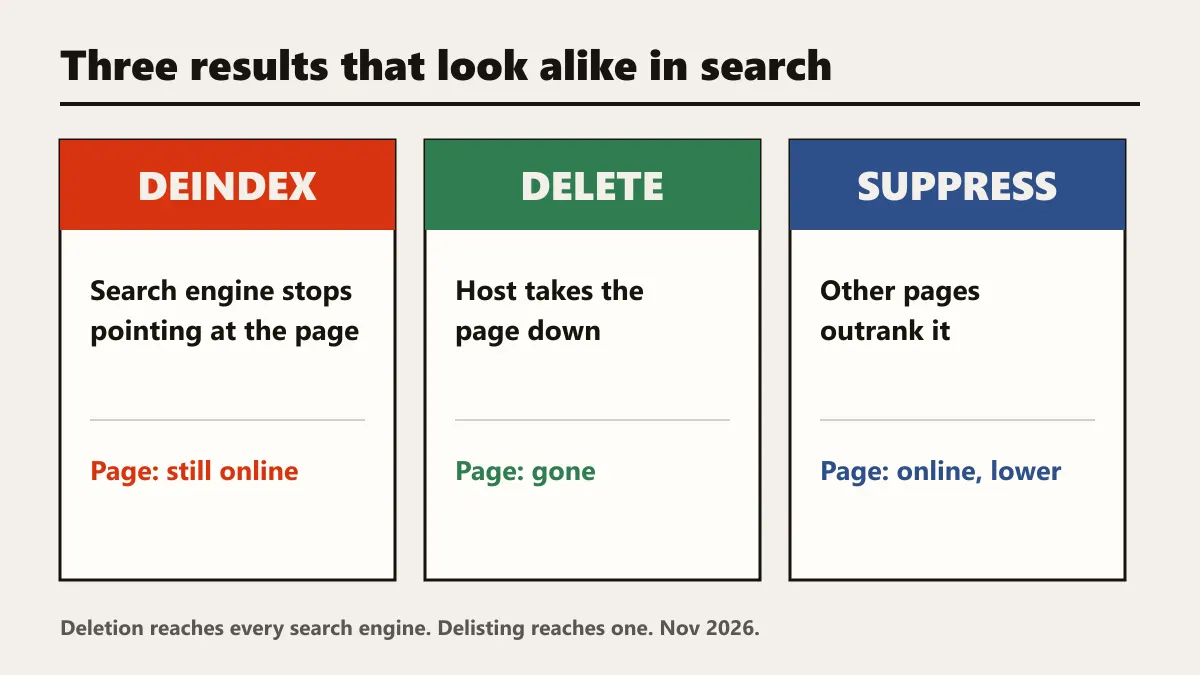
| Deindex | Delete | Suppress | |
|---|---|---|---|
| Who acts | Search engine (or the site owner via a tag) | The host or site owner | You publish other material |
| Page still online? | Yes | No | Yes |
| Shows in search for your name? | No, in that engine | No, once the engine recrawls | Yes, but lower |
| Typical route | Google removal request, RTBF, noindex |
Platform report, legal notice, DMCA | Profiles, articles, owned pages |
| Best for | Pages a host refuses to remove | Content that breaks a rule or law | True but unwelcome coverage |
Removal from the web is always the stronger outcome, because a deleted page eventually drops out of every engine without any further request. The trouble is that deletion needs the host's cooperation. A people-search clone hosted abroad, a forum that ignores email, or an old article on a news site will rarely delete on request. Deindexing works around that by asking a different party, the search engine, to stop pointing at it. The engine applies its own written policy, not the host's goodwill, and Google's policies cover a defined set of cases: doxxing content, personal contact details, non-consensual explicit imagery, and sites with exploitative removal practices, among others. Suppression is what remains when neither route applies, typically for truthful reporting. A practical order follows from this: ask for deletion where a rule is broken, ask for de-indexing where the host refuses, and suppress only what lawfully has to stay.
Who can de-index a page?
Three different parties can make a page vanish from results, and each uses a different lever.
The site owner
Anyone who controls a website can de-index their own pages with a noindex robots meta tag or an X-Robots-Tag HTTP header, as Google's noindex documentation explains. Google drops the page the next time it crawls and sees the tag. A robots.txt block does not do the same job: Google states that robots.txt is not a way to keep a page out of its results, because a blocked URL can still be indexed from links elsewhere. Owners in a hurry also use the Removals tool in Search Console, which hides a URL for about six months while the permanent fix takes effect.
The search engine, under its own policy
Google removes results about a person under its personal information removal policy, whether or not the site agrees. The request is filed through the "Results about you" tool or the removal form, and covers home addresses, phone numbers, email addresses, ID numbers, log-in credentials, and doxxing content that pairs contact details with a threat. Bing runs its own content removal tool; a Google decision does not carry across.
A court or a data-protection right
In the UK and EU, Article 17 of the GDPR gives people a right to erasure, and the 2014 Google Spain ruling applied it to search results, so a name search can be delisted where the information is inaccurate, outdated or excessive. Courts can also order a host or engine to act. These routes are slower and narrower, and they are weighed against public interest.
How deindexing from Google works for information about you
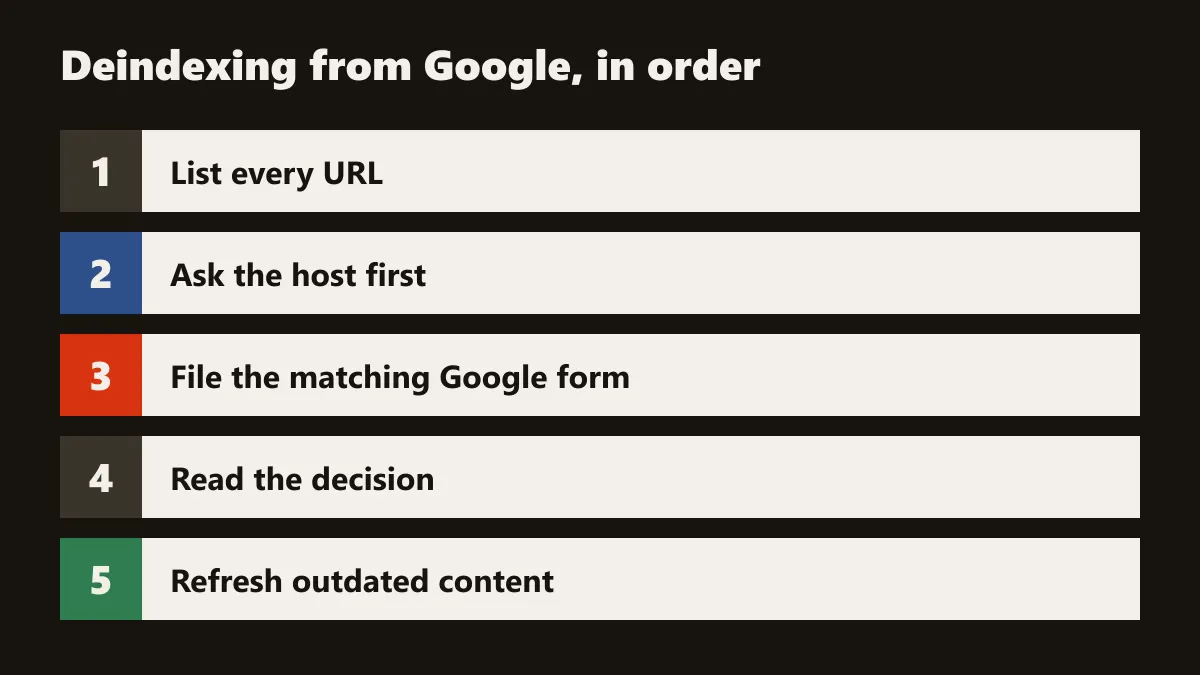
- List the exact URLs. Search your name in a private window, then with your town, employer and old usernames. Copy each result's address, not a screenshot.
- Ask the host first where a rule is broken. A leaked image, a fake profile or a doxxing post usually breaks the host's own terms, and deletion beats delisting.
- File the matching Google request. Personal details go through Results about you; explicit imagery and doxxing have their own options inside the same removal form; legal claims use Google's legal removal request.
- Recheck after the decision. Google emails an outcome. A refusal usually says which criterion was missing, and a corrected resubmission is allowed.
- Clean the leftovers. Once a host deletes a page, the old snippet can linger. The Refresh Outdated Content tool asks Google to recrawl and drop it.
People who set out to remove online information deindexing-first usually lose time. Delisting works best as the second move. Here is why. A host that deletes a page solves the problem for every search engine, every archive crawler that has not yet visited, and every person holding the link. A Google delisting solves it for one engine and one query type. So the case routine at Obscura opens by reading the host's own policy. If a doxxing thread breaks the forum's rules, the report goes there first, and the guide on how to report doxxing on Twitter shows what that looks like on one platform. Where the host is silent or abroad, the Google request follows, citing the exact criterion: contact details, a threat, or a removal-for-pay site. Each URL is filed separately, because Google decides URL by URL, and each refusal is read before anything is resubmitted.
Not sure whether your problem calls for deletion, delisting or both? Send Obscura the URLs for a confidential review; you will hear which route applies before anything is charged.
Benefits of deindexing website content, and its costs
The benefits deindexing website content brings depend on who is asking. For a business, the gains are hygiene: keeping thin tag pages, internal search results, staging copies and expired offers out of Google so the index reflects the pages that matter. That is routine site maintenance, and a noindex tag is the tool. For a person, the gain is visibility control. A name search is usually the first thing an employer, landlord or date runs, and a delisted address or old allegation stops surfacing there even if the source survives. There are costs. A de-indexed page loses every visit it used to get from search, so an owner who adds noindex by mistake can watch traffic collapse within weeks. Delisting is per engine, so Bing and DuckDuckGo may still show it. And delisting a page about yourself does nothing to the copies already saved, quoted or screenshotted elsewhere.
When a whole site gets de-indexed
Site owners usually meet the word "deindexed" from the other side, when their own pages vanish. The common causes, in rough order of how often they turn up:
- A
noindextag left over from a staging build, or a CMS setting that discourages search engines. - A manual action for spam, visible in Search Console's Manual Actions report.
- A legal or policy removal filed against specific URLs, for example after a DMCA takedown website notice names copied material.
- A host outage that returns errors long enough for the crawler to give up.
The first is the easiest to fix and the one most often missed. A penalised site, by contrast, needs the underlying problem cleaned before a reconsideration request is worth filing. Fraudulent clones are a separate case: a lookalike shop or a cloned brand site can be reported to the host and the registrar, and the comparison of the best services for removing fake websites quickly covers how that is done. Taking those sites down also takes them out of search.
Which problems deindexing actually fits
De-indexing is a search tool, so it only helps when the harm arrives through search. The table below sets out where it is the right move, where it is a supporting move, and where it is irrelevant.
| Problem | Is deindexing the main tool? | Better first route |
|---|---|---|
| Address or phone on a people-search site | Yes, alongside the opt-out | The site's opt-out, then Google |
| Doxxing post with a threat | Supporting | Host report, then Google's doxxing option |
| Leaked or intimate images | Supporting | Host report and hash-matching |
| Clone site using your name | Supporting | Host and registrar |
| Abuse inside an app | No | The app's own reporting |
The first row is where de-indexing earns most of its keep. People-search listings regenerate, and the brief on BeenVerified removal service options explains why the opt-out has to come before the Google request. For leaked images, the guide to remove leaked photos from internet hosts runs through the first hours, and a blackmail image removal service note covers extortion cases. A copied site or profile is handled through an impersonation website takedown, and stolen clips go through the platform first, as in the walkthrough on how to report stolen content on TikTok or a Vimeo content removal service request. Fake reviews are a policy question for the review site itself, and the post on how to remove fake review RateMDs pages show sets out which label to pick. In each case the delisting request is a backstop for whatever the host leaves up.
The last row matters too. A dispute over a ban service for a WhatsApp account, a question about how to ban someone from a Facebook page, an offer to buy an Instagram handle or a stolen drawing behind an art thief DeviantArt account all live inside a platform. Search is not where that harm travels, so delisting a URL changes nothing for the person affected.
What deindexing cannot do
Delisting has limits, and pretending otherwise sells false hope. It does not delete the source. It does not reach archives, screenshots or private chats. It applies one engine at a time, and a page seized by authorities, as in an FBI website takedown, follows a separate legal process entirely. Google also refuses requests about information that is newsworthy, part of public records, or about someone's professional conduct where the public has a real interest. Truthful journalism about you cannot be delisted by asking politely, and in most cases it cannot be removed at all, only outranked by other material. Google's Results about you page says as much: it generally will not remove government, educational or newspaper pages, and a removal never deletes the source. A firm that tells you otherwise is either bluffing or planning a notice it cannot defend, and a forged legal threat against a publisher tends to produce a second story about the attempt.
Obscura files the request; Google, Bing or the court makes the final decision, and no outcome is promised in advance. Obscura never asks for passwords, never sends notices it cannot stand behind, and never asks you to send intimate images. The full limits are set out on the disclaimer page.