A photo of you went up overnight: how to get a post removed from Facebook
Your cousin posts a wedding album, an ex shares a screenshot, or a stranger on a local group uploads a clip of you at the school gate. You did not consent, and you cannot delete it, because on Facebook only the person who posted something can delete it. What you can do is make Meta remove it, and that depends on picking the route whose rule the content actually breaks.
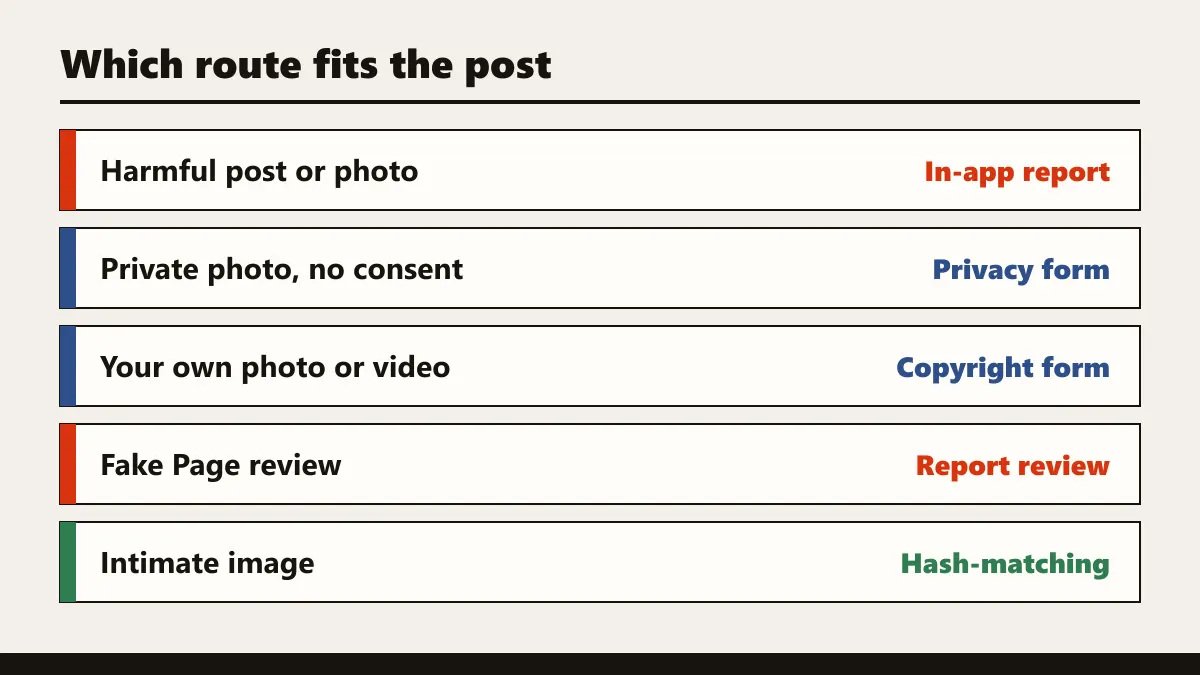
There are four. The in-app report tests the post against the Community Standards. The privacy removal form tests it against your privacy rights. The intellectual property forms test it against copyright or trademark. And the hash-matching tools, StopNCII and Take It Down, handle intimate images. Obscura, a content-removal firm working only through those official channels, starts every Facebook case by asking which of the four the post really falls under. A strong complaint filed in the wrong lane is reviewed against the wrong rule and usually comes back "doesn't go against our standards".
So before you press anything, decide what is wrong with the post: is it harmful, private, stolen, or intimate? The rest of this briefing follows that order. It holds whether you are working out how to remove someone else's post from Facebook in a group you don't run, or how to get someone's post removed from Facebook when it names your business rather than your face.
How to remove a picture from Facebook someone else posted
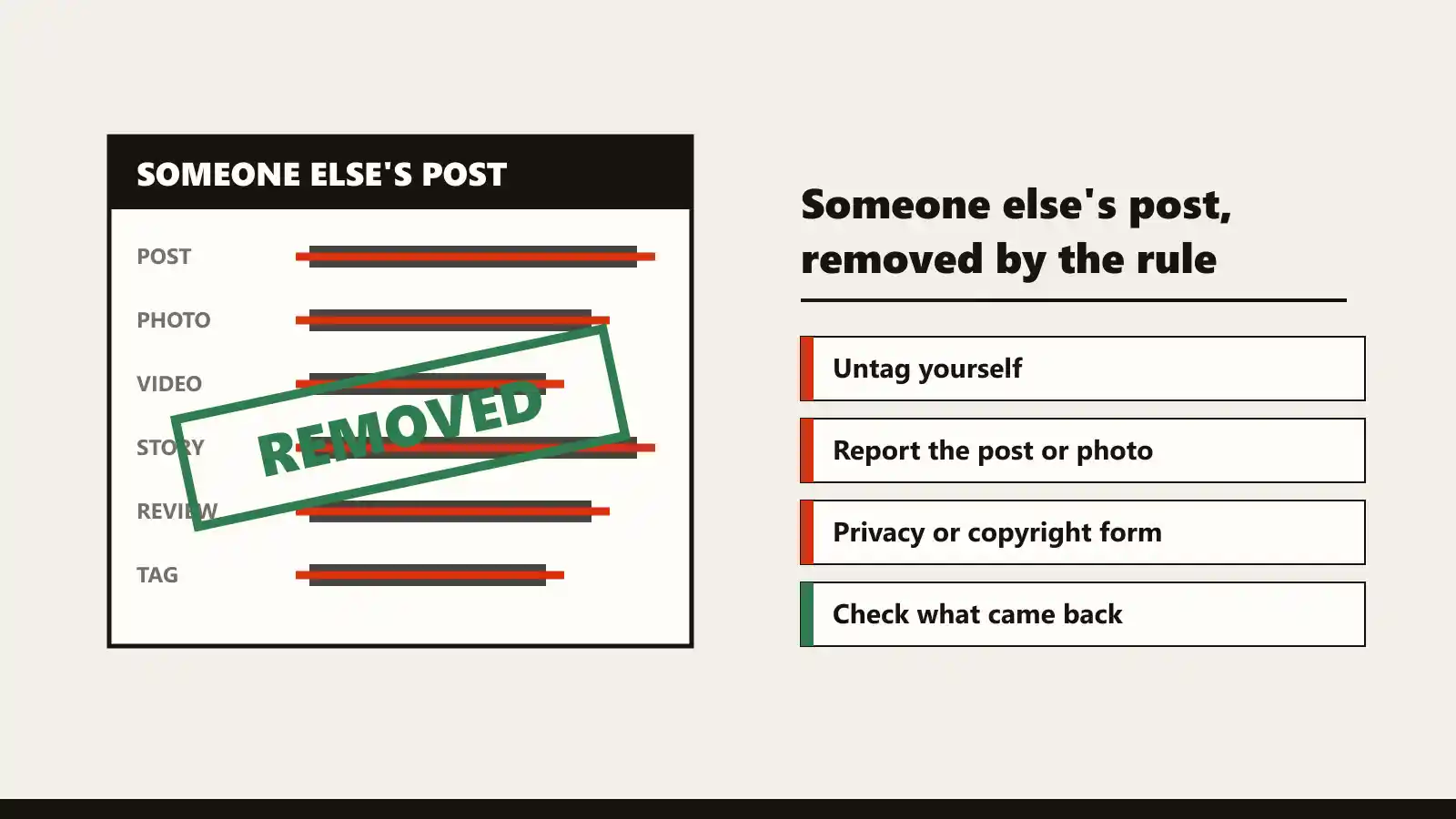
Meta's own help page on removing a photo or video that violates your privacy sets out three steps, and they work best in this sequence:
- Remove the tag. If you are tagged, untagging takes the photo off your profile and out of your friends' feeds. The photo still exists on the poster's profile.
- Ask the poster. Not on Meta's page, but it is the quickest removal there is. Keep the message short and factual, and screenshot their reply.
- Report the post. Tap the three dots, choose "Report photo" or "Report post", and pick the category that matches the harm (harassment, nudity, violence, a scam, or "something else").
- File the privacy form when the photo does not break a Community Standard but does break your privacy.
That last step is where most people searching for how to remove photos from Facebook that someone else posted give up, because the in-app menu never mentions it. If you were wondering how to delete a Facebook post from someone else directly: you cannot. Every route here is a request that Meta reviews and decides.
Facebook privacy violation photo removal request: who qualifies
The facebook privacy violation photo removal request is a separate web form, Meta's privacy rights form, not a report category. Older versions still circulate in search as the "Privacy Violation – Photo Removal Request" and a matching video form, and both now lead to the same review.
Eligibility splits by age, per Meta's User Requests policy. For a child under 13, a parent or legal guardian files. A teenager aged 13 to 17 files for themselves, unless they are unable to. A guardian or legal representative files for an incapacitated adult. For other adults, removal turns on whether the image breaks a Community Standard or whether local privacy law gives a right to have it taken down, which is why the form asks where you live.
What helps the review: the exact URL of the photo, a sentence on why it identifies you, and a plain statement that you did not consent. What does not help is a long account of the dispute behind it. Facebook report photo of me requests are judged on the image, not on who is in the right.
Facebook video removal follows the same split
A facebook video removal goes through the identical routes. Report the clip in the app for a Community Standards breach, or use the privacy form's video option when you are identifiable and did not agree to be filmed. Copy the video's own link (three dots, "Copy link") rather than the profile link, because a report with the wrong URL is rejected unread.
When the post is yours to claim: copyright, trademark and impersonation
If someone uploaded your photograph, artwork or video, privacy is the weaker argument. Ownership is stronger. Meta's copyright report form accepts claims only from the rights owner or an authorised agent, and Meta passes your name, email and the claim to the person who posted. That disclosure surprises people, so weigh it before filing. A knowingly false claim also carries liability under section 512(f) of the US DMCA.
The same ownership logic runs across platforms. It is how a redbubble copyright infringement claim succeeds, and it is the basis when you get a tiktok video taken down that reuses your footage. A trademark report covers one registered mark per filing.
Impersonation is a different file again. When the post sits on a profile pretending to be you, the account is the problem, so you report facebook account abuse for impersonation instead of reporting each photo. Dating apps run the same logic; a grindr impersonation report also asks for proof that the profile copies a real person. And if the target is a whole Page rather than one post, read how to take down a page on facebook first, because Page removal runs on stricter tests.
How to get reviews removed from Facebook
Facebook calls Page reviews "Recommendations", and the Page owner has no delete button. To work out how to get reviews removed from Facebook, start with the fact that Meta removes a recommendation only when it breaks the Community Standards, and its help page on reporting recommendations offers no other ground.
How to remove a fake Facebook review
Meta's fraud and deceptive practices policy bans buying, selling or trading reviews and ratings, and reviews given in exchange for refunds, discounts or free items. That gives you the strongest ground for how to remove a fake Facebook review: report it from the three-dot menu on the recommendation, say it is fake or spam, and mention any evidence such as a reviewer who was never a customer. A one-star review that is merely harsh stays.
The other lever is blunt. Page owners can switch Recommendations off, which hides every rating and review, good ones included; switch it back on and they return. The judgement call is close to the one behind any google review removal service: ask which written rule the review breaks before paying anyone to report it.
How to get a Facebook post taken down immediately, and when you can't
Meta publishes no review timeline for reports or privacy forms, and a borderline claim can sit longer than an obvious breach or need a second, better-evidenced filing. Anyone promising how to get a facebook post taken down immediately for a fee is selling something Meta does not offer.
There are genuine fast lanes, though. Intimate images go through hash-matching: StopNCII.org for images taken when you were an adult, and NCMEC's Take It Down for images taken before you were 18. Both create a fingerprint on your own device, so you never send the image to anyone, and Facebook is a participating platform. Threats of violence go to the police first, then to Meta.
For scale, Meta's Q3 2025 integrity report puts its enforcement precision on Facebook above 90%, and says under 0.1% of content on Facebook and Instagram was removed in error (Meta, 2025). The other side of that figure: posts that don't clearly break a rule usually stay up.
How to delete someone's story on Facebook
You can't, but stories expire after 24 hours on their own. If one breaks the rules, open it, tap the three dots and report it while it is still live, and screenshot it first, because once the story expires your report has nothing left to point to. That is the practical answer to how to delete someone's story on Facebook, and Instagram stories work the same way; our note on how to get someone else's instagram post deleted covers Meta's sister app.
How Obscura handles a Facebook post removal request
A facebook post removal request reaches us as a link and a short account of the harm. Obscura then does three things in order. First, we read the post against the written rule that fits it, whether that is a Community Standard, the privacy policy or the copyright form, and tell you plainly if none fits. Second, we prepare the filing in the right lane with the exact URL, the evidence Meta asks for and nothing it doesn't. Third, we check the result and record what came back, because a "no violation" on one route sometimes leaves another open.
Obscura files the facebook removal request; Meta makes the final decision. We never ask for your Facebook password, never file false reports, and never use bots or coordinated mass reporting, which Meta treats as abuse and which can cost the reporter their own account. If you would like the route checked before anything is filed, ask Obscura for a confidential review.
The same discipline applies off Facebook. A fake instagram account removal hinges on proof of the copy, as does learning how to report a fake tiktok account. The menus differ when you look up how to report someone on snapchat or how to report a telegram account, but the question is identical: which rule does the content break?
What Facebook content removal cannot do
Facebook content removal works on content that breaks a rule. It does not work on a truthful post, a fair but unflattering opinion, or news reporting about you. Reporting those burns your credibility with the review system and, where a forged legal threat is involved, can invite a lawsuit and draw more attention to the post. Our disclaimer sets out those limits in full.
Removal on Facebook also ends at Facebook. A copy may survive in Google's cache, on a mirror site or on a people-search profile; how to get removed from zoominfo and similar data brokers is a separate job. Video re-uploads elsewhere follow their own rules too, as explained in how to take down a video from youtube, and when a whole channel is the problem, get a youtube channel taken down explains what YouTube itself requires. Facebook post removal is usually the first step, not the last.