What IDCrawl is, and why its page feels so personal
IDCrawl is a free people-search aggregator. Type a name and it returns a page that pulls together social media profiles, profile photos, usernames, rough locations and links out to paid background-check sites. Traditional brokers lean on public records. IDCrawl leans on what it can crawl from the open web, which is why the page often shows your face rather than your old addresses.
That difference matters for removal. Obscura treats an IDCrawl page as a map, not a source: almost everything on it lives somewhere else first, and the page simply points at it. So the opt-out works on the map. It does not touch the territory.
People usually find their page in one of two ways. A friend sends it, or a stranger quotes something from it. Either way, check whether the page is pulling in an account you never made. Where a clone profile sits among your real ones, the fix starts on the platform that hosts it: the steps to remove fake X account listings, a Grindr impersonation report for a dating clone, or an impersonation website takedown when someone has built a whole site in your name.
How do you file the IDCrawl opt out remove profile request?
Filing is free and needs no account or ID. Our steps follow Redact's IDCrawl removal guide, checked against PrivacyOn's 2026 walkthrough, because idcrawl.com refused our automated fetches.
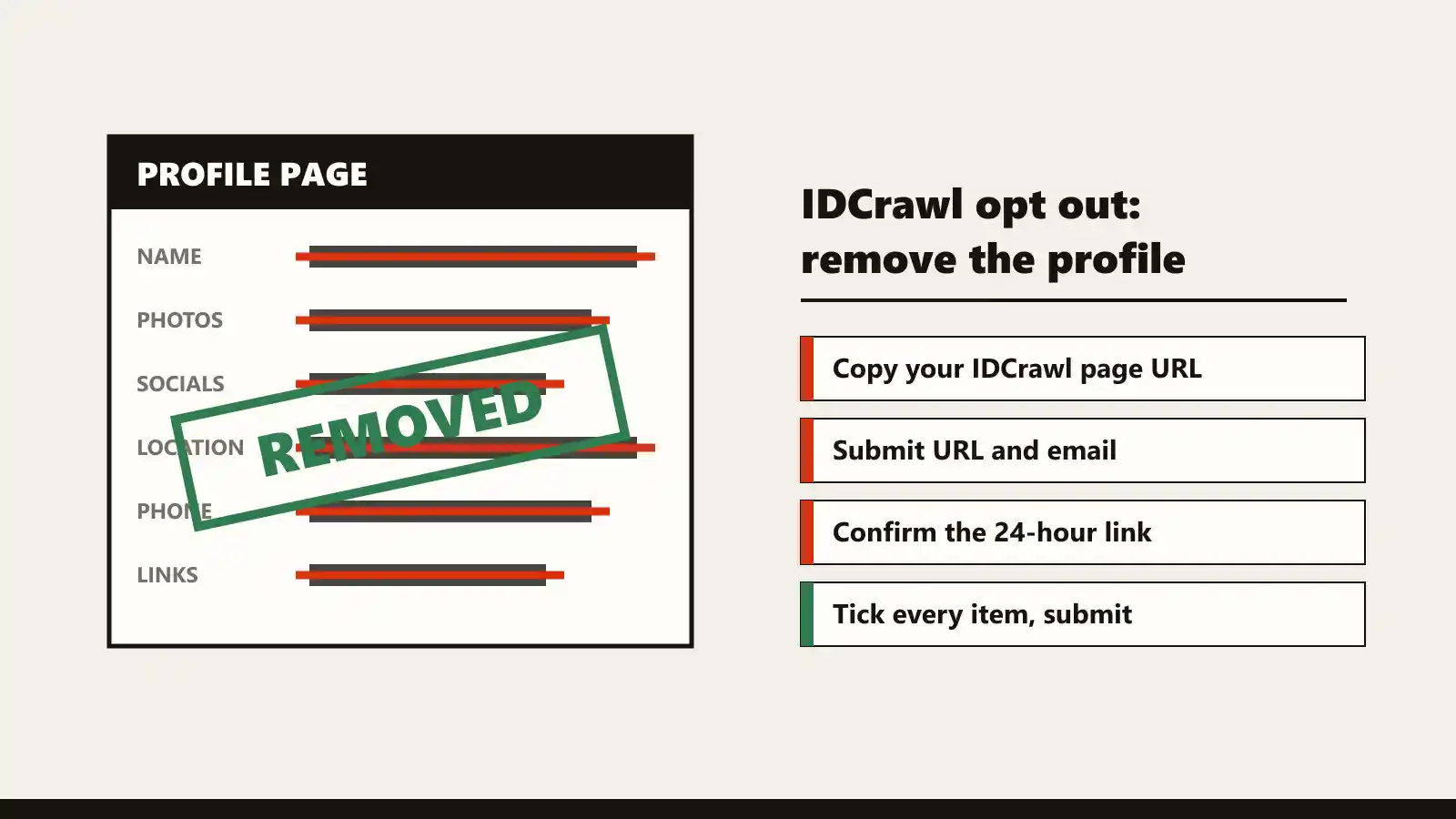
- Search your name on idcrawl.com and open your page. The address looks like idcrawl.com/first-last.
- Copy that full address. A search results page will not work.
- Go to idcrawl.com/remove-my-information, paste the address into the IDCrawl Page URL box, add an email you can open, and pass the reCAPTCHA.
- Open the email from no-reply@idcrawl.com. Redact says the link lasts 24 hours, so do this the same day.
- On the page the link opens, tick every image, profile and record that is yours. There is no select-all, and some sections hide behind links such as "Show more images".
- Press Submit Request and wait for the confirmation message.
Step five is where most requests go half-done. Untick nothing that belongs to a namesake, and open every collapsed section.
Why an idcrawl opt out remove personal information request can look unfinished
Requests are reviewed by IDCrawl's support staff, not processed instantly. PrivacyOn reports that most users see the listing go within five to seven business days and suggests resubmitting if it is still there after 14 days. We could not confirm a processing time on IDCrawl's own site. Anyone listed under a maiden name or a username has a separate page for each version, and each needs its own request.
What the ticked boxes take down, and what they leave
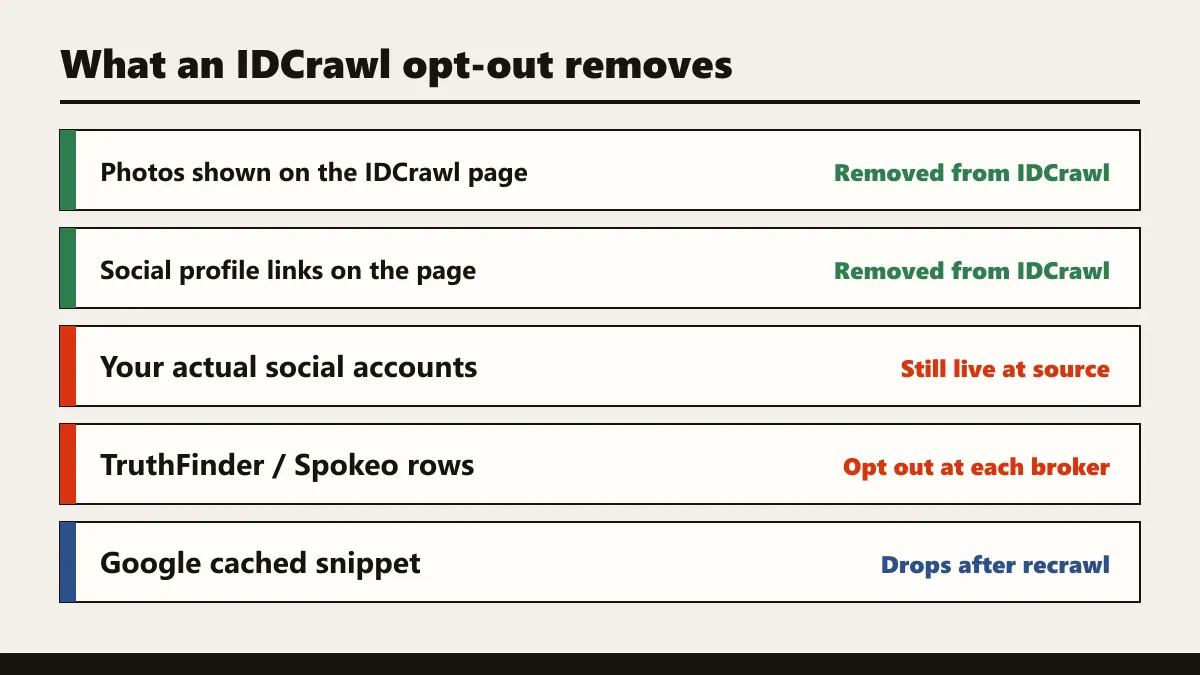
Ticked items leave the IDCrawl page. Nothing else changes.
IDCrawl opt out removal personal information: the source sites stay live
According to Redact, IDCrawl's privacy policy says that removing information from IDCrawl does not remove it from the original source. Your Instagram profile is still public. Your old forum username still resolves. The sponsored rows from TruthFinder, Spokeo and PeopleLooker carry tick boxes on IDCrawl, yet those records stay on the broker sites until you file with each one separately. That is the honest limit of any idcrawl opt out removal personal information request, and it is why the page can rebuild itself later from the same sources.
So work outwards. Lock down or delete the social accounts you no longer use. Opt out of the brokers in the sponsored rows. Should an arrest record show up through one of them, read our notes on which mugshot removal service offers are legitimate before paying anyone. When the list of brokers runs into dozens, compare a best personal information removal service with doing it yourself; both have honest costs.
Photos need a separate decision. A picture IDCrawl shows was copied from somewhere public. Intimate images, or ones being used for leverage, should not start with IDCrawl at all. Start with hash-matching and the hosting sites, the way we approach requests to remove leaked photos from internet pages, and see when a blackmail image removal service is the right call.
When the page is gone but Google still shows it
Search engines keep a cached snippet for a while after a page disappears. PrivacyOn puts that at a few days to a few weeks, until Google recrawls the address. Once the IDCrawl URL returns an error, Google's Refresh Outdated Content tool can speed up the snippet's removal.
The other lever is Google's Results about you tool. This lets you ask Google to remove search results that show your phone number, home address or email address, and it can alert you when new ones appear. Two cautions. Google decides each request on its own terms, and approval only hides the result from Google Search; the page itself stays on the site. For the source accounts the same split applies. If a Facebook profile or Page is the thing being surfaced, learn how to take down a page on Facebook properly. A hostile post on X calls for an X tweet removal service only when the tweet actually breaks a rule, and a reposted clip may need a Vimeo content removal service or a copyright notice to the host.
State privacy laws: the slower, firmer route
Residents of states with consumer privacy laws can also make a deletion request. Redact reports that IDCrawl's policy promises a response within the period the law sets, which is 45 days in California. Redact also reports that it could not find IDCrawl on California's data broker registry. Should that still hold when you check, the state's DROP platform will not reach it, and a direct request is the route.
Rights requests are slower than the form. It is also a written record, which helps if a removed page comes back. Optery's help centre lists IDCrawl among brokers it describes as difficult, and complaints to the Better Business Bureau describe names returning after an opt-out. Re-search your name every few months and keep the dates.
Where Obscura fits, and where it does not
Obscura can run the IDCrawl form with you, then trace each item on the page back to where it lives and pick the lawful route for that host. We work out which of those routes actually exist before anything is filed. Some are policy reports, some copyright notices, some privacy requests. The Federal Trade Commission's guide to people-search sites explains why that list tends to be long.
Our limits are fixed. Obscura never asks for your passwords or the codes in your verification emails, never files forged notices, and cannot remove genuine public records, truthful reporting or protected opinion; where those rank on your name, suppression is the lawful option. Nobody can promise a people-search page stays down, and we will not. Our disclaimer spells this out.
Where the IDCrawl page is only the visible part of the problem, book a confidential review of your listings and Obscura will tell you what can come down, what can only be pushed down, and what is better left alone.
Linked accounts that need their own route
Opt-outs rarely end at one site. An aggregator page often points to the content that caused the trouble. That might be an anonymous answer, which is a question of Quora defamation removal and the legal test it has to meet. It might be a fake rating about your school or practice, where the first step to remove fake GreatSchools review posts is naming the policy it breaks. Developers find their names on store listings too; to get fake app reviews removed, the store's own guidelines decide. Harassers who found you through IDCrawl may move to messaging apps, so know how to report someone on Snapchat before you need to.
And if tightening your privacy ends with your own account wrongly disabled, the official appeal comes first; read what an Instagram ban removal service can and cannot honestly do before you pay for one.